We need your help now

Support from readers like you keeps The Journal open.

You are visiting us because we have something you value. Independent, unbiased news that tells the truth. Advertising revenue goes some way to support our mission, but this year it has not been enough.

If you've seen value in our reporting, please contribute what you can, so we can continue to produce accurate and meaningful journalism. For everyone who needs it.

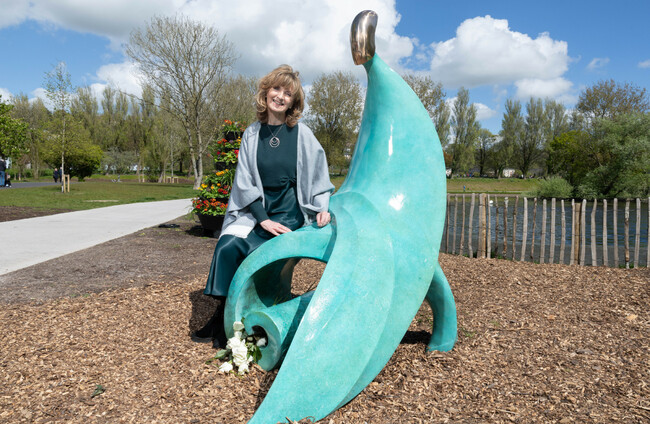
Adi Roche at the unveiling of the Chornobyl Mother sculpture in Cork Darragh Kane

'Chornobyl is forever' says Adi Roche on 40th anniversary of disaster

Adi Roche describes Ireland’s generosity ahead of the 40th anniversary of the nuclear accident

ADI ROCHE HAS said the impact of the Chornobyl disaster remains ongoing 40 years after the explosion, warning that its effects continue to shape lives across generations.

Speaking to The Journal, Roche described 26 April 1986 as a moment etched into global history.

“It’s a bit like when people ask you, where were you when JFK was shot”, Roche says. “The 26th of April 1986 is a little bit like that.”

On that day, a reactor of the Chornobyl Nuclear Power Plant exploded, leaving approximately 30 immediately dead.

The 40th anniversary of the disaster falls this Sunday.

The WHO estimate that about 9,000 people died in Ukraine, Belarus, and Russia from long-term health effects such as radiation induced cancer. 

President Catherine Connolly received Roche at Áras an Úachtaráin, as well as a Ukrainian refugee choir, Ukrainian opera singer Olga Doroshchuk, and first‑hand testimonies from witnesses and survivors.

Connolly also met with some child survivors of the disaster.

Roche describes the treatment one survivor faced, after being found in a mental asylum, including being forced to eat their food “lying on the ground like an animal”.

This survivor now has a “wonderful life of her own”, after being adopted to Ireland and receiving life-saving surgeries.

Roche is the founder of Chornobyl Children International, a charity that provides humanitarian and medical aid to children and communities still affected by the disaster.

The charity this week are beginning cardiac surgeries in Lviv on newborn babies and children with the ‘Chornobyl Heart’ condition.

‘Chornobyl Heart’ refers to severe heart defects and holes passed on from parents who have been exposed to radioactivity.

Roche described the explosion as the “greatest environmental catastrophe in the history of humanity”, and that it remained so 40 years on.

She said the explosion in northern Ukraine had devastating consequences across the region, particularly in Belarus, where “99% of their entire landmass was covered with radioactivity”.

Roche said the long-term consequences are still emerging, particularly through genetic damage.

She describes how it has “leached across the generations”, adding that doctors now refer to a Chornobyl lineage, now passing onto the third generation.

Roche also pointed to the secrecy surrounding the disaster at the time, saying that the KGB tried their best ‘to try to keep the truth from seeping out’.

“As in all wars, the first casualty was the truth”, she said.

Roche said the war in Ukraine has brought Chornobyl back to “centre stage for all the wrong reasons”. 

“One of our greatest fears has always been that the next Chornobyl will be Chornobyl itself”, she said, warning of the dangers posed by Russian military activity in the exclusion zone.

She described such actions as a form of “nuclear terrorism” and called for nuclear sites such as Chornobyl to be declared no-war zones.

Roche said Ireland’s response to the disaster in 1986 has been extraordinary, describing it as “a four-decade-long love story of resilience, of compassion and really of radical kindness”.

She added that Ireland has given more per capita to the tragedy of Chornobyl than any other country in the world.

A sculpture called Chornobyl Mother, by Irish sculptor Sandra Bell, was unveiled in Cork earlier this week to mark the anniversary.

The Ukrainian spelling of Chornobyl was ratified by the United Nations in December 2025.

Readers like you are keeping these stories free for everyone...
A mix of advertising and supporting contributions helps keep paywalls away from valuable information like this article. Over 5,000 readers like you have already stepped up and support us with a monthly payment or a once-off donation.

Close
25 Comments
This is YOUR comments community. Stay civil, stay constructive, stay on topic. Please familiarise yourself with our comments policy here before taking part.
Leave a Comment
    Submit a report
    Please help us understand how this comment violates our community guidelines.
    Thank you for the feedback
    Your feedback has been sent to our team for review.

    Leave a commentcancel

     
    JournalTv
    News in 60 seconds