We need your help now

Support from readers like you keeps The Journal open.

You are visiting us because we have something you value. Independent, unbiased news that tells the truth. Advertising revenue goes some way to support our mission, but this year it has not been enough.

If you've seen value in our reporting, please contribute what you can, so we can continue to produce accurate and meaningful journalism. For everyone who needs it.

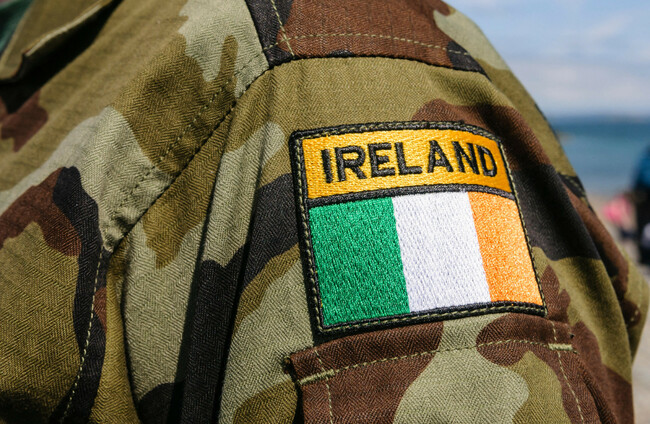
A stock image of an Irish Defence Forces uniform and flag patch. Alamy

Expert tells Defence Forces tribunal of 'crisis driven' inadequate complaints systems

The government established a Tribunal of Inquiry to examine allegations of sexual misconduct, bullying and discrimination in the Defence Forces.

COMPLAINTS PROCESSES IN the Irish Defence Forces were “crisis driven” and had shortcomings or were put in place late, the first day of the Defence Forces tribunal has heard.

The government established a Tribunal of Inquiry to examine allegations of sexual misconduct, bullying and discrimination in the Defence Forces after the recommendations of a report by an independent review group (IRG).

It is examining the effectiveness of the complaints processes in the Defence Forces concerning workplace issues relating to discrimination, bullying, sexual harassment and sexual misconduct – as well as allegations around the handling of dangerous chemicals in the Irish Air Corps.

The tribunal opened public hearings on Wednesday, with the first witness being a former Military Commissioner for his country’s Defence Forces.

Captain Kjell Arne Bratli, also a well known former Norwegian Special Forces soldier, provided analysis on the complaints processes available to Irish Defence Forces personnel over the period examined by the tribunal – 1983 to mid-2024.

The witness told the tribunal that procedures for handling complaints were “not fully adequate or appropriate” for the greater period of that 41-year period.

He said that the developments of complaint processes had been “crisis driven”.

Too many systems

Offering an overview of the seven distinct processes developed over the last 70 years he said the existence of so many systems itself was evidence that no single mechanism was ever adequate to deal with the full range of complaints arising within the Defence Forces.

He described the proliferation of several processes as a symptom of systemic failure rather than a solution to it.

Bratli said personnel had to deal with the complex challenge of navigating the complaints landscape as well as cultural barriers to reporting.

He said it was also a recurring structural weakness in the system that the chain of command retained a central role in most complaints processes. He assessed that it was the initial recipient of complaints, the investigator and a precondition for access to external mechanisms.

Bratli questioned whether the system was well-designed and whether the organisation could effectively self-regulate the most serious forms of misconduct.

Bratli’s notes, shown to the tribunal said the evidence before it suggested “it could not”.

In addition, the expert welcomed the development of a Defence Forces Ombudsman in 2005 as a “really good thing” – but said this was “late” compared with other countries and had limitations around time, its “reactive design” and “non-binding recommendations”.

He said none of the processes, including the ombudsman, provided a fully independent, proactively monitoring, systemically analytical oversight function – as seen in other countries such as Norway.

Bratli’s report said the most consistent finding across all processes is the gap between what was formally required and what was experienced in practice by personnel.

Not kept pace

Bratli said that the IRG report in 2023 showed that the culture within the organisation had not kept pace with the formal procedural framework being substantially developed by 2015.

The witness’s report said that procedures that exist on paper but that are not used or trusted or are actively circumvented by institutional culture “do not constitute an adequate complaints system”.

Bratli’s report posed the question about whether the system, in practice, provided personnel who had suffered harm with an accessible independent and effective means of seeking justice.

He said that, for most of the period under review, the “honest answer to the question is no”.

Massive task

Wednesday’s hearing was led by the tribunal’s sole member Court of Appeal judge Ms Justice Ann Power.

Earlier in proceedings, Michael Cush, SC, for the tribunal, said it had reviewed 226,000 pages of materials.

He said it found it necessary to investigate every complaint file arising from every complaint made over the 41-year-period, which he described as a “massive task”.

He explained that there had been hundreds of interviews and the process remains ongoing.

Cush told those gathered that other tribunals had focused on single events, people, or narrower timeframes and said “the sheer scale of the task at hand cannot be overstated”.

He said the tribunal may therefore exercise discretion in calling witnesses and decide a sample of evidence is sufficient to make conclusions.

The tribunal is not tasked with investigating or determining whether complaints are well-founded, and cannot make findings of a criminal nature against individuals.

Alleged perpetrators of abuse will be granted anonymity under the processes of the tribunal.

The IRG surveyed 527 serving members of the Defence Forces, representing about 6% of the total force.

Almost 90% of female respondents to the IRG said they had experienced some form of sexual harassment, while the review found a “discernible pattern of rape and sexual assault” in its analysis of participants’ contributions.

More than a third of respondents said they faced bullying within the Defence Forces.

The Defence Forces’ own Value Our People survey of 5,300 individuals last year – representing 60% of the force – found three-quarters did not experience unacceptable behaviour while 8% said it was a regular experience around them.

Close
JournalTv
News in 60 seconds