Sign in. It’s quick, free and it’s up to you.
An account is an optional way to support the work we do. Find out more.
Sign in. It’s quick, free and it’s up to you.
An account is an optional way to support the work we do. Find out more.


The FOI Files is a brand-new series from our team at The Journal Investigates. Each week, one of our investigative journalists brings you inside the fight for information that we’re all entitled to. They’ll share their documents, their stories – and tips on how to take the journey for yourself.
This week’s file is from investigative journalist Conor O’Carroll.
See here for The Journal Investigates’ most recent investigations.
HAVE YOU EVER wondered why some public bodies are exempt from Freedom of Information requests?
It’s not quite as simple as every single public body being included, as many commercial semi-state bodies like An Post, Bus Éireann and the Dublin Airport Authority are excluded from the Act.
Others are also partially excluded, like An Garda Síochána, which is exempt from requests seeking crime statistics or things to do with day-to-day policing.
RTÉ is another body partially excluded from FOI, with records about their newsgathering process or editorial decisions exempt from release.
Typically, any new public body that is created is automatically subject to FOI, though the minister can exclude it or set certain restrictions when creating the body.
This is what happened with the recently created Gambling Regulatory Authority of Ireland (GRAI), the body tasked with licensing and regulating gambling activities in Ireland.
With the GRAI ramping up towards providing licences to betting operators, a number of industry lobby meetings have taken place over the past year.
These include Entain, which owns betting brand Ladbrokes (among others), Flutter Entertainment, which owns Betfair and Paddy Power, and the industry representative body, the Irish Bookmakers Association.
According to lobbying records, each was seeking clarity from the GRAI on how the licensing system would work.
When a regulator is meeting with the industry it is seeking to regulate, there is a strong public interest in bringing transparency to what exactly was discussed, even if most of the time, there is not much worth writing about.
So I sent a Freedom of Information Request to the GRAI seeking any minutes from these meetings with the industry, not expecting there to be any issues, as lobby meeting records are a very common thing that public bodies are asked for under FOI.
But to my surprise, I received a refusal from the GRAI 20 working days later.
The letter from the decision maker states:
Having given the matter due consideration, I have decided to refuse your request on the basis that the records sought do not fall within [the] scope of the Act.
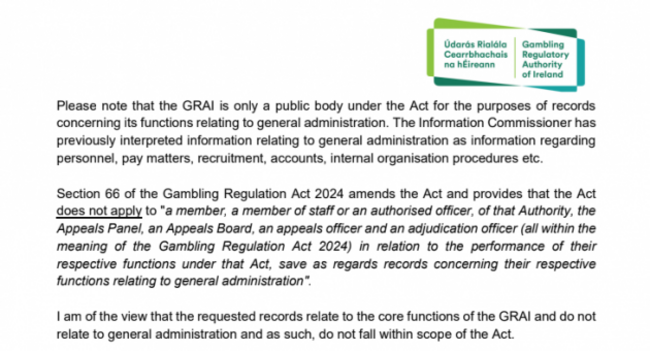
It continues by saying that the “GRAI is only a public body under the Act for the purposes of records concerning its functions relating to general administration.”
This means that only records about how the GRAI goes about its business are subject to release, and not anything involving this actual business.
But should it include more? Should the gambling regulator be subject to the entire FOI Act so that the meetings it holds can be released?
By contrast, the UK’s Gambling Commission is subject to the full bounds of its FOI law, so why is Ireland’s limited in scope?
We asked the Department of Justice this question, and they said the GRAI, in carrying out its functions, “will come into possession of a significant amount of personal data and commercially sensitive data.”
This, they said, “could not be released without risk to the individuals and companies concerned”.
But the FOI Act already has specific provisions that exempt both personal and commercially sensitive data from being released, and this type of information is regularly redacted in FOI requests for lobby meetings with other public bodies, so the question of why the GRAI was excluded from this aspect remains – at least partially – unanswered.
Perhaps someone should send an FOI and find out why.
If you have a burning FOI question about how to get certain records or why your request was refused, you can get in touch with our team at investigates@thejournal.ie. The Journal Investigates team will be back with another instalment of The FOI Files next Tuesday.

To embed this post, copy the code below on your site














have your say