We need your help now

Support from readers like you keeps The Journal open.

You are visiting us because we have something you value. Independent, unbiased news that tells the truth. Advertising revenue goes some way to support our mission, but this year it has not been enough.

If you've seen value in our reporting, please contribute what you can, so we can continue to produce accurate and meaningful journalism. For everyone who needs it.

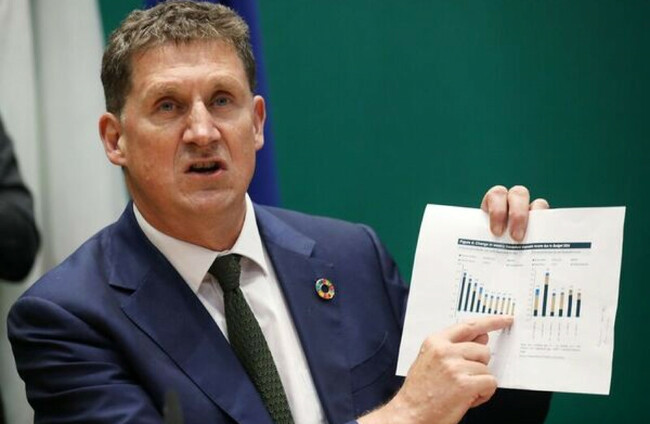
Eamon Ryan (stock photo) introduced the 'one-off' energy credit post-Covid. Sasko Lazarov via RollingNews.ie

Gavan Reilly A €750 million lesson on helping Ireland's worst-off

You may never have heard of the Parliamentary Budget Office (PBO) but its findings are powerful.

Politics by Numbers is a new series for The Journal where broadcaster, author and spreadsheet stan Gavan Reilly takes a data deep dive into a political point of the week. 

THE FUNNY THING about the energy credits that existed almost every year until last Christmas is that they weren’t originally intended as a cost-of-living measure at all.

Their original genesis was a noble way of returning cash that the country couldn’t spend during the Covid-19 pandemic. Unable to use carbon taxes to pay for measures like home retrofittings due to the public health restrictions, Eamon Ryan simply suggested returning it to households by putting €100 credit on every electricity bill.

Events overtook the plan. It was springtime of 2022 before the necessary laws were passed and by then, the war in Ukraine meant a festive tax refund was being recast as an urgent cost-of-living measure. And, because it was a useful template to take off a shelf and repeat, it will forever now be thought of as an off-the-shelf solution when bills get high.

From the very moment Eamon Ryan suggested the idea, in the weeks before that Omicron-wave Christmas, opposition parties were up in arms. Handing out free cash was all well and good, but there was no cost-of-living crisis at the time: here was a blunt, universal tool to give the same amount not just to every household, but to every domestic premises. A mansion on Millionaire’s Row would get the same credit as a cramped family flat, and as a holiday home used for only a few weeks of the year.

The retorts were twofold: firstly, that there was no pre-existing system to figure out which homes were ‘richer’ or unworthy of the credit, and secondly, that this was a one-off windfall so there was little value in devising such a system now.

But, of course, the same scheme was repeated in three subsequent winters, leading to an annual repeat of the same dispute:

These measures could be better targeted!

But we don’t have a robust system to target them!

Then design one!

Why bother? This is a one-off scheme, just like the last three!

Last winter, as many readers may remember, there was a chance of tack. Micheál Martin – perhaps with the comfort blanket of his government’s re-election – was figuratively blue in the face telling people, with Damascene zeal, that Budget 2026 would use its finite resources to help those in the greatest need. Hence, instead of giving a universal amount to everyone, specific aid would go to those on the Fuel Allowance, with higher payments and a wider net of recipients.

People will always dispute whether this is the fairest or ‘best’ way of using public resources. Many could point to the growing numbers of homes in energy arrears – one in seven is behind on its electricity payments – and say plenty in need were left without. But that’s politics: the whole point is to debate and decide on the best way for a society to set its rules and use its assets. That Budget was more devoted to job protection and apartment building than on the cost of living.

Such is the prerogative of a re-elected government.

But fast forward to February, and the war in Iran, and the rising cost of petrol and diesel at the pumps, and hauliers and farmers blockading the streets and the ports, and the measures we got as a result. And fast forward to this week, when the Parliamentary Budget Office (PBO) analysed the measures introduced in such political haste in March and April.

There’s a good chance you might never have heard of the PBO. It’s one of the legacies of the financial crash: an independent unit within Leinster House that can offer advice and analysis about the impact of State policies, without any partisan axe to grind.

That independent background is important, because its two primary findings about the cost-of-living measures should carry some weight.

Firstly: yes, the measures broadly did what they were supposed to, and provided assistance to most in society, with the poorest gaining the most. The lowest-earning decile – the 10% of households with the lowest income – increased their income by about 1.5%, while the highest decile got an increase of 0.35%. Elsewhere, the statistical measure of those whose incomes are below the poverty line (a measure called ‘AROP’) fell marginally too, from 19.43% of the public to 19.07%. 

But secondly: the drop in AROP was so relatively small, given the €750 million sunk into the measures, that (in the words of that PBO report)…

…a significant portion of the reduction in this metric could have been achieved with just the Fuel Allowance season extension, which is the most targeted component in the suite of supports.

Moreover, the extension of the Fuel Allowance season is estimated to cost just over €71 million, meaning that this policy is relatively inexpensive in terms of the reductions to poverty and inequality that it achieves.

What this means for us

In plain language: while people perceived benefits to their pocket from cutting the cost of fuels at the pump, the relative benefit in real terms was actually quite small. This is counterintuitive, but holds up: a 50-litre fill of diesel was made €16 cheaper by cutting excise and levies, but how many times per month does the average motorist fill up?

Those in government might well point to the fate of rural commuters, who consume far more motor fuels than anyone else: the economy might well grind to a halt if they couldn’t get to work. And, certainly, the prospect of truckers blockading ports meant industrial subsidies for diesel were a necessity. (Those industrial schemes are so specialised that they’re not covered by the PBO analysis.)

But how ironic that having spent years repeating the same one-off measures, and being determined to channel finite cash to those who get the most benefit, the circumstances of 2026 have resulted in that noble goal being set to one side – and that the State had a method, all along, of targeting those cost-of-living measures.

Good thing those energy credits were a one-off.

Gavan Reilly is the Political Correspondent for Virgin Media News and the host of Monday with Gavan Reilly, which airs every Monday at 10pm on Virgin Media Play and Virgin Media One.

Readers like you are keeping these stories free for everyone...
A mix of advertising and supporting contributions helps keep paywalls away from valuable information like this article. Over 5,000 readers like you have already stepped up and support us with a monthly payment or a once-off donation.

View 3 comments
Close
3 Comments
This is YOUR comments community. Stay civil, stay constructive, stay on topic. Please familiarise yourself with our comments policy here before taking part.
Leave a Comment
    Submit a report
    Please help us understand how this comment violates our community guidelines.
    Thank you for the feedback
    Your feedback has been sent to our team for review.

    Leave a commentcancel

     
    JournalTv
    News in 60 seconds