We need your help now

Support from readers like you keeps The Journal open.

You are visiting us because we have something you value. Independent, unbiased news that tells the truth. Advertising revenue goes some way to support our mission, but this year it has not been enough.

If you've seen value in our reporting, please contribute what you can, so we can continue to produce accurate and meaningful journalism. For everyone who needs it.

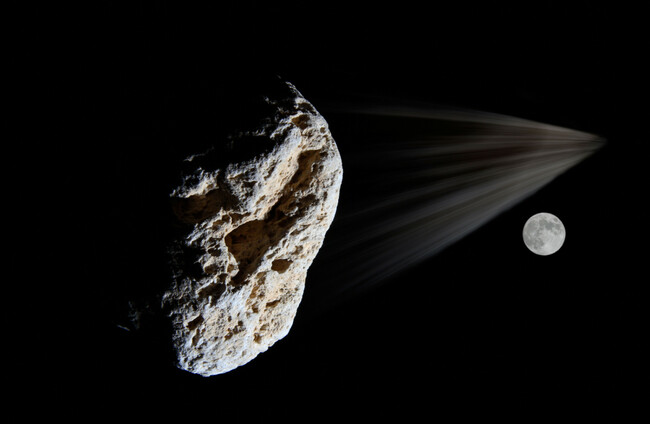
Filoe photo of an asteroid flying past the moon Alamy

Phew! The asteroid that was briefly feared to strike Earth may now hit the Moon instead

The asteroid is thought to be capable of levelling a city.

A HUGE ASTEROID that was briefly feared to strike Earth now has a nearly 4% chance of smashing into the Moon, according to new data from the James Webb Space Telescope.

The asteroid, thought to be capable of levelling a city, set a new record in February for having the highest chance – 3.1% – of hitting our home planet than scientists have ever measured.

Earth’s planetary defence community leapt into action and further observations quickly ruled out that the asteroid – called 2024 YR4 – will strike Earth on 22 December, 2032.

But the odds that it will instead crash into Earth’s satellite have been steadily rising.

After the Webb telescope turned its powerful gaze towards the asteroid last month, the chance of a Moon shot is now at 3.8%, NASA said.

“There is still a 96.2% chance that the asteroid will miss the Moon,” NASA said in a statement on Thursday.

Richard Moissl, head of the European Space Agency’s planetary defence office, told AFP that this aligned with their internal estimates of around 4%.

The new Webb data also shed light on the size of the space rock, which was previously estimated to be between 40 and 90 metres.

It is now believed to be 53 to 67 metres, roughly the height of a 15-storey building.

This is significant because it is bigger than the 50-metre threshold for activating planetary defence plans.

If the asteroid still had a more than 1% chance of hitting Earth, “the development of one or more deflection missions would already be starting now”, Moissl said.

There are a range of ideas for how Earth could fend off an oncoming asteroid, including nuclear weapons and lasers.

But only one has been tested on an actual asteroid. In 2022, NASA’s DART mission successfully altered a harmless asteroid’s trajectory by smashing a spacecraft into it.

‘Perfect opportunity’

While no one wanted to need to test Earth’s defences on the potentially hugely destructive asteroid 2024 YR4, many scientists are hoping it will strike the Moon.

“The possibility of getting a chance for an observation of a sizeable Moon impact is indeed an interesting scenario from a scientific point of view,” Moissl said.

It could offer up a range of information that would be “valuable for planetary defence purposes,” he added.

Mark Burchell, a space scientist at the UK’s University of Kent, told New Scientist that a Moon hit would be “a great experiment and a perfect opportunity”.

And on Earth, “telescopes would certainly see it, I would say, and binoculars might see it,” he added.

The asteroid is the smallest object ever targeted by the Webb telescope.

Webb’s measurements of the space rock’s thermal data indicate that it “does not share properties observed in larger asteroids”, the European Space agency said in a statement.

“This is likely a combination of its fast spin and lack of fine-grained sand on its surface,” it said, adding that this was more common in fist-sized asteroids.

More information will come when Webb again observes the asteroid again next month.

© AFP2025

Author
View 22 comments
Close
22 Comments
This is YOUR comments community. Stay civil, stay constructive, stay on topic. Please familiarise yourself with our comments policy here before taking part.
Leave a Comment
    Submit a report
    Please help us understand how this comment violates our community guidelines.
    Thank you for the feedback
    Your feedback has been sent to our team for review.

    Leave a commentcancel

     
    JournalTv
    News in 60 seconds