We need your help now

Support from readers like you keeps The Journal open.

You are visiting us because we have something you value. Independent, unbiased news that tells the truth. Advertising revenue goes some way to support our mission, but this year it has not been enough.

If you've seen value in our reporting, please contribute what you can, so we can continue to produce accurate and meaningful journalism. For everyone who needs it.

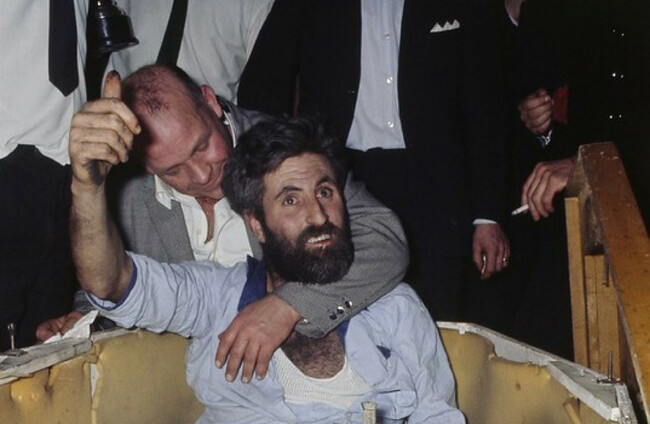
Getty Images

Beo Faoin Bhfód: The Irish man who was buried alive in 1968

A new documentary, on TG4 later this month, tells the story of Mick Meaney and his strange quest.

WOULD YOU BE willing to be buried alive in a coffin for two months, if you thought it would make you rich and famous?

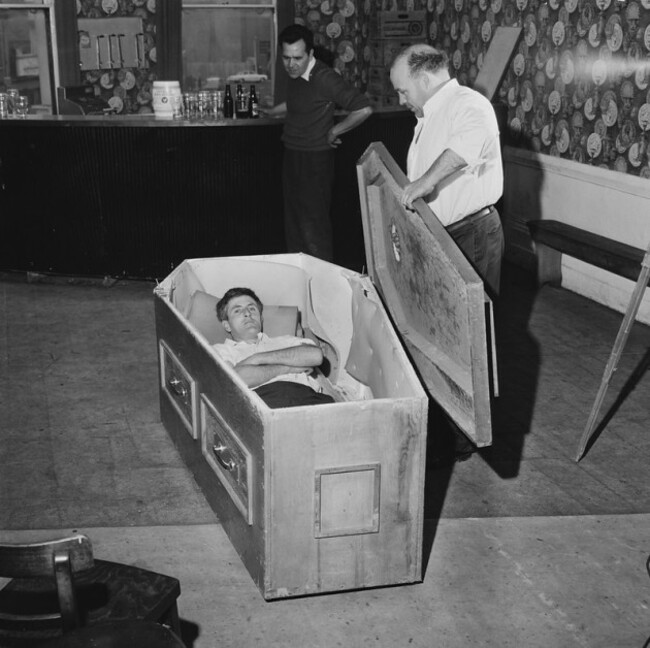
In 1968, Irish man Mick Meaney did just that. The Tipperary native was living in Kilburn in London at the time, working as a barman in a pub owned by Butty Sugrue, a Kerryman who was particularly good at grabbing headlines (Sugrue brought the boxer Muhammad Ali to Ireland in 1972). 

The Guinness Book of Records had been set up in 1955, and there were some bizarre records that were just asking to be beaten. So why not try to beat the Guinness World Record for longest time buried alive? Meaney was willing, having been brought up in poverty, to give it a try. He had moved to London to make money for his family, and this seemed a good way to earn a big sum.

Sugrue, meanwhile, knew how to get media attention. The only person who didn’t know exactly what was happening until it was underway was Meaney’s wife, Alice, who was pregnant at the time.

Meaney needed to stay underground for 61 days to beat the record, which was 60 days. He was placed into a wooden coffin in the pub, and spent some time ‘training’ in the coffin before being transferred six foot underground, where he intended to remain for two months. A ‘live wake’ was held to mark his journey, and he was transferred to Keane’s Yard (owned by a friend) to be buried.

Two chutes leading down to the coffin helped with communication, ventilation and food. Having been buried alive temporarily during a workplace accident a few years previously, Meaney was confident he’d last the 61 days.

‘This is incredible’/'Tá sé seo dochreidte’

Director Daire Collins first stumbled across Meaney’s tale while working as a journalist in the UK in 2018. While looking through news video archives, he found Movietone News footage of Mick being paraded through the streets of Kilburn on the back of a truck.

“The image of him in the coffin with his hand out, and all these hundreds of people on the streets of Kilburn… I was like, this is incredible.”

But it took a few years before Collins and his producer James O’Brien Moran were able to begin working on the documentary itself, after receiving funding from TG4 and Coimisiún na Meán. One of the keys to deciding to make it was when a friend told Collins they had come across Mick’s daughter Mary’s self-published book online.

You Can’t Eat Roses Mary!: The Story of Mick Meaney: a Man Who Dared to Dream When Dreams Were Not Allowed told the story of her and her father’s lives. Mary is one of the key interviewees in the documentary. She was three when her father went underground, and has a unique insight into the reasons behind his decision.   

History of the London Irish/Stair na hÉireann i Londain

Beo Faoin Bhfód tells Meaney’s unique story, but it also gives us a glimpse into the lives of Irish immigrants in London in the middle of the twentieth century.

“It’s like a hidden little history. It’s too bizarre in some ways to be written about in a history book,” says Collins. “It’s a unique moment in time in Irish people’s history in London, in that it’s just pre-Troubles. So if you look at the footage, there’s a Union Jack on the back of the truck [that Meaney was carried to the burial spot in] as well, with the Tricolour.”

Meaney was interested in the stunt because he was promised it would bring him fame and fortune. At the time, another man in America, Bill White, was also buried alive, though he didn’t make it as long as Mick.

“It’s very much like the Irish people, who were treated pretty badly at times, celebrating their own and taking pride in this absolutely insane thing to do,” says Collins of the interest in Meaney’s burial (it was even discussed in the House of Commons). “I think there’s a funny sort of dual layer going on, where you could tell that the people were both proud of it, but also found it quite funny and didn’t take it too seriously.”

He adds:

“What was really interesting also was hearing the extra layer of the narration from the British Movietone presenter being incredibly uncomplimentary to the Irish – all these jokes about how it was an Irish man’s dream to be buried alive, put in a coffin in a pub, and to be brought back into pub. 

“It was a really interesting snapshot into a very small community in London that [doesn't] really exist in the same way anymore.”

Several of the onloookers to the stunt – Irish men who moved to London – take part in the documentary. 

54869819274_0ea3dcee83_c Michael Meaney lies in a coffin in the Admiral Nelson pub on the eve of his burial record attempt, with publican Butty Sugrue holding the lid. Getty Images Getty Images

Why did Mick Meaney decide to be buried alive?

“I think he genuinely did want to be famous,” says Collins.

“He was totally aware that he was in his mid 30s when he did this. There wasn’t that many other opportunities for him to do interesting things. He basically had his lot in life. And then this was an opportunity to break out of that.

I think he really, truly believed that he could become rich and famous from it.

Meaney wasn’t the only person taking part in such a stunt – Meaney’s Irish ‘rival’ was a man named Tim Hayes, who also was buried alive. 

Meaney was promised that he’d make a lot of money, and the documentary explores whether this ended up bearing out as expected.  

“Everyone thought they’d be rich and famous [after being buried alive], and they were for a brief time, but no one really thought about what came after,” says Collins. “The minute you come out of the coffin no one cares, because you’re no longer doing the thing that you’re famous for.”

Recognition/Aitheantas

Mary Meaney has an interesting dynamic with her father, says Collins. “When she was growing up, and she wouldn’t mind me saying this, she was quite ashamed of it. It was a bit embarrassing. Whereas in later years, she’s come to realise that it was a very unique thing to do, and that her dad was a bizarre, interesting character, but also someone who should be remembered in some way.”

“She put a lot of trust in us. She’s one of the most interesting speakers I’ve ever come across.

Meaney fought for years to have her father recognised in his adopted town of Mitchelstown in Co Cork, and in 2022 a memorial plaque to him was unveiled in its main square. 

To promote the film, the filmmakers made a replica of the coffin that Meaney stayed in, and created an installation where people can listen to audio recordings and experience being ‘buried alive’. The installation only lasts for several minutes, but Collins says it’s enough to show that being buried alive was no picnic.

“Even when it’s overground, it’s incredibly hot. I don’t know if there were fans [inside for Meaney], but it was not a pleasant experience. I think they all downplay how difficult it was,” he says. Why? “I think it was a stoicism.”

Of course, the mind naturally goes to the… practicalities of staying in a coffin for 60 days. So what about the hygiene aspects?

“That’s usually the third question people ask,” laughs Collins. “Usually it’s: how do they breathe? How do they eat? And then: how do they go the bathroom? Meaney claimed that he had a trap door. I don’t know if that’s true.” 

Kerry Film Festival / YouTube

The film includes some animation by Collins, much of which was sourced from old copies of the Guinness Book of Records, and which adds a further level of quirkiness to the tale. 

“It’s so much fun being able to come up with creative ways of telling stories,” says Collins. The documentary also tells us a bit about the story of other people – like the aforementioned Tim Hayes – who were buried alive. 

While stunts like this are not so common these days (the Guinness Book of Records hasn’t accepted them for quite a few decades), YouTube phenomenon Mr Beast did bury himself alive for a week. Though one suspects his circumstances were a lot more palatable than Mick Meaney’s.

Meaney’s is a quirky story, but there were sobering reasons behind his decision. 

“I think it’s easy sometimes to forget, or not realise, how few opportunities there were [in Ireland] at that time, and how in large parts of the country life was fairly set, you didn’t have any opportunities to change it. Mick sought out a chance to change his lot in life. And maybe it didn’t work out the way he wanted it to, but there’s something quite admirable in taking that shot,” says Collins. 

“I don’t think he’s a character to ridicule. There’s a level where you can take some inspiration from him.”

A website with more about Mick Meaney and the stories of other people who were buried alive is available here. 

Beo Faoin Bhfód will be broadcast on TG4 on 26 November at 9.30pm.

Close