Sign in. It’s quick, free and it’s up to you.
An account is an optional way to support the work we do. Find out more.
Sign in. It’s quick, free and it’s up to you.
An account is an optional way to support the work we do. Find out more.
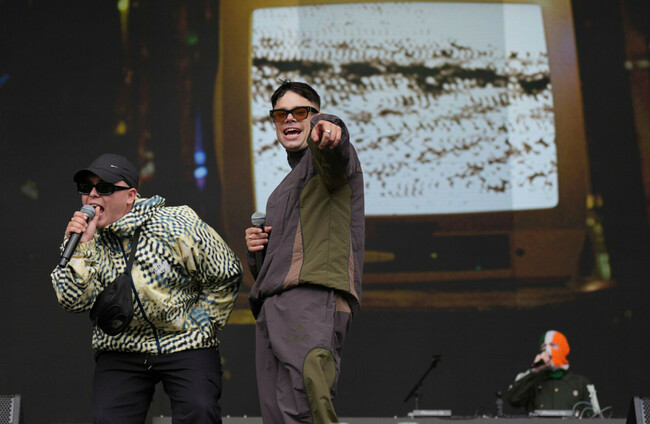
KNEECAP ARE A musical phenomenon, but they’re not the only Irish-language rappers out there. In fact, those who haven’t been keeping up with the genre should know that it’s growing wider and more influential by the year.
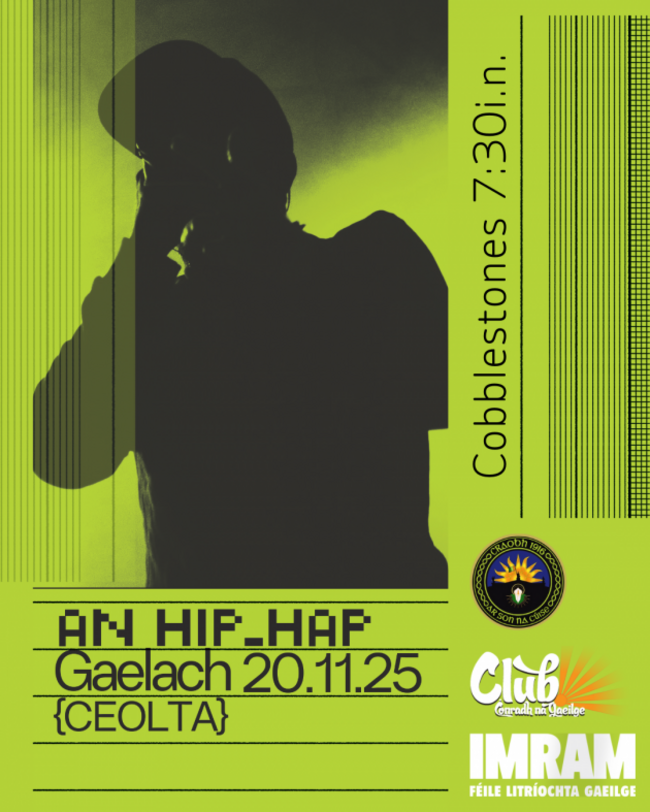
That’s proved by an upcoming event called Ceolta: An Hip-Hap Gaelach. It has been curated by Eoin P Ó Murchú as part of IMRAM, the Irish-language literature festival, and will take place on 20 November at the Cobblestone in Dublin.
The night is a celebration of Irish-language hip-hop and as Ó Murchú puts it, he’s pushing at an open door with such events these days. But he hadn’t seen a showcase of this kind being organised in recent years.
“I wanted to go to this gig. No one else was organising it, so I said, ‘I’ll have to do it myself’,” says Ó Murchú with a laugh.
“It’s a showcase of the best people doing rap. There’s a mixture of other little things in there as well. We have some reggaeton – or even regael-ton – and some electronica, and drum and bass mixed in. But the main theme throughout the whole thing is hip hop.”
“Irish language rap is having something of a moment at the moment. And Kneecap are brilliant, they’ve brought lots of people to the language in loads of ways,” he adds.
One of his own favourite rappers is Súil Amhain, who’s performing on the night. “He was originally a poet. He has just the best lyrics, the best rhythm and he’s an amazing artist.”
Speaking separately, Súil Amhain, aka Séamus Ó Súilleabháin, says that Kneecap have been hugely important to him and his career.
“Kneecap are my brothers and a huge inspiration – Móglaí [Bap] used to ring me regularly on their come-up trying to get me to make music again. He had heard music on soundcloud that Robert Mulhern, my close collaborator and producer from Gaoth Dobhair, had put out with me way back in 2015.”
The members of Kneecap were really active and supportive in the Irish language music scene before they were in the band, involved with performing individually, organising gigs and parties in Belfast and Ráth Chairn, bringing together Irish speakers from all over the country.
Ó Súilleabháin and musician Ushmush are opening for Kneecap in December in Killarney in the INEC.
“They changed everything in a very direct way – before, I used to hear the question why do you bother write in Irish?” he says. “Now all I hear is why aren’t you doing more? That’s the Kneecap effect. ‘Ná habair é, déan é’ as they say in West Belfast.”
‘We are part of a wider music scene’/'Is cuid de radharc ceoil níos leithne muid’
Ó Súilleabháin says we should be careful to not separate Irish language hip hop from Irish hip hop in general.
“The best of Irish language hip hop right now is the parts of it that are in contact with a wider scene,” he points out. “You take the likes of Torby or Blue Niall – they are active within their own scenes which intersect with other communities and artists outside of the Irish language world.”
Irish language art isn’t in some vacuum, there’s at least four Irish speakers on the new Rory Sweeney record and only one of them is using the language on the album. We are a part of the wider music scene.
He adds: “We are grounded though, as Irish speakers, because our community has a particular social context built around the language in which our music and message can have a real impact on the community.”
Súil Amhain will perform alongside Ushmush at Ceolta, as well as Amano from Kerry, who mixes sean nós and electronic music; Dublin rapper Oisín Mac; Dublin hip-hop artist James Shannon; Julie Goo from Cork; and Torby from Belfast. Poets Ciara Ní É and Cúán de Búrca will perform spoken word.
“We even have a rapper from Scotland, Hammy Sgìth, who raps in Scottish Gàidhlig. He’s brilliant. He has a fantastic album, and he has lots of his own Scottish references and influences that you can hear in his music. But there’s even a bit of Kneecap in there,” says Ó Murchú.
Creating connections/Naisc a chruthú
Ó Murchú wanted to make sure there was a wide geographic sweep among the performers. “You never know what kind of thing might blossom from this,” he says.
For those who don’t know much about the Irish-language hip-hop scene, Ó Murchú says it’s very varied.
“There’s lots of different things going on. In the big cities there are different gigs, different venues, different artists that play. I’ve been to fantastic sold out gigs in An Daingean/Dingle, at Féile na Bealtaine, with Súil Amhain and Ushmush – a room full of people singing back the lyrics to the rappers, which is brilliant.”
Ó Súilleabháin points out too that hip hop is a culture itself, with its own history and influences. “I know for a fact I wouldn’t be rapping if it wasn’t for what Irish hip hop has already set down,” he says.
“Though I wasn’t ever directly involved, I wouldn’t be rapping now if it wasn’t for the likes of Community Skratch Games, Working Class Records in Dublin, Unscene Music in Limerick, This Side Up in Sligo, Rusangano Family in Clare, and spaces like Club Head Bang Bang in Kerry etc.”
He says too that Irish hip hop has always been subtly incorporating the language into their art.
“Denise Chaila has lots of wordplay with Irish language words in her songs. Go back to [1990s group] Scary Éire, even the [band member's] name Rí Rá is a statement, that hip hop and the spirit of our indigenous poetry are not opposed but deeply connected,” says Ó Súilleabháin.
“Ophelia McCabe was probably the first MC (other than Muipéad) I heard rapping in Irish on some random music show that was on TG4 years fadó fadó. All of these seeds set a subconscious precedent that you are not even aware of.”
What topics are people rapping about in Irish these days?
“So many different topics. I think rap is always quite politically engaged – particularly, people follow the lead of Kneecap,” says Ó Murchú. “There’s a lot of political stuff, especially maybe from Súil Amhain, Amano and Hammy Sgìth.
“We have a Dublin rapper, James Shannon, who talks about his day-to-day life, and the complaints we all have about day-to-day life.
“There’s a lot of engagement with trying to encourage other people to reclaim their language, and that’s a common theme in current Irish language culture.”
Social media is helping people connect other languages with Irish. For example, Ó Murchú first saw Hammy Sgìth perform on TikTok.
“You’ll often see people from Ireland saying, ‘oh my god, I thought you were speaking Irish, and [I realised] it was Scots Gàidhlig’,” he says of Sgìth’s work.
Open door/Doras oscailte
Ó Murchú has been involved in organising Irish cultural events for around 20 years.
“The difference is that it’s just easier now. You’re pushing at an open door, whereas before, the hardcore would always come to things. You could have a successful event, but you might have to do the slog of making sure you got a crowd.
“Now, people are more open to it, whereas people a couple of years ago would have said something like, ‘oh yeah, I like Irish’ or whatever, but they wouldn’t really have bothered to go to a gig. I think people are just more like, ‘Oh, that looks good. I’ll go for that’.”
He notes that bands from many genres are embracing Irish in their lyrics.
“I remember back in the day where there would only have been a handful of bands that would have sung in Irish, and you wouldn’t really see them that much outside Irish language stuff. But now there’s way more genres covered, or even people doing bilingual songs, like Chasing Abbey. Le Boom are amazing. They’re translating some songs but also writing new songs in Irish.”
It can be tempting to suggest, then, that Irish is suddenly cool. But maybe it was cool all along.
“There always was that small group, or hardcore, that we were always going to speak Irish, or we were always gonna do things [with Irish],” says Ó Murchú. But of witnessing the latest embracing of the language, he says: “It is great. It gives you a lot of energy when you see things… Anything we do now, it’s just easier for it to spread, or you can see the influence of how things spread.”
He also reminds us that a phenomenon like Kneecap didn’t come out of thin air.
“As great as Kneecap are, they have created a lot of the positivity, but also they came out of some of the positivity as well. There were loads of other things happening that were the foundation blocks that led to them eventually coming about.”
You need the ‘building blocks’ laid down by previous generations in order to progress.
“You need a bit of a spark as well, which is probably what exists in West Belfast, and a really, really engaged community, people who are aware of global politics and global struggles, and people who are really passionate and artistic as well. You need a mix of all those things, and sometimes they come together. And I think that’s what happened there.”
These building blocks can’t be neglected as the language gets more popular:
“We just have to make sure that basic things are there – that enough gaeilscoileanna exist for people, that enough services exist, or that things are funded properly.
It could be easy to just get caught up and say, ‘Oh, this is brilliant’, and then for nothing actually to be put in place, or nothing actually to be provided. So it’s important to keep an eye on that as well.
What does he get out of being involved in Irish-language communities?
“For me, I think Irish is about community and spending time with people I know and people I get to know and people I will get to know, and just having the craic,” says Ó Murchú.
I think you get a real sense of history and what Ireland is and what Ireland can be when you speak Irish, and when you have friends through Irish, or you go to a gig with Irish music. It’s really special in that respect.
As for attending the gig if you don’t have Irish, all are welcome.
“I’ve been to some rap gigs in different languages where I’ve got virtually nothing [of the language], but I’ve enjoyed myself all the same,” says Ó Murchú.
Ceolta: An Hip-Hap Gaelach will take place on 20 November at the Cobblestone. Tickets can be bought here and more information on IMRAM can be found at its website.
To embed this post, copy the code below on your site




have your say