Sign in. It’s quick, free and it’s up to you.
An account is an optional way to support the work we do. Find out more.
Sign in. It’s quick, free and it’s up to you.
An account is an optional way to support the work we do. Find out more.
(Foireann Gaeltachta The Journal a chuir an scéal seo ar fáil. Tá leagan as Gaeilge anseo.)
THE BRITISH AMBASSADOR to Ireland, Kara Owen, has been learning Irish long before she knew she would be sent to Ireland to become the chief diplomat in Dublin representing our neighbours’ government, she has revealed in an interview with The Journal.
The newly appointed Ambassador also said that King Charles, like his late mother Queen Elizabeth who died in 2022, had used a few words in Irish on various occasions, which she said was a reflection of his fondness for Ireland.
🎉 Today was a truly special occasion as we officially welcomed the new British Ambassador to Ireland!
— British Embassy Dublin (@BritEmbDublin) October 15, 2025
👋 Meet Ambassador @karaowen CMG CVO pic.twitter.com/u9GVQUow5Z
Owen sparked much discussion and surprise when she spoke a few sentences in fluent Irish in a video she published on the embassy’s social media platforms as she began her duties last month.
Speaking to The Journal, Owen acknowledged she still had a lot to learn.
“I started learning Irish after my first daughter was born—long before I knew I’d be posted here.
“It was something I found intriguing and wanted to explore properly.
“When I found out I’d be coming to Dublin, I took six weeks off last autumn and went to Irish lessons every day. Since then, I’ve kept up weekly lessons.
“Irish has been the hardest language I’ve ever learned—harder than Cantonese, Vietnamese or French—but it’s also been the most rewarding.
“People here have been so kind and encouraging.
“I know I’ll be learning it for a long time to come, and I’m okay with making mistakes. I just want to be able to communicate easily and understand the language deeply.
It’s a beautiful language, and it’s helped me understand so much about Irish culture and even Hiberno-English.
“Tá go leor le foghlaim fós—there’s still a lot to learn.”
She also spoke about her family links to Ireland which include her mother who has family in Ireland and her husband, William, who hails from Galway and is a former member of the Irish Defence Forces.
“The Treacys came from a town land outside Castlemacadam in Wicklow,” she said referring to an ancestor who moved to England in the middle of the 19th century and married a woman from Newtonards in County Down.
“Both of them had moved to Cumbria in the 1850s and 1860s, him for mining work and her with her father who also worked in the mines.
“There was a big Irish origin community where I grew up – you can tell that from the names (eg Kinsellas, Costelloes, Brennans).
“Growing up, there were impacts on our culture that I didn’t realise at the time were Irish: Irish words like “craic” and phrases like “hold your whisht” were part of our everyday language.
“My husband William is from near Ballinasloe in County Galway and served in the Irish Defence Forces.”
She praised her teacher and said she had recently spent a weekend immersed in the language in Wicklow.
She said that the British Foreign Office encourages diplomats they send abroad to learn the languages of the countries they will be working in, but that it is not required.
“The Foreign Office values cultural engagement and understanding, and language is a big part of that
“In Ireland, the Irish language carries deep cultural and historical significance, so making the effort to learn it is more than symbolic—it’s meaningful.
“For me, it’s also personal. I’ve always tried to connect with and understand the places I live, and language is one of the best ways to do that.
Now ensconced into her new position, what is the Ambassador’s plan to use Irish and continue her learning journey?
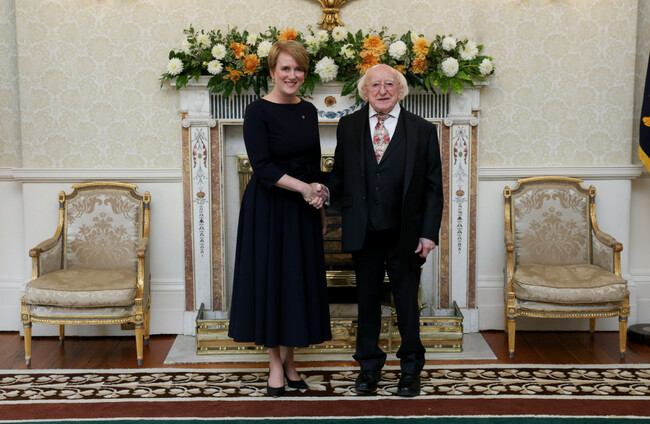
“I’ve already had the chance to use Irish publicly, including when I presented my Letter of Credence to President Higgins at Áras an Uachtaráin. That was a nerve-wracking moment, but also incredibly special.”
The Ambassador, who was living in Ireland at the time, recalled when Queen Elizabeth visited Ireland in 2011 and when she spoke a few words in Irish at the State banquet held in her honour in Dublin Castle.”
“Her gesture at the Garden of Remembrance, and her opening words in Irish—“A Uachtaráin agus a chairde”—were incredibly powerful.
“It showed how diplomacy can speak to real people and real histories.
“That moment stayed with me, and I think it helped shape the tone of British-Irish relations in the years that followed. dúirt sí.
The Ambassador believes that King Charles is very sympathetic to the Irish language and recalled various occasions on which he spoke a few words and described this as “very meaningful”.
During his visit to Cashel in 2022, he opened his speech with “A chairde”—“friends”. More recently, in 2025, he greeted Northern Ireland’s First Minister Michelle O’Neill in Irish, saying “Tráthnóna maith, a Chéad Aire”. He also used Irish in his St Patrick’s Day message, ending with “Lá Fhéile Pádraig sona daoibh go léir.”
According to the Ambassador, King Charles has spoken very fondly of Ireland and she cited as an example what he said in his message on St. Patrick’s Day to the President of Ireland, Michael D. Higgins.
“What’s more, King Charles has spoken very warmly about Ireland. In his St Patrick’s Day message to President Higgins, he said “On our own visits to your wonderful country,
An Irish speaking British Ambassador to Ireland will certainly also be welcomed in Áras an Uachtaráin during the forthcoming term of President-Elect Catherine Connolly, who has said that Irish will be the working language in her new home, and at other Irish-language events during her time in Ireland. Because, as the old saying goes, a job well-begun is half the battle.
The Journal’s Gaeltacht initiative is supported by the Local Democracy Reporting Scheme

To embed this post, copy the code below on your site













have your say