Sign in. It’s quick, free and it’s up to you.
An account is an optional way to support the work we do. Find out more.
Sign in. It’s quick, free and it’s up to you.
An account is an optional way to support the work we do. Find out more.
LAST UPDATE | 17 Aug 2023
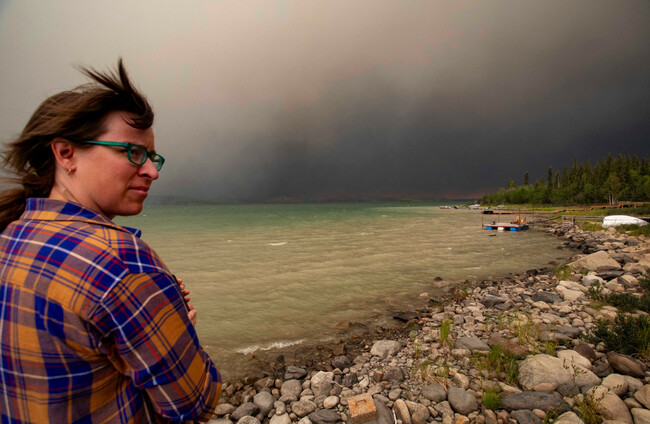
THOUSANDS ORDERED TO flee wildfires advancing on one of the largest cities in Canada’s far north have crammed into a local airport to board emergency evacuation flights, as convoys snaked south to safety on the only open highway.
The order last night to evacuate Yellowknife in the Northwest Territories marked the latest chapter of a terrible summer for wildfires in Canada, with tens of thousands of people forced to leave their homes and vast swathes of land scorched.
As of early today, more than 1,000 wildfires were burning, including about 230 in the Northwest Territories.
More than 20,000 residents of Yellowknife, the regional capital, have been given until noon tomorrow to leave by road or on commercial and military flights.
“We’re all tired of the word unprecedented, yet there is no other way to describe this situation in the Northwest Territories,” regional premier Caroline Cochrane said on X, the platform formerly known as Twitter.
Yellowknife Mayor Rebecca Alty warned drivers that the flames were skirting the edges of highways and they would encounter limited visibility as thick smoke turned the sky orange.
Flights to nearby Alberta province were scheduled to depart Yellowknife starting at 1pm (7pm Irish time).
“Kilometres of vehicles started leaving yesterday, and there were folks flying out yesterday and today,” Alty said.
NW Territories environment minister Shane Thompson warned last night: “Without rain, it is possible (the fire) will reach the city outskirts by the weekend.”
Crews scrambled to erect fire barriers as one fire got to within 16 kilometres of Yellowknife today. Water bombers were seen flying low over the city, and swooping in to fill up at a nearby lake.
Canadian Prime Minister Justin Trudeau was to convene an incident response group this evening.
Several military aircraft have already been dispatched along with more than 120 soldiers to help beat back the flames.
Yellowknife declared an emergency earlier this week, and that was soon expanded across the huge northern territory.
Strong winds stoked the flames, and several towns and Indigenous communities were already under evacuation orders.
In what had already been declared the Northwest Territories’ largest-ever evacuation, the emptying of Yellowknife now means half the population of the near-Arctic territory will soon be displaced.
On Monday, the Canadian military started airlifting residents of smaller far-flung communities in the region to safety after roads were engulfed in flames.
For many, it was the second time in recent months that residents were forced to leave their homes.
Images shared on social media and on Canadian television showed large swaths of blackened forests. Those fleeing reported seeing burned carcasses of wildlife including bears on roadsides.
On those cars and trucks that made it to evacuation centers in Alberta province at least 1,150 kilometres away before roads became impassable, headlights were melted and paint peeled off the vehicles.
The evacuation of Yellowknife is the second time a Canadian city has been cleared due to wildfires since 100,000 residents of Fort McMurray in Alberta’s oil and gas producing heartland were forced out in 2016.
More than 2,000 homes and businesses were destroyed in that blaze.
Earlier this year, suburbs of Halifax on the Atlantic coast were also evacuated.
Fires this season have spread across Canada with remarkable intensity, scorching 13.5 million hectares, according to the Canadian Interagency Forest Fire Centre. Four people have died so far.

To embed this post, copy the code below on your site














have your say