We need your help now

Support from readers like you keeps The Journal open.

You are visiting us because we have something you value. Independent, unbiased news that tells the truth. Advertising revenue goes some way to support our mission, but this year it has not been enough.

If you've seen value in our reporting, please contribute what you can, so we can continue to produce accurate and meaningful journalism. For everyone who needs it.

File photo Alamy Stock Photo

Farmers say the collapse of a major carrot grower is a red flag for Ireland's vegetable farms

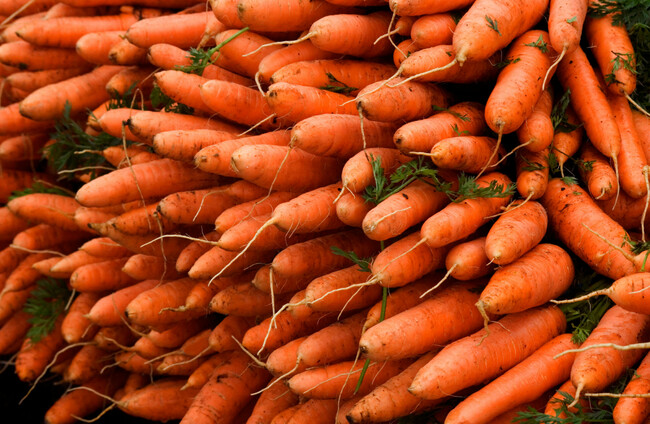
Hughes Farm in Co Kilkenny is responsible for 12% of Ireland’s carrot production but the company going under has raised questions.

THIS WEEK SAW one of Ireland’s main carrot producers go into administration, blaming a combination of rising costs and worsening growing conditions thanks to “relentless rain” for its demise.

Hughes Farming in Kells, Co Kilkenny is reportedly responsible for 12% of Ireland’s carrot production but the company going under has raised questions over not just the future for its approximately 40 workers, but also whether the crop’s growers may also be in danger.

According to a number of vegetable growers who spoke to The Journal in the wake of Hughes Farm’s collapse, the case is a reminder of the pressures facing the sector.

Others in the broader sector said it was also a sign they had seen in recent months of how the weather was putting pressure on supply of fresh produce, with retailers further up the chain seeing 50% prices increases for some goods put down to the rain.

These pressures are only expected to grow given the developing war in the Gulf and the chokehold that is exerting on key elements such as fertilizer.

John Dockrell, a carrot farmer for more than 30 years in Monroe, Co Wexford, said the “key” pressure facing growers is the price they’re getting paid for their crops.

Added to this has been climate change as a factor resulting in “extraordinary increases” for maintaining crops, which Dockrell said has particularly impacted affected field vegetables, including parsnips and celery.

“About 20 years ago the price was €1.30 or 1.50 and here today carrots are €1.29 today, so the price has dropped effectively,” Dockrell told The Journal.

To keep up with inflation the price “should be €1.90″, the farmer added.

“If the market functioned properly, then that’s where the price really should be and that’s why we’re suffering.”

Pressures on contracts

The Journal heard of a number of examples from farmers who, under pressure to meet contractual demands for the country’s main supermarket chains, had found that the recent deluge meant they had to source some produce from fellow farmers to meet the quota of their contracts.

For carrot growers, the harvest usually takes place right through the winter on a weekly basis to fulfill contracts.

Some in the sector said that some of their vegetables remain in the ground because it’s been so wet and that they may be rendered unsellable.

According to RTÉ, Hughes Farm has sought the appointment of a liquidator to ensure the current harvest is not lost and that crops won’t perish.

In a recent report by State agricultural research body Teagasc, it found that last year was broadly positive for horticulture, but noted that a “major challenge” for the sector was labour cost and availability of workers.

Food security

Martin Flynn, a tomato farmer in Swords, Co Dublin, told The Journal that the case of Hughes Farm again highlights the need for Ireland to focus on its food security.

“If you take tomatoes, there’s five main growers in the country. If you take parsnips, there’s four growers. Carrots, there’s maybe five growers. So there’s five major retailers and there’s essentially only one grower of each crop per retailer,” Flynn said.

This makes it all the more vital, Flynn said, that these growers are “supported and stay in business and expand their businesses to be able to meet the demands of the fruit and veg sector in years to come”.

Flynn – who is the vice-chair of the Irish Farmers’ Association’s horticulture committee – added that Ireland may “struggle due its reliance on the importation of produce”.

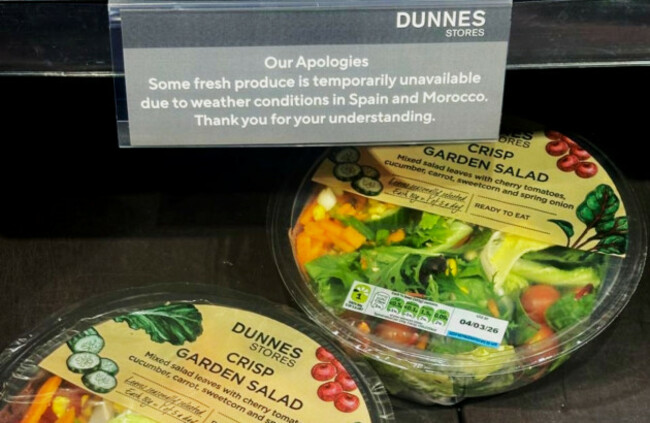
He pointed to recent storms across Spain, Portugal and Morocco that have resulted in lack of fresh produce at some Irish supermarkets, and which may also push up the cost of food we import from these regions.

river (35) Sign in Dunnes Stores last month apologising for shortages. The Journal The Journal

Flynn’s argument echoed that of GIY founder Michael Kelly who, writing for The Journal yesterday, noted that Ireland exports around 90% of the food we produce, while the country also imports around 83% of its fruit and vegetables

“That means the onions, tomatoes, peppers, broccoli and spinach leaves that fill supermarket shelves and are the backbone of our 365-days-a-year mono-diet are mostly coming from somewhere else,” Kelly wrote, illustrating our vulnerabilities if examples such as Hughes Farm were to happen elsewhere.

Elsewhere, Peader Rice of Small Change grocery in Inchicore in Dublin said he is increasingly seeing shortages blamed for price increases.

In one example, he has found that buying a kilo of blueberries wholesale has jumped in price from €19.50 to €29.50 per kilo.

“So like I’ve lost over €10 on the increase. I can’t pass that on to the customers and I have no margin left to absorb those increases,” Rice told The Journal.

He said that at this time of year, that produce is coming from Morocco, but that suppliers had told him the price increase was due to the war in the Gulf.

“But regardless of what wars or conflicts are going on, climate change is already having a huge impact on the availability I’ve found,” Rice said, adding that it’s affecting growers he works with.

“I don’t this will be the last time this year we hear of a producer entering receivership,” Rice added.

Readers like you are keeping these stories free for everyone...
A mix of advertising and supporting contributions helps keep paywalls away from valuable information like this article. Over 5,000 readers like you have already stepped up and support us with a monthly payment or a once-off donation.

Close
63 Comments
This is YOUR comments community. Stay civil, stay constructive, stay on topic. Please familiarise yourself with our comments policy here before taking part.
Leave a Comment
    Submit a report
    Please help us understand how this comment violates our community guidelines.
    Thank you for the feedback
    Your feedback has been sent to our team for review.

    Leave a commentcancel

     
    JournalTv
    News in 60 seconds