We need your help now

Support from readers like you keeps The Journal open.

You are visiting us because we have something you value. Independent, unbiased news that tells the truth. Advertising revenue goes some way to support our mission, but this year it has not been enough.

If you've seen value in our reporting, please contribute what you can, so we can continue to produce accurate and meaningful journalism. For everyone who needs it.

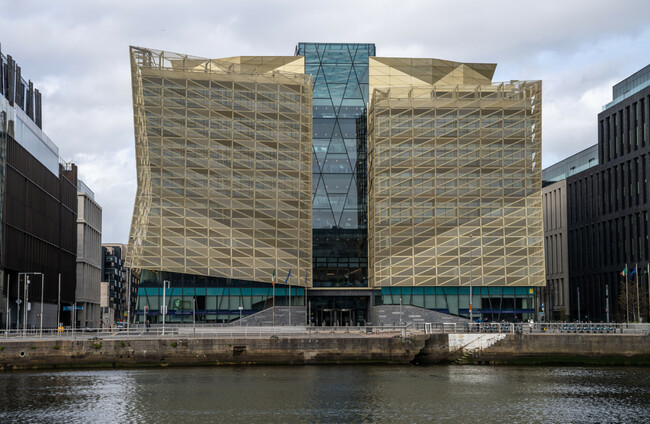
The Central Bank's headquarters in Dublin's Docklands Alamy Stock Photo

Central Bank went €3.6m over budget on new data system despite giving reassurances about cost

It’s one of 15 capital projects where the bank has overspent since 2020.

THE CENTRAL BANK went €3.6 million over budget on a new system that upgraded how the bank handles data from 15,000 financial companies that it regulates. 

The huge overspend occurred despite reassurances given to senior Central Bank staff who raised questions about the risks and costs involved when the programme was first proposed in 2017.

The bank had expected to spend around €18 million on the new system but ended up spending just over €22 million instead – a massive increase on the projected cost.

On Friday, The Journal revealed that the bank paid €616,000 for a sculpture at its new premises on Dublin’s North Wall Quay, despite initially putting a €300,000 price tag on the artwork and claiming on its website that it cost €320,000.  

The overspends could drag the bank into a series of controversies around spending on other capital projects that have dogged the Government since last year.

They include questions over the value for money of the €336,000 Oireachtas bike shed, a €1.4 million security hut at Government buildings and a €6.7 million IT project by the Arts Council that was later abandoned.

The bank is not directly taxypayer-funded, but makes money through an investment portfolio, a funding levy paid by banks and other financial institutions, and through profit on the issuing of banknotes. 

Social Democrats TD Aidan Farrelly has called on the Central Bank to appear before the Public Accounts Committee to explain the overspends.

“I find the catalogue of overspends by the Central Bank quite concerning given the institution’s position in our State financial sector,” he told The Journal.

The overspend on the data management project is one of 15 capital projects in which the bank has gone over budget in recent years at a cost of more than €6.5 million.

Figures released to Farrelly via a Parliamentary Question show that the bank’s largest overspend was by €3.6 million on the first phase of the new data management system – known as the Unity Programme – which began to be implemented in 2021. 

The first phase comprised the launch of a portal through which financial institutions can submit data to the Central Bank for regulatory purposes.

The programme was first mooted in 2016 following a review of the bank’s systems architecture, which was designed to anticipate future regulatory requirements and how it would process the data it received.

In September 2017, the bank’s then-governor Philip Lane told a meeting of the bank’s senior staff that the Unity Programme would come at a significant cost, but that it would lead to “better regulation at the macro and micro levels”.

Records of that meeting show that following a presentation about the programme, unnamed staff asked for “further specific detail on costings and on assurances around some of the risks involved”.

At the bank’s next meeting in October 2017, staff indicated they were satisfied with additional detail given and reassurance provided, and the first phase of the programme was subsequently approved.

The first phase of the programme was delivered in 2021 and ultimately cost €19 million, with figures provided as part of the PQ showing that this was €3.44 million over budget.

In 2022, part of the second phase of the programme called “product stream” was also delivered at a cost of €3.1 million, which the bank said was €198,000 over budget – bringing the total overspend on the project to date to almost €3.64 million.

Another part of the programme’s second phase was delivered in 2024 at a cost of €16.4 million, though the bank said that this did not go over budget.

The overspend on the programme was attributed to the project being more complex than the bank originally planned for, a desire to take a more prudent approach around the rollout of the external portal and the impact of remote working during the pandemic.

Further overspend

Other figures provided as part of the PQ response also show how the Central Bank went significantly over budget on further projects since 2020.

Finance Minister Paschal Donohoe indicated that the bank went €84,000 over budget on the €616,000 Double Rainbow artwork by artist Eva Rothschild at its North Wall Quay headquarters.

However, this did not tally with the figures of the initial estimate of €300,000 and the final cost of €616,000, which instead suggest that the artwork went €316,000 over budget.

The overspend was partly attributed to delays in the construction of the bank’s new premises because of the Covid-19 pandemic, which meant the sculpture had to be stored before it was installed, as well as professional service costs.

The bank also said there were additional costs related to VAT on UK invoices, which were not anticipated when the initial price was estimated in 2015 and which added to the cost of the sculpture. 

A new in-house IT system that helps the bank run a prospectus approval process was delivered in 2020 at a cost of €2.7 million, which the bank said was €878,000 over budget.

The new system was required because the bank leased an older version of the system from the Irish Stock Exchange, which was ending its vendor support, leaving the bank unable to perform functions required by the Prospectus and Transparency Directive.

The Cental Bank also cited a €365,000 overspend on Covid-19 remote working infrastructure that cost a total of €966,000.

There was also an overspend of €366,000 on a system enabling the implementation of a European Commission directive called the Prospectus Directive in 2021.

The overspend was due to a delay in the system going live, additional complexity of the system’s specifications, and the impact of Covid-19 on resourcing at critical junctures of the project.

A €1.2 million contract management service, whose purpose was to enable initial calls and emails from members of the public requiring support to be outsourced, came in €363,000 over budget.

The overspend was put down to technical difficulties that arose during the implementation of the service, particularly around data protection and security requirements that needed to be reconfigured.

Asked to explain why there was overspend on 15 capital projects, a spokesperson for the Central Bank said that decisions were taken to increase planned investment as part of a “well-governed process” that allows for “complex projects” with “evolving requirements, inflationary pressures, and external factors”. 

They said that capital projects carried out by the bank are often complex, have high security requirements and are used to build systems that are accessed by thousands of users working for both the bank and the firms it regulates.

They added that the bank ”prioritises responsible spending”, that it has “strong internal governance controls”, and that it adheres to the Public Sector Spending Code – a framework that ensures public funds are used efficiently and deliver value for money.

The bank’s spokesperson also pointed out that although planned investment on the projects had increased, the bank’s overall spending on capital projects since 2020 was delivered within budget because some other projects cost less than expected.

However, Social Democrats TD Aidan Farrelly said the overspends, particularly on the Unity Programme, were concerning. 

“Running over by almost €3.5m on one project alone should have alarm bells ringing,” he said.

“The extent of the overspending does not compliment the mission of the Central Bank in the slightest. There are questions to be answered here in respect of internal controls, process and decision-making.”

Readers like you are keeping these stories free for everyone...
A mix of advertising and supporting contributions helps keep paywalls away from valuable information like this article. Over 5,000 readers like you have already stepped up and support us with a monthly payment or a once-off donation.

Close
JournalTv
News in 60 seconds