Sign in. It’s quick, free and it’s up to you.
An account is an optional way to support the work we do. Find out more.
Sign in. It’s quick, free and it’s up to you.
An account is an optional way to support the work we do. Find out more.
A “SEVERE ENERGY shock” caused by the war in Iran could see inflation rising above 4% this year, according to the Central Bank.
In its first quarterly bulletin of 2026, the bank said the higher oil and gas prices we are seeing as a result of the conflict are expected to lead to lower growth and higher inflation than previously anticipated.
This outlook hinges on the length of the conflict as well as the scale of damage to critical infrastructure in the Middle East.
The bank revised its inflation prediction upwards to 2.9% in 2026 and 2.6% in 2027. This baseline assumption is based on market data as of 11 March.
This baseline forecast also puts respective oil and gas prices 30% and 57% higher on average this year than in the bank’s previous forecast in December.
However, due to the risk that energy prices could rise further as a result of the ongoing war, the bank also examined what a severe scenario would look like.
This would include damage to infrastructure “where it takes quite a while for pipelines to be reopened, for facilities to come back on stream, and there’s a global reduction in capacity to supply oil”.
In this scenario, inflation would be 4.2% in 2026 before dropping to just under 4% the following year. Oil prices would average at around $120 per barrel this year, close to 20% higher than the peak observed since the outset of the Russia-Ukraine war.
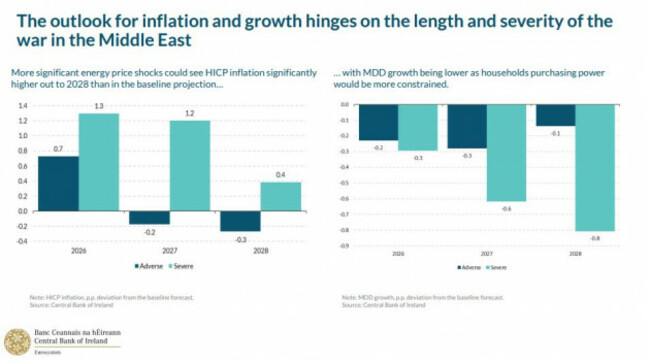
The severe scenario would also see energy prices begin to decline in 2027 but remain persistently high until 2028, with oil and gas prices almost 50% and 80% above baseline by the end of the period.
Central Bank economics and statistics director Robert Kelly said the severity and the duration of the conflict and what it means for energy markets “hangs over the outlook for growth and inflation”.
“Essentially, we’re looking at highly volatile energy markets. They change almost on a daily basis,” he said during a briefing yesterday.
These events highlight just how sensitive the Irish economy is to global developments and the need to maintain and build resilience in our domestic economy and public finances.
Modified Domestic Demand (MDD), a measure of underlying domestic activity that covers personal, government and investment spending, is expected to grow by 2.9% this year and 2.5% next year.
Nominal wage growth is expected to ease back to 3.5% by 2028 which, when combined with the inflation outlook, will see average household disposable income remaining relatively unchanged, the bank said.
Meanwhile, the pace of employment growth is expected to be just below 2% out to 2028, with the rate of unemployment set to rise to above 5%.
Kelly said the government’s response to the current energy shock through “targeted, temporary and tailored” measures.
“We have to acknowledge that we actually don’t know how this is going to evolve,” he said, adding that a more prolonged impact may require different supports in different ways.
If the government felt that further cost of living supports were needed, it would be important to see how “we would adjust the spending and tax mix to accommodate those rather than creating additional spending within the economy”, he added.
Martin O’Brien, researcher with the Central Bank, said there was “more positive momentum in business investment” toward the end of 2025 and into 2026.
“That actually is very, very concentrated to a certain extent in multinationals,” he said, pointing in particular to data centres and AI-related physical investment.
“We expect that positive momentum to carry into this year to a certain extent as well.”
The Central Bank said overall cross-border merchandise exports grew by 17.5% last year, with 95% of this growth down to polypeptide hormones, which are found in weight-loss drugs.
It said that while medium-term demand for these exports is expected to be strong, continued volatility is likely in the short-term, influenced by the stocks and production cycles of the multinational firms manufacturing these products in Ireland.
Non-pharmaceutical exports accounted for 46% of overall goods exports last year, a slight decline of 1.1% on the previous year.
The bank said housing investment performed better than expected last year, but further progress is needed to confirm a sustained pick-up in activity.
There were 36,300 new houses built in 2025, a number the bank said was boosted by a large increase in completions in the last quarter of the year. The number of completed units increased by 38% in that quarter compared with the same quarter in 2024.
Housing completions are forecast to number 40,000, 43,000 and 46,000 in 2026, 2027 and 2028 respectively.
These forecasts depend on the delivery of necessary public infrastructure in water, energy and transport, including the implementation of the government’s Accelerating Infrastructure Action Plan.
Kelly said it also depends on a number of other factors, including growing inflationary pressures.
“If there was a more severe realisation of energy and related costs, that could impinge the viability of certain investment activity over the next two to three years, and that could present a downside risk to housing,” he said.
“While our baseline expectation is that there’s a positive momentum in investment in housing, there are certain downside risks.”

To embed this post, copy the code below on your site















have your say