Sign in. It’s quick, free and it’s up to you.
An account is an optional way to support the work we do. Find out more.
Sign in. It’s quick, free and it’s up to you.
An account is an optional way to support the work we do. Find out more.

LAST UPDATE | 3 Dec 2025
THE DEPARTMENT OF Public Expenditure has published a new “radical” plan this morning that it says will speed up the delivery of infrastructure projects.
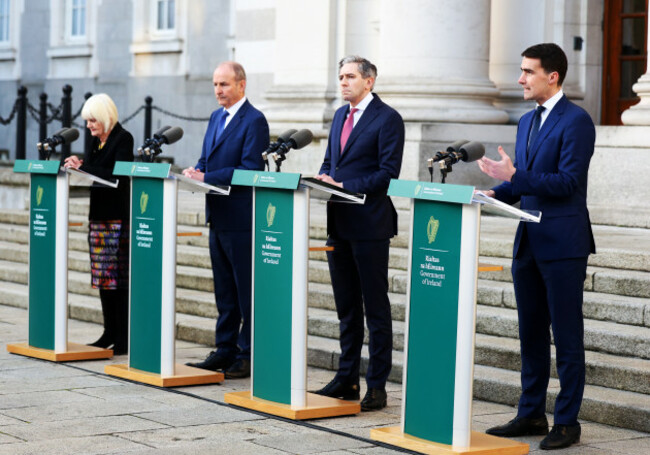
Unveiling it at a press conference at Government Buildings, Minister for Public Expenditure Jack Chambers explained that the 30-point plan aims to address “regulatory complexity” that has compounded delays in delivery.
“The State faces an infrastructure deficit, and we are not delivering at the pace and the scale that’s required,” he told reporters.
He added: “Successive reforms over many years, while well intentioned, have imposed layers of rules, regulations and requirements.
“We become trapped by process at the cost of progress.”
Chambers said the plan is a “fundamental change to how government, state agencies and the public service work” and that it is a move away from “a culture of caution to one of delivery, which tolerates a higher risk appetite to get projects delivered.”
Central to the plan is an ambition to cut the time it takes to deliver big projects.
The Minister said this will be done by allowing steps in the process to be carried out in parallel with each other. For example, consenting, permitting, licensing, where possible.
“All of that will will shrink timelines,” Chambers said.
He was joined at the press conference by Taoiseach Micheál Martin, Tánaiste Simon Harris and junior minister Marian Harkin (who was representing the Regional Independents).
The Taoiseach described the publication of the plan as a “critical milestone in the lifetime of this government”.
He said the government’s legacy will be tackling the country’s “infrastructure deficit”.
“The fact is that our planning, legal and regulatory systems, and the interactions between them have become extremely complex and unwieldy,” he said, arguing that in extreme cases this has caused the delivery of important projects to be “abandoned”.
Tánaiste Simon Harris spoke about the population growth Ireland has experienced in recent years. He said, while this is positive for the employment sector, “our water systems, our transport network, our energy grid, they simply have not kept up with the Ireland of 2025”.
He said Ireland’s delivery system is “too slow” and “everyone knows this”.
“Incremental change simply won’t cut it. We need to think bigger. We need to think radically,” he said.
Harkin, who is a junior minister in the Department of Higher Education, said the plan is being fully supported by the Regional Independents in Government.
The Accelerating Infrastructure Action Plan will cap legal costs for judicial reviews and bring forward legislation that would place the judicial review process on a statutory footing, allowing the government to set new parameters for how they can be used.
The plan outlines a range of measures the government hopes will bring a “cultural shift” in the delivery of key projects, such as housing, roads, water treatment plans, energy sub-stations and hospitals, under the planning system.
The government plans to do this through reforms to the legal system and planning regulations, improved coordination between stakeholders and more communication from the Department.
It comes days after Chambers said that judicial reviews were being “weaponised” against the public good.
As part of the legal reforms, a scale will be introduced that will cap the legal fees of a standard environmental judicial review case at around €41,000, a complex case at around €53,000 and a very complex case at around €65,000.
The current average legal costs in a judicial review are understood to be over €200,000.
A public consultation on capping the legal costs will commence in the next number of weeks.
The proposed actions were welcomed by the Chair of the Bar Council of Ireland, Seán Guerin SC, who said the actions align with the Bar Council’s position that “high quality and lawful planning processes” would reduce the need for judicial reviews and ensure infrastructure is delivered efficiently.
He said: “Judicial review remains an essential constitutional safeguard to ensure that Government and other public bodies, in particular planning and environmental authorities, act lawfully and rationally.
“It is the view of the Council of The Bar of Ireland that strengthening public-service legal capacity, supported by appropriate training and resourcing, will be essential to improving decision-making in the planning process across State bodies.”
He said that while it is not the role of the courts to make planning decisions, judicial scrutiny helps to improve and maintain the quality of planning decisions for all.
Guerin added that the Council would consider the report’s findings and recommendations and engage with Government to support its efforts “to ensure that Ireland’s planning process functions in the most effective, lawful, and trusted manner possible”.
The government will also limit who can take a judicial review to those who would be directly impacted by any proposed project.
The Minister for Justice will introduce a Civil Reform Bill that will place the judicial review on a statutory footing. As a result, rather than the courts deciding by a precedent as to what rules might apply on judicial review, legislation would determine how the process could be utilised.
Other reforms under the plan include a Critical Infrastructure Bill that will create a legal obligation for State bodies to accelerate key projects. This could incorporate statutory timelines for project delivery and require all parts of the system to prioritise these projects.
It will allow the government to determine what constitutes critical infrastructure and create a fast-track pathway for significant projects that are in the national interest.
It’s understood the government is committed to fast-tracking this Bill early next year.
Other legal reforms contained within the plan include strengthening limitations on the use of quashing orders for minor issues in judicial reviews of planning decisions and examining the legislation that planning authorities have to abide by when making decisions.
It’s understood the government is expecting the reforms to be challenged due to their “radical” nature, but it is determined to carry on with enacting them in order to see infrastructure projects delivered.
The plan also commits to establishing a Regulatory Simplification Unit within the Department that would review existing structures, governance and oversight and simplify existing legislation.
A series of reforms will also be developed to standardise the practices used by regulatory bodies, including a requirement for agencies to work together to support the delivery of infrastructure projects.
Guidelines and statutory deadlines will be introduced and published for every regulatory process, and agencies will be required to engage and communicate with planning applicants on their status.
While water and electricity infrastructure is developed by the State, the government has agreed to allow private developers to deliver certain projects in circumstances where they would be delivered more quickly or efficiently.
Private developers will be able to build and own electricity lines in certain circumstances, such as between renewable generators, while measures will also be brought forward to deliver new standalone wastewater treatment plants, with Uisce Éireann taking responsibility for regulatory compliance and the completed infrastructure.
The Department of Public Expenditure will monitor and coordinate the progress of critical infrastructure projects across sectors and ensure planning, funding and delivery and aligned.
It will resolve cross-departmental conflicts and any bottlenecks that might delay projects, while also proposing solutions for government to consider.
The National Development Finance Agency will also provide support and expert assistance for major projects through the approvals process.
The Construction Industry Federation (CIF) has welcomed the plan, describing it as an important milestone in tackling “Ireland’s infrastructure deficit”.
However, it stressed “the urgent need for detailed project timelines and implementation plans to ensure the strategy delivers on its ambition”.
CEO Andrew Brownlee said that the largest capital investment plan in our history “must be matched with a clear roadmap of projects and timelines”.
“Construction companies need certainty to scale up operations and deliver. Without granular detail, investment planning becomes impossible,” he said.
Chair of the Council of The Bar of Ireland, Seán Guerin SC, also broadly welcomed the plan. He said that while accelerating infrastructure delivery is crucial, bad planning decisions “have far-reaching consequences”.
Guerin said that judicial review “remains an essential constitutional safeguard to ensure that Government and other public bodies, in particular planning and environmental authorities, act lawfully and rationally”.
“While it is not the role of the courts to make planning decisions, judicial scrutiny of the lawfulness and rationality of decision-making serves an important public interest in improving and maintaining the quality of planning decisions for all citizens,” he said.
Guerin added that the council will give careful consideration to the report’s findings and recommendations “in due course”.
With reporting from Jane Matthews

To embed this post, copy the code below on your site














have your say