We need your help now

Support from readers like you keeps The Journal open.

You are visiting us because we have something you value. Independent, unbiased news that tells the truth. Advertising revenue goes some way to support our mission, but this year it has not been enough.

If you've seen value in our reporting, please contribute what you can, so we can continue to produce accurate and meaningful journalism. For everyone who needs it.


Childcare fees to reduce for some as more parents are brought into subsidy scheme

Changes to the income thresholds will make thousands more families eligible for subsidies.

LAST UPDATE | 20 hrs ago

CHANGES TO THE National Childcare Scheme will result in thousands of families receiving more subsidies.

Children’s Minister Norma Foley launched the government’s new Action Plan on Childcare this morning, which sets out a pathway to getting to the election promise of setting childcare costs at €200 per month per child.

She said she is confident the government will deliver on its €200 pledge within its lifetime.

The ‘Shaping the Future: Early Years Action Plan’ commits to actions in 2026 to make services more affordable and accessible, while also pledging to improve quality.

The report published today sets out the plan to enact Phase 1 over 2026 to begin to strive towards achieving its election promises in the childcare sector. It also provides an outline on what Government plan to undertake to prepare for Phase 2, which will be undertaken from 2027 through to 2029.

A public consultation will take place next year to inform Government’s plans for Phase 2.

Getting to the point where childcare costs €200 per month per child will be a focus of the second phase of the plan, following the outcome of the extensive public consultation process.

Minister Foley has previously acknowledged that it will be a “long journey” to get to the €200 mark

One of the key measures in today’s report, as flagged previously by The Journal, is reducing costs for lower-income families by changing the income thresholds for National Childcare Scheme.

There are two types of subsidies under the NCS – the universal subsidy, which is not means-tested, provides €2.14 per hour for a maximum of 45 hours of childcare per week.

An income-assessed subsidy is means-tested and is based on a family’s individual circumstances with rates of the subsidy depending on the income of the family.

Currently, families get full subsidies if their income is below €26,000. If a household income is between €26,000 and €60,000, families can access a graduated level of subsidies.

The detail set out today by the minister clarifies the changes to the income limits, making more families eligible for the scheme. 

What are the key actions in the plan?

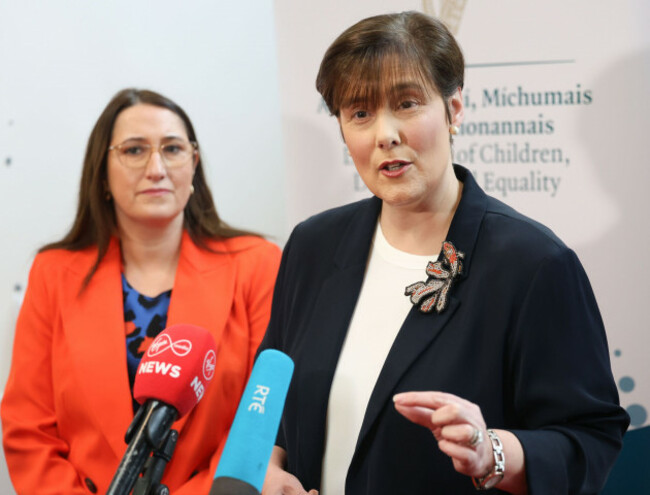
Minister Norma Foley-9_90739944 Minister for Children, Disability and Equality Norma Foley launched the Action Plan on Childcare at YMCA Dublin, with Minister of State Emer Higgins. Leah Farrell / © RollingNews.ie Leah Farrell / © RollingNews.ie / © RollingNews.ie

The lower income threshold will be increased from €26,000 to €34,000 and the upper income threshold will be increased from €60,000 to €68,000.

There will also be changes to the multiple child deduction element of the scheme, so a family with an income of €68,000 would have their reckonable income reduced by €11,000 to €57,000, allowing them to qualify for higher graduated subsidies under the National Childcare Scheme.

As childcare fees lower, the Department said it is likely for demand for childcare places to rise significantly and it is working to increase supply. 

It has announced more funding available for providers under Core Funding to cover any gaps in operational costs faced as a result of a reduction in revenue from fees. Funding will be increased to €482m for the programme year beginning in September, an increase of 23%.

An additional €45m in Core Funding is ringfenced to support providers with the possible increase in wages of its workers as a result of Joint Labour Committee negotiations for new Employment Regulation Orders (EROs).

An ERO fixes the minimum rates of pay and conditions of employment in specified business sectors.

There have been three EROs in the past three years, the latest of which was in October this year. They have delivered increases in minimum wages for early years educators and school-age childcare practitioners. 

Providers

Foley told media following the report that the highest number of providers are now availing of Core Funding since the scheme began, at 93%, and said while she “absolutely accept[s] that some providers choose to leave the system”, more than 70% of those who exited the system returned.

“The whole purpose of core funding was to reduce the cost for parents in terms of introducing the fee cap,” she said, “but to do that, increasing monies are being given to the providers to make that work.”

Foley said the three priorities are lowering fees, increasing supply, and ensuring quality across all childcare services and providers.

An Action Plan for Simplification was also released in conjunction with the report. It sets out plans to streamline administrative processes, develop an overarching framework that can be applied to the majority of providers, and enable a “once only” data capture.

Part of this plans for a single, long-term Childcare Identifier Code Key (CHICK) – a code for a child to show their subsidy under the NCS has been approved – rather than being renewed annually.

These changes will not kick in immediately, but are due to be implemented in September 2026, at the start of the new early learning programme year. The government believes these changes will benefit almost 47,000 families by providing them with additional subsidies.

Additional reporting by Emma Hickey

Readers like you are keeping these stories free for everyone...
A mix of advertising and supporting contributions helps keep paywalls away from valuable information like this article. Over 5,000 readers like you have already stepped up and support us with a monthly payment or a once-off donation.

Close
36 Comments
This is YOUR comments community. Stay civil, stay constructive, stay on topic. Please familiarise yourself with our comments policy here before taking part.
Leave a Comment
    Submit a report
    Please help us understand how this comment violates our community guidelines.
    Thank you for the feedback
    Your feedback has been sent to our team for review.

    Leave a commentcancel

     
    JournalTv
    News in 60 seconds