Sign in. It’s quick, free and it’s up to you.
An account is an optional way to support the work we do. Find out more.
Sign in. It’s quick, free and it’s up to you.
An account is an optional way to support the work we do. Find out more.

AN ASYLUM SEEKER group that mobilised hundreds of supporters outside the gates of the Dáil this week has garnered attention in recent months, partly for how it has been protesting against other migrant organisations.
Abolish Direct Provision Ireland (ADPI) has undertaken a tour of the country calling for a “boycott” of other groups representing asylum seekers, demonstrating outside NGO offices in Dublin, Limerick, Cork and Donegal.
On Wednesday, the group held a demonstration outside the Dáil where members called for the end of the direct provision accommodation system and a stop to deportations.
It shows a growing divide among Ireland’s asylum-seeker community amid the government’s hardening policies that have seen a rise in deportations.
The group – which was founded in 2018 – claims a membership of 1,500 people, with numbers swelling in recent months as it has embraced more visible campaigning.
The ADPI’s aims have drawn attention, as the group wants the Irish government to fast-track its members through the international protection system.
A mass amnesty isn’t an unusual request. It’s happened in Ireland in the past and just this week the Spanish government announced an amnesty for 500,000 undocumented people and asylum seekers to bolster its labour market.
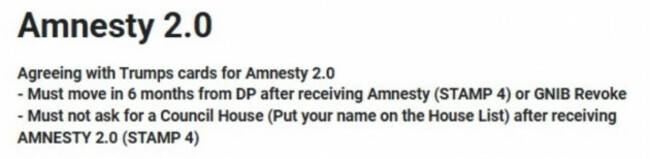
But the ADPI’s proposal would come with a catch for its members: in return for an amnesty, they must promise they will not claim any housing supports or join a housing waiting list in any local authority area.
In such a scenario, the group says that if any of the members claim any support from the Irish state then they commit to losing their amnesty and being a candidate for deportation.
This proposal is viewed as unlikely and highly unrealistic in the sector, but the ADPI has been undeterred.
The group has called the housing crisis a “myth” and has strongly criticised other organisations for supporting the stance that housing is a “human right”.
In one post on Facebook, where the group promotes its work regularly, it sets out its belief that “asylum seekers should not get housing” from the State. “They should work and buy their own houses,” the group said.
This position – contradicting the work many other asylum groups do with Ireland’s trade unions and political parties on housing – has seen the ADPI face criticism from parts of Ireland’s migrant network.

When questioned on social media as to where members – or the almost 33,000 international protection applicants in State accommodation – could be housed in the case of an amnesty, the group said they will be able to “find houses themselves”.
Elsewhere, they have hit out at Ireland’s government for having “accepted 100,000 Ukrainians in the country” following Russia’s invasion.
The ADPI has sought to draw a distinction between itself and other asylum seeker groups.
In a series of posts on social media this month, the group lists more than a dozen other groups that work with asylum seekers in a “hall of shame”, claiming they are failing to provide resistance to the government’s intensified deportation campaign.
These longstanding groups, the ADPI claimed on social media, say they are “working for asylum seekers” but are “not proactive in the current climate” of increased deportations.

In recent weeks, the ADPI has stepped up its campaign with hunger strikes, lobbying politicians from parties including Labour, Fine Gael, the Green Party and Sinn Féin along the way.
The group – which has also been known as Say No to Direct Provision in Ireland – was founded by Owen Chance, who is based in Co Monaghan and also goes by the name Owen Ireland.
He has described himself as a former asylum seeker who came to Ireland from the Caribbean more than a decade ago and had his application accepted.
Owen and the ADPI were contacted by The Journal for comment. In response, Owen sent The Journal a video clip of ADPI spokesperson Angelia Russell discussing the amnesty proposal.
Russell, who is from South Africa, said in the clip that asylum seekers are “trapped” in Direct Provision and “scapegoated” for Ireland’s housing problems.
By committing to not receiving any State supports upon receiving the proposed amnesty, Russell claimed this would be a way of providing “accountability” for any person granted permission to remain in Ireland.

To embed this post, copy the code below on your site













have your say