Sign in. It’s quick, free and it’s up to you.
An account is an optional way to support the work we do. Find out more.
Sign in. It’s quick, free and it’s up to you.
An account is an optional way to support the work we do. Find out more.
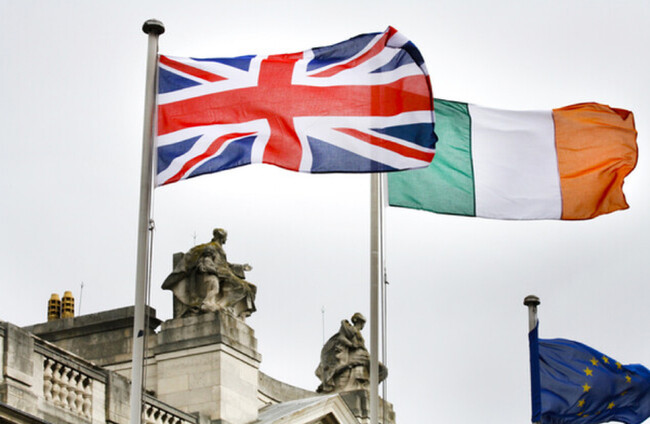
THE GAP BETWEEN both sides of the Irish unity debate in the North has narrowed to just four percentage points, according to a new poll.
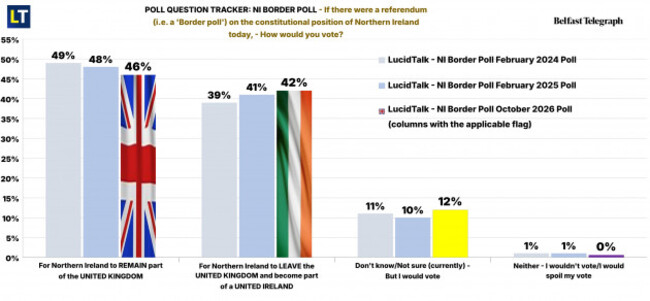
A LucidTalk poll carried out for the Belfast Telegraph found that while more people would opt to remain within the UK, the gap has decreased quite significantly over the course of two years.
In a 2024 poll for the Belfast Telegraph, the pro-Union camp had a 10-percentage-point lead, a lead which then narrowed to seven points last year.
In the most recent poll, the results of which were published on Sunday night, that gap has again narrowed to four percentage points.
The poll found that 46% of voters would opt to remain in the UK while 42% would back joining a united Ireland if a referendum were held today.
The remaining 12% said they were unsure as to how they would vote.
Meanwhile, the poll found that a third of nationalist voters think a referendum should be held within two years, some 55% think there should be one within three to 10 years, and 8% think there should be a referendum in the next 11 to 20 years.
For unionist voters, some 69% say there should never be a referendum, while 16% say there should be one over two decades from now.
Only 4% of Alliance and Green Party voters believe that there should never be a referendum held, while 10% would like to see one in the next two years.
Some 45% of this cohort would like to see a referendum in the next three to 10 years, while 23% would opt to have one in the next 11 to 20 years.
Support for a united Ireland is also strongest among younger voters, with a vote for a United Ireland leading the way among those aged 55 and younger.
Among those 35 and younger, 46% would back a united Ireland while 45% would opt to remain in the UK.
The gap widens among those aged 35 to 44, with 48% saying they would vote to join a united Ireland while 42% are in the pro-Union camp.
And among those aged 45 to 54, some 45% back a united Ireland while 43% would opt to remain in the UK.
However, a wide margin of those aged 55 to 64 would opt to remain in the UK, with 54% of this age cohort in the pro-Union camp compared to 37% who would back a united Ireland.
Among those aged 65 and over, some 47% would opt to remain in the UK while 34% would vote for a united Ireland.
Elsewhere, one-in-five SDLP voters are undecided on their support for Irish unity, while 10% would opt to remain in the UK, with some 70% backing a united Ireland.
Meanwhile, twice as many Alliance and Green Party voters want to see a united Ireland (38%) than want to remain in the UK (19%), but the majority are undecided (43%).
The poll also asked the opinion of non-voters, and there has been a surge of support for a united Ireland among this cohort.
Last year, 70% of non-voters said they would opt for remaining in the UK, while 29% backed a united Ireland.
But in the latest poll, some 42% back a united Ireland while 38% would opt to remain in the UK.
Meanwhile, some 84% of Protestants back remaining in the UK and 80% of Catholics want to see a united Ireland, and among those of no religion, 45% would opt for Irish unity (with 32% in favour of the union).
And should a future referendum result in a united Ireland, around three-quarters of unionists said they would find this impossible to accept.
The online poll was taken from 29 to 31 October and 3,989 took part, making it the largest poll ever held in the North.

To embed this post, copy the code below on your site













have your say