We need your help now

Support from readers like you keeps The Journal open.

You are visiting us because we have something you value. Independent, unbiased news that tells the truth. Advertising revenue goes some way to support our mission, but this year it has not been enough.

If you've seen value in our reporting, please contribute what you can, so we can continue to produce accurate and meaningful journalism. For everyone who needs it.

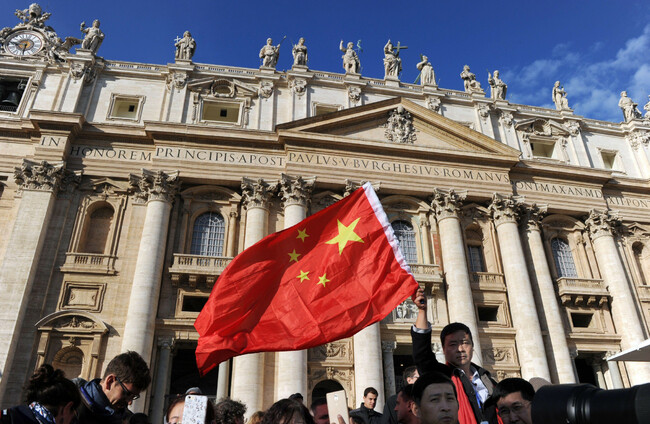
Pilgrims from China attend Pope Francis 's weekly general audience in Saint Peter's square at the Vatican on 22 November, 2017. Alamy Stock Photo

China ‘elects’ two bishops despite Pope Francis's death, defying Vatican agreement

The Vatican is unable to ratify any bishop appointments following Pope Francis’s death, as only the pope has the ability to do this.

CHINA HAS “ELECTED” two bishops despite the Catholic Church being in the “sede vacante” period following the death of Pope Francis.

When a pope dies or resigns, the Catholic Church enters a period known as sede vacante - Latin for “the seat being vacant”.

During this period, the Vatican is unable to ratify any bishop appointments as only the pope has the ability to do this.

AsiaNews first reported the incident and said that the “Catholic Church in China are promoting the idea that everything must go on as if nothing had happened”.

One of the bishop appointments is particularly striking because the diocese is already led by a Vatican-appointed bishop.

The Vatican-approved bishop in this diocese is Bishop Joseph Zhang Weizhu, who was secretly appointed by Pope John Paul II in 1991.

He spent decades ministering without Chinese-state approval and has been arrested multiple times.

It’s reported that Zhang was most recently arrested in 2021 while recovering from cancer surgery and remains in custody without trial.

While AsiaNews said the appointments “had probably been scheduled before the death of Pope Francis”, it is nevertheless “a way of saying that the exceptional moment in the history, with sede vacante, does not concern Catholics in the People’s Republic”.

2018 Vatican-China accord

The appointments defy a 2018 joint-accord that was reached between the Vatican and China and presents an immediate diplomatic challenge to whoever becomes the next people.

The accord was renewed last year and seeks to find a middle-ground between the underground Catholic Church that is faithful to the Vatican and the state-controlled Church.

In China, the five main religions have government-controlled bodies that manage their affairs – for Catholicism, it’s the Chinese Catholic Patriotic Association (CCPA). 

The CCPA in the past appointed bishops in China without Vatican approval.

But the colloquially known underground Catholics do not affiliate with the CCPA and instead looks to the Vatican and its own secretly ordained bishops.

Chinese authorities have in the past harassed this underground Church and has reportedly detained some of its clergy and closed its churches.

There are close to 12 million Catholics in China and around half worship in these underground churches, while the other half turn to the government-controlled Church.

While the agreement has not been made public, it includes a framework whereby Chinese authorities put forth names of new bishops that the pope then either approves or disapproves.

Pope Francis also recognised the legitimacy of the seven state-appointed Chinese bishops who had been named without papal approval and re-admitted them into the Church as part of this accord.

Meanwhile, China would have to recognise the so-called underground bishops and allow them to practise more openly.

However, the deal has been criticised by some in China, with one priest telling the New York Times in 2018: “Those that are in jail, or those who don’t want to belong to the patriotic Church, what will happen to them?”

American conservatives have accused the Vatican of selling out the faithful who have been forced underground.

The Vatican has also acknowledged that China has violated the agreement on multiple occasions. 

‘Betrayal’

The relationship between China and the Vatican has been rocky going back over decades.

In 1951, China severed ties with the Vatican and expelled its papal nuncio on “espionage” charges.

The Vatican is also one of only 12 governments – and the only one in Europe – to recognise the State of Taiwan.

China claims Taiwan is a province and has vowed to annex it.

It’s reported that a full reconciliation with the Vatican would involve the Holy See breaking diplomatic ties with Taiwan and allowing China free reign on appointing bishops, something the Vatican will not agree to.  

Taiwan’s president, who met Francis six times, did not attend the funeral and instead sent a former vice-president. This meant Taiwan’s president Lai Ching-te missed a rare opportunity to mix with other global leaders.

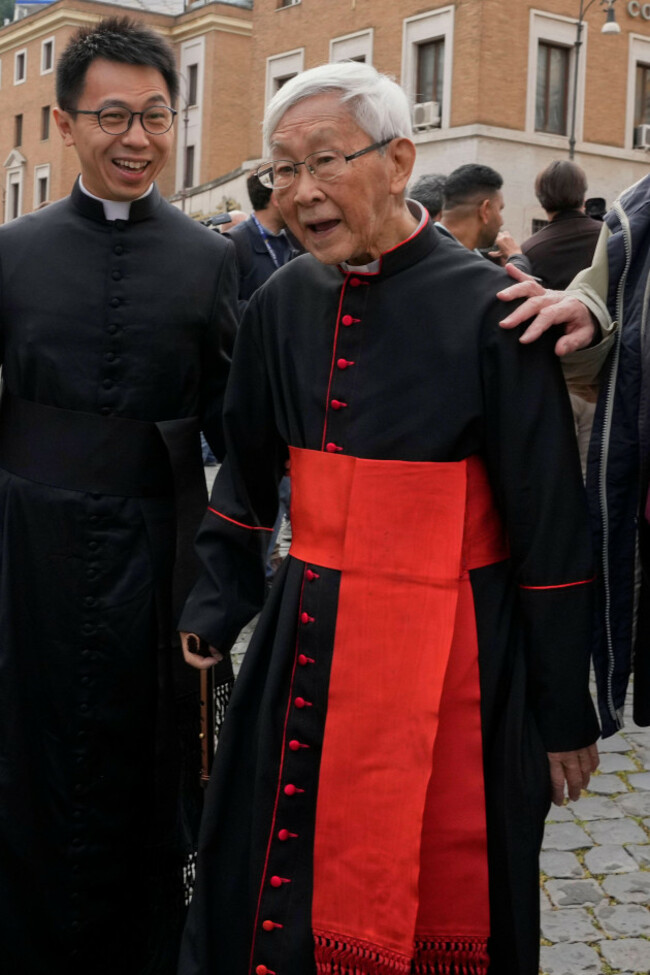
Cardinal Joseph Zen of Hong Kong previously described the agreement as an “incredible betrayal” and accused the Vatican of “selling out and abandoning the faithful of the underground church in China”.

In 2018, he said: “The consequences will be tragic and long lasting, not only for the Church in China but for the whole Church because it damages the credibility.

“Maybe that’s why they might keep the agreement secret.”

cardinal-zen-ze-kiun-arrives-for-a-college-of-cardinals-meeting-at-the-vatican-monday-april-28-2025-ap-photogregorio-borgia Cardinal Zen arrives for a college of cardinals' meeting at the Vatican on 28 April, 2025. Alamy Stock Photo Alamy Stock Photo

He added: “The Holy See encouraged them to persevere and for so many years Popes praised their courage. And now they are being told to surrender.”

At 93, he is too old to vote in the conclave, he has travelled to Rome for the pre-conclave Cardinal meetings.

His secretary told the Associated Press that he has to apply to get his passport back – he was arrested in 2022 in Hong Kong on suspicion of colluding with foreign forces to endanger China’s national security.

On Wednesday, Cardinal Zen is said to have spoken at a pre-conclave meeting for 15 minutes, exceeding the five minute limit placed on interventions.

Cardinal Pietro Parolin, the Vatican’s Secretary of State under Francis, was integral to signing the 2018 agreement.

He advocates for a similar accord with Vietnam.

Readers like you are keeping these stories free for everyone...
A mix of advertising and supporting contributions helps keep paywalls away from valuable information like this article. Over 5,000 readers like you have already stepped up and support us with a monthly payment or a once-off donation.

Close
19 Comments
This is YOUR comments community. Stay civil, stay constructive, stay on topic. Please familiarise yourself with our comments policy here before taking part.
Leave a Comment
    Submit a report
    Please help us understand how this comment violates our community guidelines.
    Thank you for the feedback
    Your feedback has been sent to our team for review.

    Leave a commentcancel

     
    JournalTv
    News in 60 seconds