We need your help now

Support from readers like you keeps The Journal open.

You are visiting us because we have something you value. Independent, unbiased news that tells the truth. Advertising revenue goes some way to support our mission, but this year it has not been enough.

If you've seen value in our reporting, please contribute what you can, so we can continue to produce accurate and meaningful journalism. For everyone who needs it.

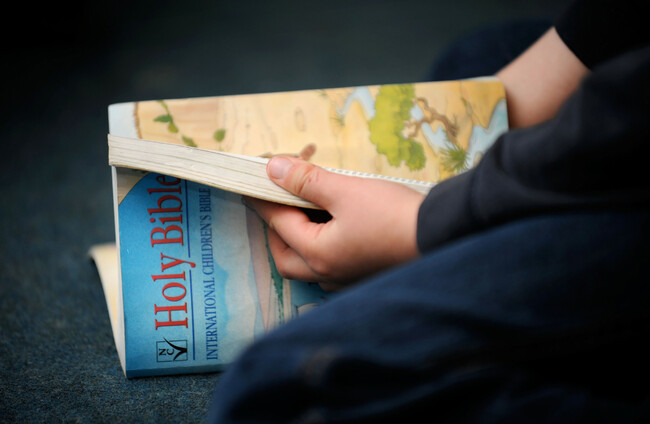
The Supreme Court said to teach pupils to 'accept a set of beliefs without critical analysis amounts to proselytising, and indoctrination'. Alamy Stock Photo

Christian religious education in schools in Northern Ireland unlawful, UK Supreme Court rules

It had been argued that the right to withdraw from religious education prevented any breach to religious freedom protections under the European Convention on Human Rights.

THE UK’S SUPREME Court has ruled that the Christian religious education taught in schools in the North is unlawful. 

The case surrounds a child known as ‘JR87’ who attended a controlled primary school in Belfast between the ages of four and seven.

A controlled school is one that is under the ‘control’ of the Education Authority in Northern Ireland.

In this school, the child participated in non-denominational Christian religious education and collective worship.

In a controlled school, the religious education should be non-denominational, meaning it is based upon the Holy Scriptures but not distinctive of any particular religious denomination.

This means there is a requirement that religious education and collective worship is not distinctive of Catholic or Protestant beliefs or forms of worship.

The child has been anonymised to protect their identity. 

Her parents did not wish their child to be taught that “Christianity was an absolute truth”.

In a ruling by the UK Supreme Court, it was noted that her parents were “at pains to point out that they are not against the teaching of religion”. 

“What the parents seek is education (including religious provision) that is appropriately objective, critical, and pluralistic, having regard to JR87’s age,” said the Court. 

In 2019, the parents wrote a letter to the school expressing concern and outlining that the child had “absorbed and adopted a religious (specifically Christian) worldview which was not consistent with their own views and beliefs”.

The parents are not Christian and say they are “broadly speaking” humanists.

The school replied that the child was able to be excused from both religious education and collective worship. 

The school also said its provision of religious education and collective worship was “Bible-based” and followed the core syllabus for education.

The child’s parents brought a successful appeal to Belfast’s High Court in 2022. 

While parents are allowed to withdraw their children from religious education and collective worship, the High Court deemed this was not sufficient as it placed an “undue burden on parents” and runs the risk of “stigmatisation of the child”.

However, the Department of Education went on to win an appeal against that judgement after arguing that the right of withdrawing from religious education and collective worship prevented any breach to religious freedom protections under the European Convention on Human Rights.

The Court of Appeal also “doubted that fears of stigmatisation or an undue burden on the parents would have been realised in practice”.

The Court of Appeal did however allow that the school’s religious education and collective worship “were not conveyed in an objective, critical, and pluralistic manner”.

The child’s parents then went on to appeal to the Supreme Court, the highest court in the UK, challenging the Court of Appeal’s findings. 

The Supreme Court unanimously dismissed this cross appeal and found that there could be an “undue burden on parents” and “risk of stigmatisation” in withdrawing children from religious education. 

The Supreme Court added that there is “no commitment in the core syllabus to objectivity or to the development of critical thought” and that to teach pupils to “accept a set of beliefs without critical analysis amounts to evangelism, proselytising, and indoctrination”.

The Supreme Court meanwhile noted that denominational religious education and collective worship is not prohibited in Catholic maintained schools.

Phoenix Law acted on behalf of the child and her parents and welcomed the UK Supreme Court’s finding. 

Darragh Mackin, Solicitor for the child and her parents, described the decision as a “watershed moment for educational rights in this jurisdiction”.

“The Supreme Court has confirmed that all children are entitled to an education that respects their freedom of thought, conscience, and religion,” he added.

He also noted that the judgment “makes clear that the State cannot rely on withdrawal mechanisms to justify religious instruction”.  

“Schools must not place children in the impossible position of being singled out or stigmatised simply because their families do not share the religious worldview embedded in the curriculum,” said Mackin.

Readers like you are keeping these stories free for everyone...
A mix of advertising and supporting contributions helps keep paywalls away from valuable information like this article. Over 5,000 readers like you have already stepped up and support us with a monthly payment or a once-off donation.

Close
JournalTv
News in 60 seconds