We need your help now

Support from readers like you keeps The Journal open.

You are visiting us because we have something you value. Independent, unbiased news that tells the truth. Advertising revenue goes some way to support our mission, but this year it has not been enough.

If you've seen value in our reporting, please contribute what you can, so we can continue to produce accurate and meaningful journalism. For everyone who needs it.

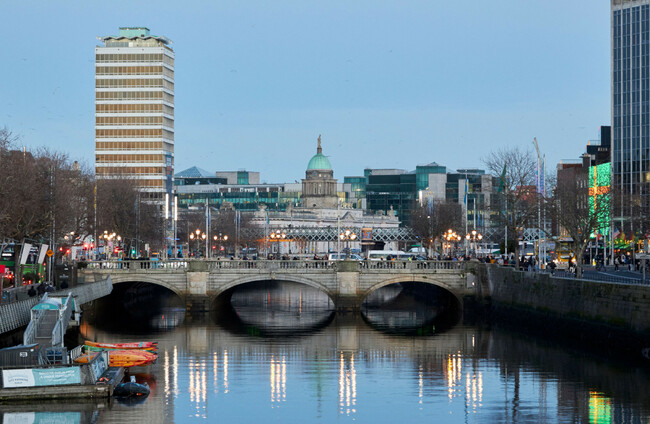
It's been warned 'dark money' through Dublin should be considered a 'national security threat'. Alamy Stock Photo

Corruption watchdog warns ‘dark money’ poses growing risks to Irish national security

Ireland has maintained a strong standing in the Corruption Perceptions Index but ‘illicit financial flows pose threats’.

LAST UPDATE | 2 hrs ago

IRELAND HAS MAINTAINED a strong standing in the latest Corruption Perceptions Index, but it’s been warned that “dark money” through Dublin should be considered a “national security threat”.

Transparency International’s Corruption Perceptions Index (CPI) ranks countries by their perceived levels of public sector corruption, as assessed by experts and business executives.

Its 2025 report was published today and Transparency International Ireland (TI Ireland) has called on the Government to strengthen transparency and oversight across political finance, corporate and financial services regulation.

Ireland scored 76 out of 100 in this year’s index, maintaining a comparatively strong international reputation for controlling public-sector corruption.

The CPI ranks countries according to perceived levels of corruption using a scale from 0 (highly corrupt) to 100 (very clean).

But despite Ireland’s continued strong performance, TI Ireland said that the “State remains exposed to emerging corruption risks that receive less public attention but may have significant long-term consequences”.

TI Ireland warned that Ireland’s role as a major international financial centre, combined with gaps in transparency around corporate ownership and lobbying finance, increases the risk that illicit funds or undisclosed political influence could pass through the State.

 “Ireland’s globally significant financial services sector make it attractive for legitimate investment, but also create opportunities for organised crime and hostile state actors where transparency and oversight are weak,” TI Ireland’s Head of Policy and Research, Dr Alexander Chance said.

Meanwhile, John Devitt, Chief Executive of TI Ireland, said that the “absence of daily headlines about corruption does not mean the risks have disappeared”.

He added: “Corruption and illicit financial flows through Dublin pose threats to social cohesion, as well as economic integrity and democratic resilience.

“This has always been the case but is especially so given recent political developments on both sides of the Atlantic and corresponding rise of anti-democratic forces across Europe.

“It’s important that this be considered a threat to national security and be addressed in any future national security strategy.”

TI Ireland called on Government to strengthen enforcement of political finance rules and to increase transparency around lobbying funding sources.

US slide

Elsewhere, the United States had slid to the lowest-ever score on the CPI.

The average global score also hit its worst level in more than a decade.

US President Donald Trump has upended domestic and foreign politics while ramping up pressure on institutions ranging from universities to the Federal Reserve.

TI raised concerns over “actions targeting independent voices and undermining judicial independence” in the US.

The Trump administration’s gutting of overseas aid has also “weakened global anti-corruption efforts”, it said.

The US has dropped to a score of 64, with the report noting that its “political climate has been deteriorating for more than a decade”.

The global average score was 42, its lowest level in more than 10 years.

“The vast majority of countries are failing to keep corruption under control,” the report said, with 122 countries out of 180 posting scores under 50.

‘Strain’

The US case illustrates a trend in democracies experiencing a “decline in performance” in battling corruption, according to the report, a phenomenon it also said was apparent in the UK and France.

While such countries are still near the top of the index, “corruption risks have increased” due to weakening independent checks, gaps in legislation and inadequate enforcement.

“Several have also experienced strains to their democracies, including political polarisation and the growing influence of private money on decision-making,” the report noted.

The worst-performing countries in the European Union were Bulgaria and Hungary, both scoring just 40.

The report said the government of Hungary’s nationalist leader Viktor Orban, in power since 2010 and facing a tough battle for re-election in April, “has systematically weakened the rule of law, civic space and electoral integrity for over 10 years”.

“This has enabled impunity for channelling billions – including from European Union funds – to groups of cronies through dirty public contracting and other methods,” the report said.

The watchdog noted that the government of Prime Minister Robert Fico in neighbouring Slovakia, with a score of 48, is “weakening investigations of corruption and organised crime, especially those involving senior officials”.

The highest-ranked nation in the index for the eighth year running was Denmark with a score of 89.

Among the more positive stories of progress in the report was Ukraine, which scored 36.

The government of President Volodymyr Zelenskyy has faced widespread public anger over graft allegations against those close to him, even as the country is hammered by Russian attacks.

However, TI noted that “the fact that these and many other scandals are being uncovered … shows that Ukraine’s new anti-corruption architecture is making a difference”.

It hailed the “civil society mobilisation” last year, which prompted Zelenskyy to backtrack in an attempt to curb the independence of anti-graft bodies.

-With additional reporting from © AFP 2026 

Readers like you are keeping these stories free for everyone...
A mix of advertising and supporting contributions helps keep paywalls away from valuable information like this article. Over 5,000 readers like you have already stepped up and support us with a monthly payment or a once-off donation.

Close
95 Comments
This is YOUR comments community. Stay civil, stay constructive, stay on topic. Please familiarise yourself with our comments policy here before taking part.
Leave a Comment
    Submit a report
    Please help us understand how this comment violates our community guidelines.
    Thank you for the feedback
    Your feedback has been sent to our team for review.

    Leave a commentcancel

     
    JournalTv
    News in 60 seconds