We need your help now

Support from readers like you keeps The Journal open.

You are visiting us because we have something you value. Independent, unbiased news that tells the truth. Advertising revenue goes some way to support our mission, but this year it has not been enough.

If you've seen value in our reporting, please contribute what you can, so we can continue to produce accurate and meaningful journalism. For everyone who needs it.

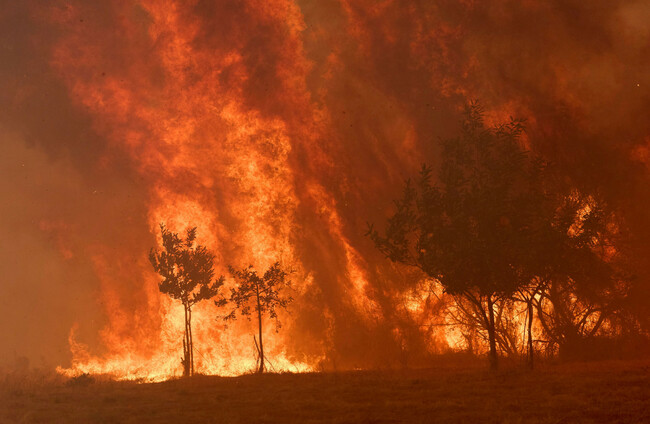
Wildfire burns out of control in forest near Rebordondo village in northwestern Spain on 18 Aug., 2025. Alamy Stock Photo

Deadly wildfires in Spain and Portugal made 40 times more likely by climate change

In Spain, more than 380,000 hectares have burned this year, while Portugal lost more than 280,000 hectares.

HUMAN-CAUSED CLIMATE CHANGE made the hot, dry and windy conditions that fuelled deadly wildfires in Spain and Portugal last month 40 times more likely, researchers have said.

The Iberian Peninsula saw unusually high temperatures throughout August, with thermometers topping 40C in many areas.

The persistent heat fanned wildfires – mainly in northern Portugal and western and northwestern Spain – that killed four people in each country, forced the evacuation of thousands, and ravaged vast areas of land.

In Spain, more than 380,000 hectares have burned this year – a record annual total and nearly five times the annual average, according to the European Forest Fire Information System.

Portugal has lost more than 280,000 hectares, almost three times the area usually burnt in a year.

Climate change, caused primarily by the burning of fossil fuels, made the fire-prone weather about 40 times more likely and 30 percent more intense, European researchers said in a report published by World Weather Attribution.

“Without human-caused warming, similarly severe fire weather conditions would have been expected less than once every 500 years, rather than once every 15 years as they are today,” said Theo Keeping, a researcher at Imperial College London.

These hot periods rapidly dry vegetation and can trigger intense blazes that “can generate their own wind, leading to longer flame lengths, explosive outbreaks and the ignition of dozens of fires nearby from flying embers”, he added.

Spain endured a 16-day heatwave in August that was “the most intense on record”, with average temperatures 4.6C above previous events, according to national weather agency AEMET.

More than 1,100 deaths in Spain have been linked to the August heatwave, according to an estimate released by the Carlos III Health Institute.

Since it began keeping records in 1975, AEMET has registered 77 heatwaves in Spain, with six going 4C or more above the average. Five of those have been since 2019.

Rural depopulation has worsened the impact of climate change by leaving large areas of land less managed, said Maja Vahlberg, an adviser at the Red Cross Red Crescent Climate Centre.

“Traditional farming and grazing declines, reducing natural vegetation control. Land that was once lived in and worked has thus become more flammable,” she added.

© AFP 2025 

Author
View 36 comments
Close
36 Comments
This is YOUR comments community. Stay civil, stay constructive, stay on topic. Please familiarise yourself with our comments policy here before taking part.
Leave a Comment
    Submit a report
    Please help us understand how this comment violates our community guidelines.
    Thank you for the feedback
    Your feedback has been sent to our team for review.

    Leave a commentcancel

     
    JournalTv
    News in 60 seconds