We need your help now

Support from readers like you keeps The Journal open.

You are visiting us because we have something you value. Independent, unbiased news that tells the truth. Advertising revenue goes some way to support our mission, but this year it has not been enough.

If you've seen value in our reporting, please contribute what you can, so we can continue to produce accurate and meaningful journalism. For everyone who needs it.

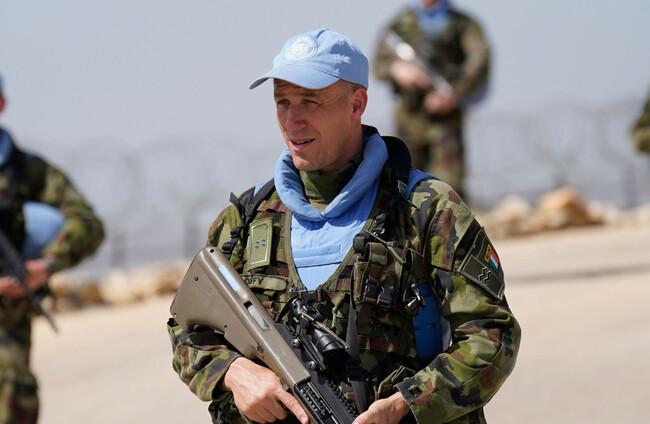
Irish peacekeepers on patrol near the border between Lebanon and Israel.

Defence committee weighs in on plan to scrap the 'Triple Lock' for Irish troop deployments

The removal of the need for a UN mandate has been a fraught political issue.

THE OIREACHTAS COMMITTEE on defence and national security has published a long list of recommendations for the bill that will overhaul the ‘Triple Lock” system that governs the deployment of Irish troops abroad. 

The committee has not opposed the passing of the bill, which would see the requirement for UN approval for overseas deployment removed from existing law, but it has recommended giving more oversight powers to the Oireachtas. 

As it stands, a contingent of more than 12 soldiers cannot be despatched to another country without the approval of the government, the Dáil and the UN, although there are exceptions for some non-combat duties. 

The removal of the need for a UN mandate has been a fraught political issue, with those in favour saying it curtails Ireland’s ability to participate in overseas missions that do not get the green light from the UN Security Council.

Those opposed to its removal have raised concerns that sending troops abroad outside of UN peacekeeping missions would compromise Ireland’s military neutrality. 

Many of the recommendations the Oireachtas committee published today aim to ensure that troop deployments are carried out with close adherence to UN practices and in accordance with international law. 

For example, the committee has recommended that the proposed legislation specify that Irish forces cannot be deployed as part of a mission led by someone who is under investigation from the International Criminal Court (ICC), and that troops should not be involved with missions in which cluster munitions and landmines might be used.

Ireland is a signatory to conventions banning the use of cluster bombs and land mines but they are still used by some countries, like the United States and Russia. 

Another recommendation from the committee, the first of 27, is that Ireland “explore the opportunity for the Defence Forces to provide protection and support to the International Criminal Court, the International Court of Justice and other multilateral organisations”.

The ICC in particular has been targeted by Israel and its allies since it issued arrest warrants for Prime Minister Benjamin Netanyahu and his former defence minister for their conduct during the assault on Gaza in Palestine. The United States has sanctioned the court’s lead prosecutor and some of its judges.

Other recommendations made by the committee focus on practical matters related to troop deployment and oversight. 

It has recommended that, “at minimum”, there be a legal review of any proposed deployment carried out by an independent body and that a report should be made available to all Oireachtas members and the public.

It also recommended that the government should be required to renew a mandate for an overseas mission “at regular intervals” with a majority vote in the Dáil, and that the government seek approval from the Dáil for a mission that goes beyond 12 months. 

The new legislation should also allow for an urgent review of a despatch or deployment on request of a Dáil or Seanad resolution or by request of the defence committee, it recommended. 

The chair of the committee, Rose Conway-Walsh, said that the limited amount of time posed a challenge.

“The committee spent the last eight weeks scrutinising this bill but one of the regrets that I have as chair is that we were not afforded more time to scrutinise it further,” she said. 

“Opposition members expressed continuous concern about the shortness of time allocated for such important legislation, considering the huge public interest and concern regarding the government’s attempts to remove the ‘Triple Lock’.

“Working within those constraints, the committee endeavoured to give all the bill’s implications due consideration and to engage with as broad a range of relevant stakeholders as time would allow.”

Conway-Walsh also stressed that the committee did not recommend removing the “Triple Lock”. 

Readers like you are keeping these stories free for everyone...
A mix of advertising and supporting contributions helps keep paywalls away from valuable information like this article. Over 5,000 readers like you have already stepped up and support us with a monthly payment or a once-off donation.

Close
24 Comments
This is YOUR comments community. Stay civil, stay constructive, stay on topic. Please familiarise yourself with our comments policy here before taking part.
Leave a Comment
    Submit a report
    Please help us understand how this comment violates our community guidelines.
    Thank you for the feedback
    Your feedback has been sent to our team for review.

    Leave a commentcancel

     
    JournalTv
    News in 60 seconds