We need your help now

Support from readers like you keeps The Journal open.

You are visiting us because we have something you value. Independent, unbiased news that tells the truth. Advertising revenue goes some way to support our mission, but this year it has not been enough.

If you've seen value in our reporting, please contribute what you can, so we can continue to produce accurate and meaningful journalism. For everyone who needs it.

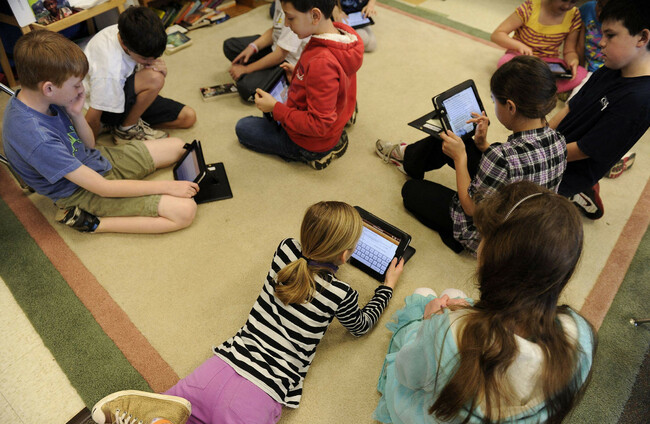
Some countries have taken action when it comes to laptops and iPads being used in everyday education. Alamy Stock Photo

Textbooks v screens: Parents are now questioning the use of classroom tech

In a number of countries there is a movement away from using laptops and digital devices for schoolwork. Could Ireland follow suit?

‘TEXTBOOKS AND PENCILS are back’: That was a line in The New York Times article this week which detailed a “tech backlash” in one US school over the use of digital devices in everyday learning. 

The newspaper article reported how one middle school asked all 480 students to return the Chromebooks they had been using.

Now the computers are stored away in carts in the classrooms and the children are taking notes mostly by hand, with the laptops brought out sparingly.

Other countries have also taken action when it comes to laptops and iPads being used in everyday education.

Norway announced one of the biggest overhauls in primary education this year, restricting the use of screens in education for young students due to declining results in reading and numeracy.

Denmark has also announced it is rolling back “digital learning”, while Sweden took steps a lot earlier than others, changing its education policy some years ago to make printed textbooks mandatory once again. 

So, is this a trend Ireland is also experiencing? 

Anecdotally, yes, with politicians telling The Journal that the issue has been raised with them. 

In the last year, there has been a public debate around smartphone use by children, but this movement is more focused on digital devices for education. 

Sinn Féin’s education spokesperson Darren O’Rourke said it is a matter that has been raised with him by parents in his constituency. 

“We’re seeing evidence from across Europe that this rush towards digital-first learning is being rolled back because of clear educational downsides,” he explained.

“These countries have found that over-reliance on screens harms concentration, reduces handwriting and basic literacy skills, and may not deliver better learning outcomes. If they are moving back to books and copybooks, we should ask why.” 

Review the impacts of digital learning

O’Rourke said there is a need for Education Minister Hildegarde Naughton to press pause on current plans and commission an independent review of the impact of digital learning on literacy, retention and equity before issuing clear guidance to schools.

“We cannot leave individual schools or parents to fight this out on their own. This requires deep consideration, not a race to digitise for its own sake,” he added. 

Social Democrats TD Jen Cummins, who is the party’s education spokesperson, said a few parents have contacted her about the issue.

She said some parents have older and younger children and see the difference in learning styles their children have received in school and have questions about the various approaches. 

Cummins, who has a doctorate in education from DCU, said in her view there is a need for a variety of learning tools, not just computers, to cater to different learning styles.

“I have four kids, so my older kids didn’t have laptops. My youngest one does. He’s 14, and so in that group of parents those conversations are happening,” said Cummins, who believes some parents are of the view they should be taken out of the classroom.

She questioned whether there would one day be a realisation that there might be an over-reliance on “one type of tool and then they’re going to roll back on that”.

“It should be used like every other tool that we have in the classroom. So whether it’s books, whether it’s instruments, whether it’s computers or whatever else, there needs to be a variety, because not everybody learns the same way,” she said.

“That is the crux of it, we have lots of different types of learners, but our system is really only designed for one type of learner.”  

She said for children with disabilities, having a laptop or an iPad is fantastic, with Cummins also stating that interactive boards in the classroom have been a “game changer”.  

Cummins, who is a member of the Oireachtas Education Committee, highlighted how committee members had recently travelled to Finland to learn more about the education system there. 

More hands-on learning needed

Multiple tools were being used in Finnish classrooms, from computer programmes to laptops, books and even Lego Technic.

“That is what we need, more hands on stuff as well. If we were able to broaden our education system to use lots more tools, rather than only books, rather than only computers,” she said. 

“I think we need to be flexible. I don’t think we need to be ‘oh, we have to get rid of all the computers’, or ‘we can only have computers’, there needs to be flexibility.”

Aside from the serious concerns about the impact digital devices are having on learning outcomes, O’Rourke said he is worried about the unplanned, costly and potentially regressive shift towards digital devices in schools. 

The financial burden on families is immense, he said. 

“Expecting parents to buy laptops or tablets, often costing hundreds of euro, for their children to participate in everyday learning is deeply unfair. It risks creating a two-tier system where children from lower-income families are left behind,” he added. 

Responding to queries from The Journal, the education minister said: 

“Our approach has always centred on an evidence-based use of technology that genuinely supports student learning. We have taken a proactive step in commissioning the OECD’s analysis, so our policies are grounded in international evidence,” she said. 

The literature review she refers to, was carried out by the Knowledge Centre for Education based in the University of Stavanger in Norway and overseen by the OECD. 

Published in September 2025, the papers set out the impact of various digital technology tools on education, as strategies to support effective integration.

The findings reported that moderate, purposeful use of digital tools can boost student learning and that digitalisation is most effective when aligned with clear educational aims, careful planning and teacher competence.

The minister has also said that it is Boards of Management that have responsibility for the day-to-day management of schools, including decisions regarding the use and deployment of digital technology in the classroom.

“Schools are advised to consult with members of the school community including parents when planning for the introduction of digital technologies including devices with cost and other implications being fully considered by the Boards of Management before a decision is made,” said Naughton. 

“It is the responsibility of each individual school to select the digital resources, if any, that it will use to support its implementation of the curriculum,” added the minister, who stated that the government’s Digital Strategy for Schools to 2027 does not mandate or prescribe the use of any particular devices or technologies in teaching and learning. 

Naughton said the overall strategy is about the deeper embedding of digital technologies in education, so as to develop digital literacy and competency, critical thinking, and enhance collaborative learning.

“It is not merely about replacing physical textbooks and resources with digital versions accessed via a digital device,” stated the minister.  

Readers like you are keeping these stories free for everyone...
A mix of advertising and supporting contributions helps keep paywalls away from valuable information like this article. Over 5,000 readers like you have already stepped up and support us with a monthly payment or a once-off donation.

Close
28 Comments
This is YOUR comments community. Stay civil, stay constructive, stay on topic. Please familiarise yourself with our comments policy here before taking part.
Leave a Comment
    Submit a report
    Please help us understand how this comment violates our community guidelines.
    Thank you for the feedback
    Your feedback has been sent to our team for review.

    Leave a commentcancel

     
    JournalTv
    News in 60 seconds