Sign in. It’s quick, free and it’s up to you.
An account is an optional way to support the work we do. Find out more.
Sign in. It’s quick, free and it’s up to you.
An account is an optional way to support the work we do. Find out more.
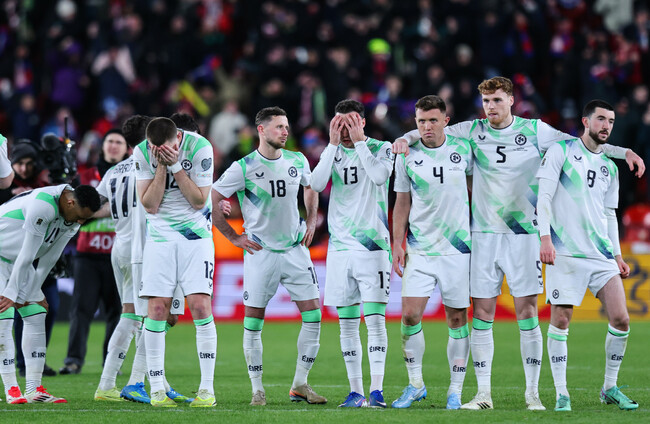

WHY DO SOME nations have far superior records at penalty shootouts than others?
Ireland, for instance, tend to be poor at spot kicks, albeit from a small sample size.
In four shootouts, the Republic have triumphed once in arguably the most famous game in their history – the defeat of Romania to reach the quarter-finals of Italia ’90.
Since then, the Boys in Green have lost three fixtures of similar importance — the 2002 World Cup round-of-16 clash with Spain, the Euro 2020 playoff qualification semi-final against Slovakia and the World Cup 2026 playoff qualification clash versus Czechia.
Neighbours England have a similarly awful record, though it has improved of late.
Pre-Gareth Southgate, the Three Lions lost six of seven shootouts. But since the former Aston Villa player took over, they have won three of four.
By contrast, certain countries nearly always seem to prevail when a game goes to penalties.
The German team have lost one of seven, and that was all the way back at the 1976 Euros in the final against Czechoslovakia, as Antonín Panenka etched his name into football history with an audacious winning spot kick.
Croatia are similarly strong, prevailing in all four of their World Cup penalty shootouts, although they have lost twice in the Nations League since their last victory against Brazil at Qatar 2022.
Sometimes written off as a ‘lottery,’ being proficient at penalties is invariably crucial – there were five shootouts at the last World Cup, with champions Argentina prevailing twice by this method.
Spain, on the other hand, have had a particularly torrid time. It is 10 years since they exited a major tournament via a non-shootout scenario – Italy beat them 2-0 in the round of 16 at Euro 2016. They have since lost on penalties at Euro 2020 and the last two World Cups.
There is, of course, a degree of luck involved, but skill and science play a part too.
Penalties are one of the areas of interest for Dr Paul McCarthy, a Cork-born, Glasgow-based sport and performance psychologist with over 25 years of experience who has worked with athletes, coaches, parents and teams across the globe.
The considerable research on the topic contains some fascinating insights.
One of the less surprising results is that players have a higher success rate with regular one-off penalties (85%) compared to in shootouts (76%). There is a similar disparity depending on the context. For instance, players are much more likely to score in a regular Premier League game than in a higher-pressure situation such as a knockout match.
Footballers also become statistically less likely to score as a penalty shootout develops, seemingly due to increased pressure – although that factor may also be influenced by how teams often select their most reliable penalty taker to step up first.
“The best way I’d like to describe it is that they’ve got a backpack on with a weight in it, but when they come back, there’s another weight put on the second player going down, when they come back, there’s another weight put on for the third, fourth, fifth, and so on,” McCarthy tells The 42.
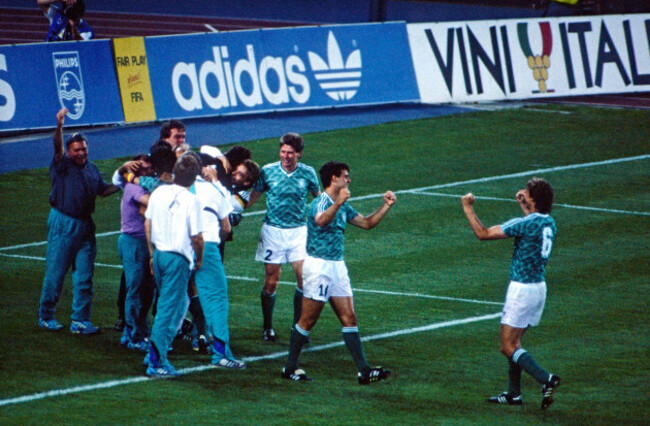
In the modern game, there is a greater level of sophistication to when Ireland beat Romania 36 years ago.
Goalkeepers study and memorise penalty takers’ habits in the lead up to matches – sometimes they can be seen consulting notes ahead of the shootout.
Often, it is a matter of guesswork, but sometimes the most beneficial actions are neglected.
“To give you an example of that, most goalkeepers will dive,” says McCarthy. “The reason they dive is known as an action bias. So there’s a fear of doing nothing, and they would rather be seen to do something.
“And so we have some research that shows, let’s say, goalkeepers will dive on about 93% of all penalties, and there was an analysis done of penalties taken, and of the 286 penalties that were taken, the goalkeepers would have saved a third of them if they just stayed in the centre.
“And one of the things they know about talking to goalkeepers afterwards is that they would feel worse standing still in the centre, even though statistically we know there would have been a better chance of them saving the ball standing still in the middle.”
Mind games can be important too. Goalkeepers often try to distract or unsettle the penalty taker by waving their arms or standing off the centre, making the kicker likely to aim for the wider space.
Other distractions, like the crowd or the timing of the referee’s whistle, can affect the taker.
“We become self-focused, so that means we become overly concerned with what we are thinking and feeling,” McCarthy explains.
“They might have their own rituals of what exactly they do, breathing rhythms, and so on, but one of the issues really is that the timing following the whistle being blown has quite a detailed effect. So players who take more than a second after placing the ball convert about 80% of penalties, whereas those who are rushing score only about 60%.
“So, taking our time is crucial. Although we may have decided beforehand, we also want to be able to maintain our regulation to say, I hear the whistle, I’ll breathe, and then I’ll strike.”
There are also certain cues goalkeepers can pick up, such as the kicker’s hip position, thereby increasing their chances of success.
“A lot of goalkeepers are looking at the behaviour of the player, but they’re also able to look at foot position, so our planted foot. If you were to draw a line between heel and toe and continue it outward, it would tell you where the ball is likely to end up about 80% of the time.
“So we make these adjustments that the expert goalkeepers are waiting and waiting and waiting before they dive, whereas people who are less expert are going to go a couple of 100 milliseconds beforehand. So, with the goalkeepers, they’re looking for advanced cues, so the players are trying to make sure that they disguise that, but that’s very difficult to do.”
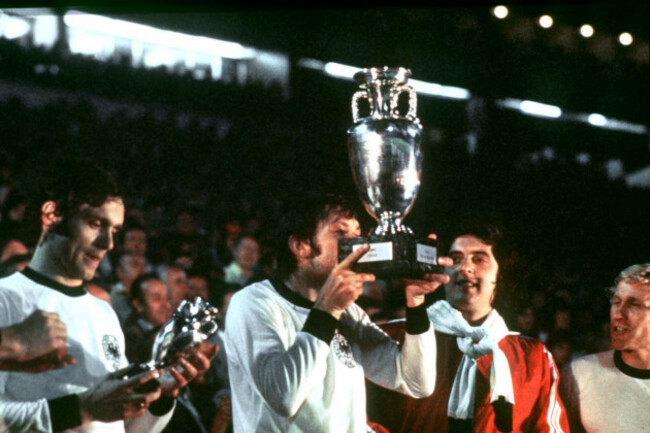
Specific other factors favour some teams over others. In an analysis of roughly 1,300 penalties from 129 shootouts, the team that went first prevailed 60% of the time.
McCarthy believes that only in the last 10 years have people begun to pay serious attention to the science behind penalty shootouts, and the next decade is expected to see a substantial improvement in the data and knowledge in this area.
Geir Jordet, a Norwegian professor of psychology, is one of the most influential voices on the topic.
In 2024, he released the acclaimed ‘Pressure: Lessons from the psychology of the penalty shoot-out.’
Among those to praise it was Edwin van der Sar. “If I had known half of what’s in this book, my trophy cabinet would be bigger,” the former Man United and Netherlands goalkeeper said.
McCarthy cites Jordet as an important figure, adding: “One of the things we certainly do know is about the spread of emotions through teams, it’s called emotional contagion, and we see it a lot with successful penalties, where the team, the teammates, their reaction shape the psychological landscape for the other takers. And I know there was a study done where they were looking at the World Cup and Euros, and the players who were celebrating more, engaging more in celebratory behaviours, were more likely to wind up on the winning team.
“So they would raise their arms, and the likelihood was that the next opponent was, for example, two or three times more likely to miss it. There were big effects on how they demonstrated the success of their penalty and how they returned to their team.
“I know they showed as well that when the scores were tied, that 80% of the players celebrated substantially, and they ended up winning. So there is this ripple effect as well.
“People aren’t necessarily practising or encouraging that. It tends to be less choreographed, I would say.”
There are also certain other unhelpful habits, which explain why some countries have such a torrid time in shootouts.
“I know from the research they were showing that England’s shootout win record is really, really low, but one of the reasons is that they tend to shoot faster than the other nations, and not only do they know culturally that ‘we are bad at penalties,’ as they would say, it becomes its own self-fulfilling prophecy.
“If you look at something called stereotype threat, it means that if we have a stereotype that we attach ourselves to, we’re more likely to feel under the pressure of that stereotype threat, and you get a lot of cultural narratives at the World Cup about national character and penalty taking that people would assume might affect performance outcomes. I know that Spain improved from a 33% win record after addressing their rotten tendency: ‘The whistle has blown, I need to hit the ball now.’
“So there might be a cultural orientation of ‘get this done quickly,’ and the reason why we try to get things over with is that it’s like it’s an escape plan for us. We’re feeling these very intense emotions, and we don’t want to feel them, so we want to get out of the situation that’s causing them. But any conscious interventions to address those things do seem to work as well.”
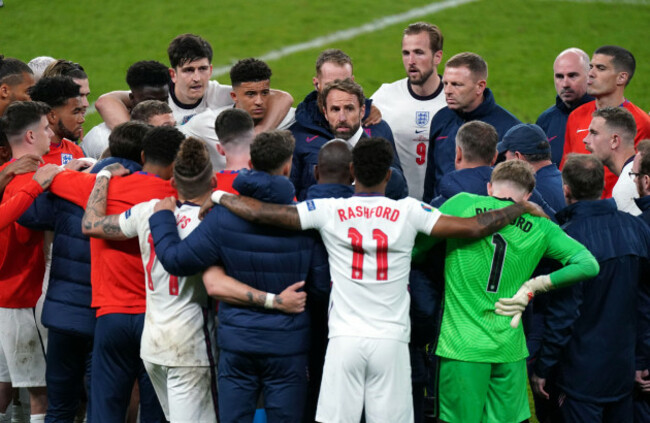
Southgate’s England are one example of a team whose record improved after they sought to address their issues.
A TV series that premiered on BBC One last month, ‘Dear England,’ dramatises the Three Lions’ trajectory between 2016 and 2024.
It stars Joseph Fiennes as Southgate and Jodie Whittaker as Pippa Grange, a British applied psychologist, who was Head of People and Team Development at The Football Association.
The series highlights how the manager can be a crucial figure in tackling harmful cultural narratives hampering a national team.
“They were putting a lot of time into the group, connections within the group, orientation, selflessness, looking at history, loads and loads of stuff that was trying to look at the past, learn from it, not dismiss it necessarily, but recognise that where they are in history and what they’re trying to do was much more about the here and now
“Gareth highlighted that in lots of ways, both in the ways he spoke about the team and the squad, the way he talked about the nation, his reflections on his own career, acknowledging his own 1996 miss [against Germany in semi-finals of the Euros], all the things that would have been typically avoided, dismissed or not detailed.
“But there was greater openness, vulnerability, sharing, and now, it’s hard to pull these pieces apart. We look at the outcome, and we look at these possibilities, and we join them. We say: ‘Well, of course, they were playing in the pool with the unicorns, and so that relaxed team atmosphere meant they were more likely to be successful.’ In part, that is true that we would say they are psychologically safe. So psychological safety really means that they have a way of sharing among the group, sharing their opinion and not feeling threatened, dismissed, or would receive sanctions for how they are contributing.
“So there is a collective psychological safety in there, and the manager really sets the tone for all of these things. From my time working in soccer, in particular, with different clubs, the manager has quite a dramatic effect on the behaviour of everyone around them.
“So, if they are more encompassing, engaging, warm, I know there’s research that shows if they are humble, that there is a greater collective effort to work on their behalf, to say that ‘we’re in this together,’ and the humility of the manager is establishing that collective unity and effort.”
Teams usually have a list of pre-arranged penalty takers for shootouts. However, McCarthy suggests there should be scope within that framework for individuals to opt out if they suffer a crisis of confidence or do not feel up to taking the kick when the moment comes.
If a player is experiencing a bad spell of form, they are less likely to score. Conversely, certain footballers always seem to succeed.
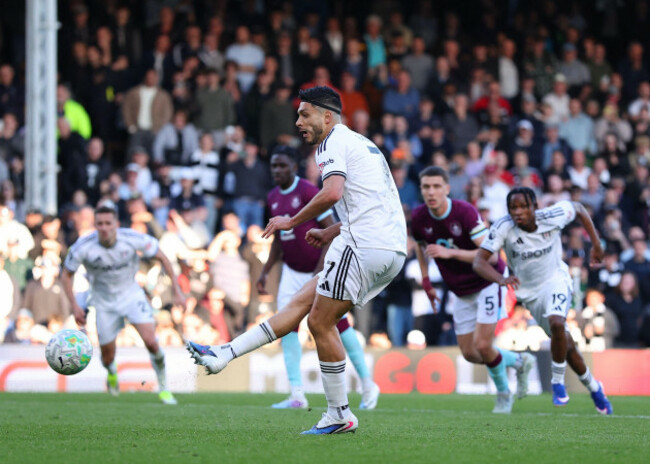
Mexico and Wolves forward Raúl Jiménez was recently described as the “Premier League’s best-ever penalty taker,” after converting his 14th spot kick from 14 attempts.
Ex-Ireland and Man United player Denis Irwin was similarly reliable.
“If you think about it as a self-fulfilling prophecy, the Denis Irwin thing, he was good at penalties, he did [score]. Was he feeling confident because he had scored more than usual? Yes, increasing the likelihood that he would be composed, confident, and approach the penalty as if he were going to score it.”
Ireland could have done with Irwin last March, when penalties cost them for a second time in their last four attempts at qualifying for a major tournament.
Before the game in Prague, boss Heimir Hallgrímsson suggested the Boys in Green would not be practising penalties ahead of time.
“I am not so sure that training penalties would be such an asset, especially when you look at the short time we have. Other things are more important,” he told reporters.
It is easy to be critical with the benefit of hindsight, but does McCarthy consider this policy unwise, even in the restrictive circumstances in which the national team were operating?
“The load on a national coach is enormous, and the greatest support they need is in the backroom staff, anybody who was given that role. So a psychologist or an analyst would be able to deal with or address that as a priority, and that would take off the mental load and the numerous obligations that he has as a national coach. Whereas that would be bread and butter to a psychologist, understanding a little bit more about that, and providing resources and helping the players to be prepared.
“Shootouts are always a likelihood in these kinds of competitions. Not preparing for them is like saying, I’ll go out, and I’ll drive my car, I have a spare wheel, but I’ll leave it in the garage.
“The sensible thing is, bring your spare wheel, so that does happen, and it’s unfortunate, but I appreciate the load that the manager is always under.”
The Football Association of Ireland’s scant resources mean there is no in-house team psychologist to help guide the side in pressurised circumstances – an issue Hallgrímsson has lamented and which perhaps partially explains their failure against Czechia.
“Psychologists would do several jobs, if you know what I mean, that are more about the collective culture, reducing the strain that players feel, having a better understanding of themselves and others, things that would probably make the head coach’s life much easier,” McCarthy concludes.
You can find out more about Dr Paul McCarthy via his official website here.
Written by Paul Fennessy and originally published on The 42 whose award-winning team produces original content that you won’t find anywhere else: on GAA, League of Ireland, women’s sport and boxing, as well as our game-changing rugby coverage, all with an Irish eye. Subscribe here.

To embed this post, copy the code below on your site




have your say