We need your help now

Support from readers like you keeps The Journal open.

You are visiting us because we have something you value. Independent, unbiased news that tells the truth. Advertising revenue goes some way to support our mission, but this year it has not been enough.

If you've seen value in our reporting, please contribute what you can, so we can continue to produce accurate and meaningful journalism. For everyone who needs it.

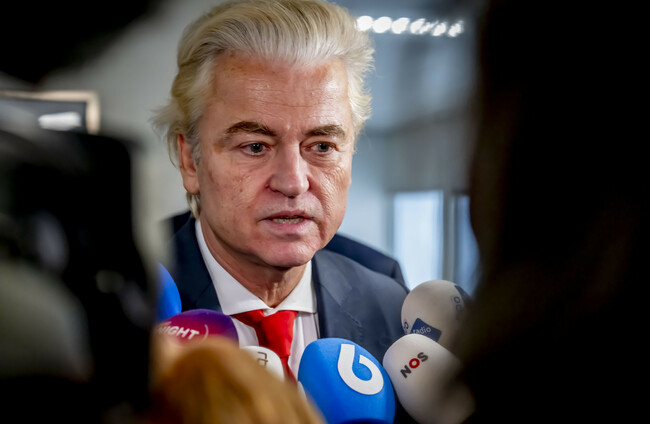
PVV party leader Geert Wilders during a faction meeting after the Dutch parliamentary elections. Alamy Stock Photo

Geert Wilders’s far-right populists and centrist party set for unprecedented tie in Dutch election

The centrist D66 party, led by Rob Jetten, defied expectations and won the same number of seats as the Party For Freedom, led by Geert Wilders.

ANTI-ISLAM LAWMAKER Geert Wilders’s far-right Party For Freedom and the centrist D66 were tied with nearly all votes counted today in the Dutch general election in an unprecedented neck-and-neck race to become the biggest party.

The near-total count tallied and published by Dutch national news agency ANP and cited by Dutch media showed each party winning 26 seats in yesterday’s election.

The nail-biting finish is expected to lead to delays in starting the process of forming a new coalition. No Dutch election has previously ended with two parties tied for the lead.

When D66 reached its previous record of 24 seats in 2021, the leader at the time, Sigrid Kaag, danced for joy on a table at a party meeting.

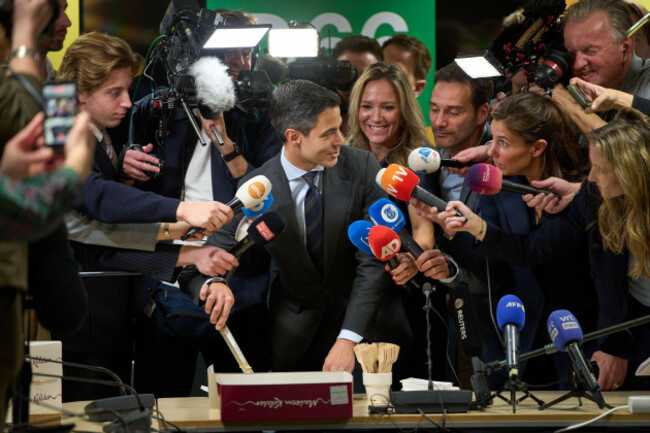
This time, current D66 leader, Rob Jetten, cut cake for the party faithful gathered at Parliament.

rob-jettenleader-of-the-democrats-66-d66-cuts-a-pie-in-celebration-one-day-after-the-general-election-at-the-house-of-representatives-in-the-hague-thursday-oct-30-2025-ap-photopeter-dejong Rob Jetten cuts a pie in celebration of D66’s election results Alamy Stock Photo Alamy Stock Photo

“This is the best result for D66 ever,” the 38-year-old told a crowd of party insiders and media this morning after he had been welcomed with chants of the party’s optimistic election slogan “Het kan wel”, or “It is possible”.

Wilders’ Party for Freedom is forecast to lose 11 seats in the 150-seat House of Representatives, while D66 gains 17, according to the vote count.

Wilders insisted early today that his party, known by its Dutch acronym PVV, should play a leading role in coalition talks if it is the largest.

“As long as there’s no 100% clarity on this, no D66 scout can get started. We will do everything we can to prevent this,” he said.

A scout is an official appointed by the winning party to look into possible coalitions.

Wilders faces an uphill battle to return to government, however.

Mainstream parties, including D66, have ruled out forming a coalition with the PVV, arguing that Wilders’ decision to torpedo the outgoing four-party coalition in June in a dispute over migration underscored that he is an untrustworthy partner.

As a result, which party ultimately gets the largest number of seats is “completely and utterly irrelevant”, political scientist Henk van der Kolk told the Associated Press.

Van der Kolk sees a possible path forward with a centrist coalition of D66, the centre-left bloc of the Labour Party and Green Left, the centre-right Christian Democrats and the right-wing People’s Party for Freedom and Democracy.

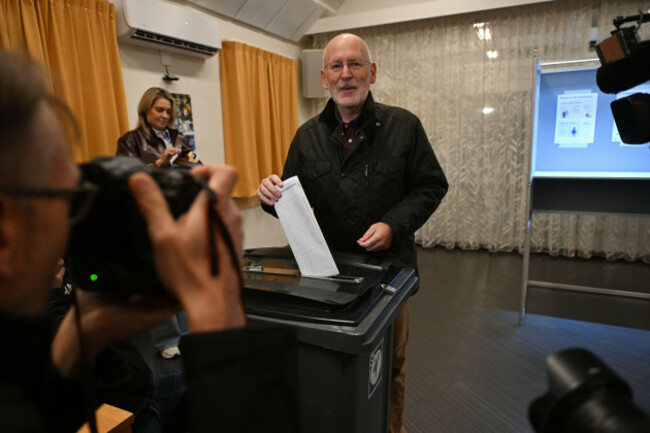
In fallout from the vote, former European Commission vice president Frans Timmermans said he was quitting Dutch politics after the centre-left bloc he led lost seats in an election it had hoped to win.

frans-timmermans-of-the-center-left-two-party-bloc-of-labor-party-and-green-left-casts-his-vote-at-a-polling-station-during-general-elections-in-maastricht-netherlands-wednesday-oct-29-2025-a Frans Timmermans arrives at a polling station to cast his vote Alamy Stock Photo Alamy Stock Photo

The election is “unlikely to mark the end of populism in the Netherlands,” said Armida van Rij, senior research fellow at the Centre for European Reform think tank.

She noted that another right-wing party, JA21, which she described as a “PVV-light party with equally undemocratic ideas,” made big gains. The party had one seat in the last parliament and is forecast to rise to nine seats.

The vote came against a backdrop of deep polarisation in the Netherlands, a nation once famed as a beacon of tolerance.

Violence erupted at a recent anti-immigration rally in The Hague – when rioters smashed the windows of the D66 headquarters – and protests against new asylum-seeker centres have been seen in municipalities around the country.

In the splintered Dutch political landscape, forming a coalition is likely to take weeks or months.

Close
63 Comments
This is YOUR comments community. Stay civil, stay constructive, stay on topic. Please familiarise yourself with our comments policy here before taking part.
Leave a Comment
    Submit a report
    Please help us understand how this comment violates our community guidelines.
    Thank you for the feedback
    Your feedback has been sent to our team for review.

    Leave a commentcancel

     
    JournalTv
    News in 60 seconds