Sign in. It’s quick, free and it’s up to you.
An account is an optional way to support the work we do. Find out more.
Sign in. It’s quick, free and it’s up to you.
An account is an optional way to support the work we do. Find out more.
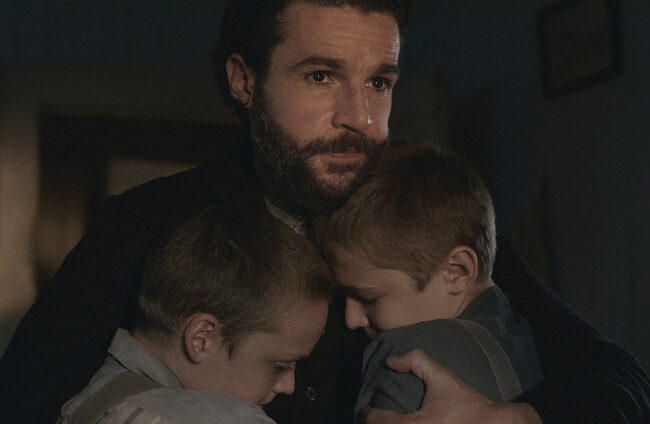
JOHN STEINBECK’S epic 1952 novel East of Eden is the sprawling tale of two families who move to the Salinas Valley of California. It’s a sweeping story that asks questions about what’s passed on through families; whether evil is incarnate to a person; and what it takes to create your own life in an America that’s newly creating itself.
But is it possible to bring such a rich tale to the screen? When director Elia Kazan did so in 1955 – in a film with a then-unknown James Dean at the helm – he focused mainly on characters from the latter part of the book, the brothers Cal and Aron Trask. Now Kazan’s granddaughter, actor and writer Zoe Kazan, has created her own spin on the story in a seven-part Netflix adaptation.
So what has Zoe Kazan done with this huge story, and does it work as a miniseries?
Family tale
Telling the tale of East of Eden in a miniseries means cutting the original story down considerably. The novel concerns the lives of the American family the Trasks and the Irish-American family the Hamiltons, but Irish viewers might be sad to hear that the Hamiltons have mostly been cut from this series. The good news? The Hamilton who gets most screen time is the father Samuel, played by Ciarán Hinds, one of our finest actors.
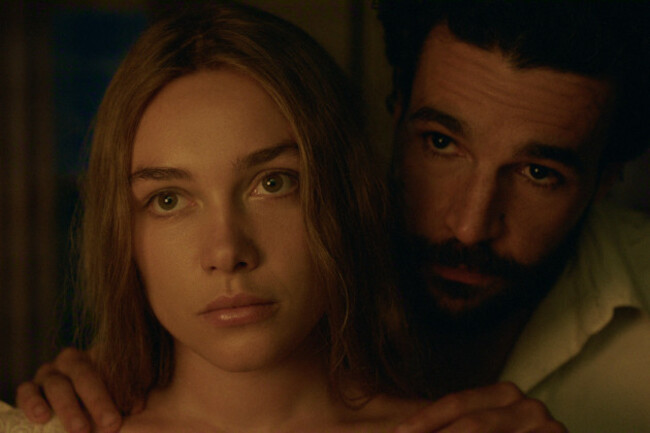
In focusing on the Trasks, Kazan brings us back to the childhood of brothers Adam (Christopher Abbott) and Charles (Mike Faist), who grew up the sons of the strict, abusive and morally slippery ‘war hero’ Cyrus (Tracy Letts). But rather than beginning their story chronologically, she opens the series with a dramatic moment: the appearance of Cathy Ames (Florence Pugh) on the adult Adam and Charles’ rural Connecticut doorstep, her face bruised and bloodied. She’s been assaulted by a brothel owner-come-boyfriend, and when Adam and Charles take her in they have no idea how she will affect the course of their lives.
Cathy is one of literature’s great monsters: a woman who’s always out to do what’s right for her, and is not afraid to manipulate, abandon or even kill to get what she wants. Kazan has said in interviews that she first read East of Eden at 15; returning to it as an adult and mother, she began to see the character of Cathy slightly differently to back then.
In this version of East of Eden, Kazan doesn’t restrain herself from showing us the depths of depravity that Cathy is willing to plumb. But she welcomes in some context to examine how Cathy might have become the woman she is. Some Steinbeck purists might baulk at this, believing it to be a re-writing of his original characterisation. To some, it’s important that Cathy remain pure in her monstrosity.
But Kazan uses a more contemporary, 21st-century lens to place Cathy’s actions in a new context. We see her as a child, prey to older men. We recognise that in the world she was born into, late 19th-century America, her voice was not listened to. We understand that she had to put on an armour of some kind, and that she sought to find her own form of justice. To this reviewer, Kazan isn’t trying to forgive Cathy for her crimes, but instead is asking – just as Steinbeck asked in his novel – how much of a person’s world impacts who they are.
Kazan dares us to examine how Cathy was treated as a young person – as a sexual object – and wonder how that might have impacted her behaviour. Was Cathy born a monster? Perhaps. But did a misogynistic, patriarchal society help shape her into one too? Undoubtedly. Placing her actions out of the context of women’s experiences during this time would do a disservice to her character, and Kazan’s approach doesn’t lessen the impact of Cathy’s actions.
Pugh embodies Cathy as sensual, watchful and intelligent. She’s not truly haunted by her decisions until later in life. We see Cathy grow from childhood to an older woman, although the series struggles with ageing Pugh in a believable way, trapping her like a fly in amber. Still, she portrays Cathy’s emotional range so well that we can mostly overlook her rarely-changing appearance.
Eager for a better life
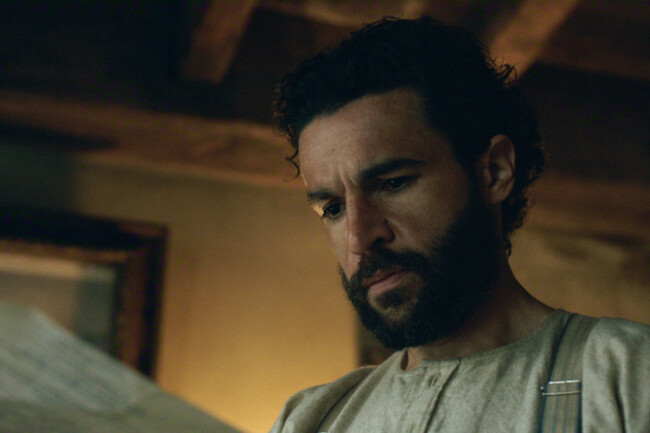
Christopher Abbott plays Adam Trask (who marries Cathy after he and his brother rescue her) as a man who’s mostly turned into himself. He’s traumatised by his father’s abuse and by Cathy’s decision to leave him and their twin boys. Adam is an internalised character, who only starts to come out of himself as his boys age into adults. Abbott does a fine job of portraying Adam as a man determined to drag himself to a better place, even as life keeps buffeting him about.
Mike Faist has less screen time as Charles Trask, but still makes an impact on the series. He objects to Adam and Cathy’s marriage (in a scene that’s energetically similar to Adam Driver’s Marriage Story scene where he theatrically shouts at Scarlett Johansson) but he also knows a secret about Cathy that he doesn’t want to share with his brother. Even when Charles isn’t on screen, his presence is felt by how he’s always on Adam’s mind; towards the end of the series, he haunts a paranoid Cathy.
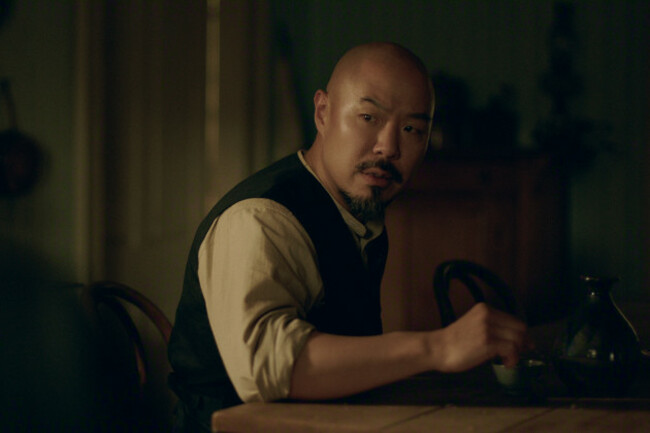
One of the series standouts is Hoon Lee as Lee, the Chinese-American domestic worker who helps Charles to raise his twin boys after Cathy’s disappearance. Lee functions as a stand-in parent for the twins, paying them more attention than their own father. He’s diligent and caring, but the show thankfully doesn’t restrict him to that role alone.
Instead, we also get insight through his character into the struggles of Chinese immigrants to America in the late 19th century and early 20th century. Lee is trapped in a liminal space: he was born in America, but his Americanness is not recognised. He struggles to find a place in his Chinese community.
In a revealing conversation with neighbour Samuel Hamilton (Ciarán Hinds), we see that he code-switches by putting on a Chinese accent when dealing with white people, because otherwise they claim not to understand him.
In episode five, Lee travels to Chinatown in San Francisco to find a friend from his past, and strike out for his own future. It’s devastating to watch him realise that his dreams show little chance of coming true, and to see him so out of step with the community around him. We know by that point what a kind, capable and smart person he is. We just want him to be happy, and it hurts when he isn’t.
Existential questions
In East of Eden, the arrow is never headed towards the simple target of happiness. As the lives of the Trasks progress, we see the grown-up twin sons of Adam and Cathy, Cal (Joseph Zada) and Aron (Joe Anders), try to build their own lives in an America that offers them work, education and a brewing world war.
Cathy and Adam’s diverging paths are echoed in how Cal in particular struggles with what kind of person he is, believing that he has a badness in him that can’t be removed. Eventually, we know that something will occur to show him what he is made of, as the family’s history holds its grip on the new generation.
East of Eden leans towards the overly dramatic at times, but that’s because it’s concerned with big ideas about identity, family and legacy. The characters wrestle with the wider issues going on in the world – like the burgeoning war – as well as their internal battles. As viewers, we can sink into their troubles and wonder about the existential questions they raise for us all these decades on.
Visually, East of Eden is a sumptuous watch, but never over-eggs the pudding. The costumes and make-up never draw attention to themselves but feel correct to the period. Pugh’s Cathy is the only one who gets to live in true luxury, and her coiled hair and layered dresses are the beautiful spoils of her role as a brothel madam.
The colour grading of the series leans towards jewel-toned blues and greens, balanced by sepia tones. The effect is to make each episode feel like an old photograph you found in a tin of family memories.
Though East of Eden grapples with big themes, as writer of this series Kazan has managed to both stay true to the text for the most part (dialogue in some scenes is almost word-for-word to the book), and distil its story down to a manageable narrative. In moving between characters, we get a sense of who the Trasks are, and how their issues and concerns continue to travel through the generations. The characters surrounding them, like Cathy and Lee, show us other sides of humanity and are as central to the story as the Trasks.
East of Eden is an emotional watch. It never tiptoes around its characters’ internal and external battles. Steinbeck fans might quibble over some of the narrative choices, but emotionally the series rings true. Compelling, intense and beautifully shot, the impact of the show’s exploration of human struggles and pain lingers long after its devastating final episode.
East of Eden is streaming on Netflix now.

To embed this post, copy the code below on your site







have your say