We need your help now

Support from readers like you keeps The Journal open.

You are visiting us because we have something you value. Independent, unbiased news that tells the truth. Advertising revenue goes some way to support our mission, but this year it has not been enough.

If you've seen value in our reporting, please contribute what you can, so we can continue to produce accurate and meaningful journalism. For everyone who needs it.

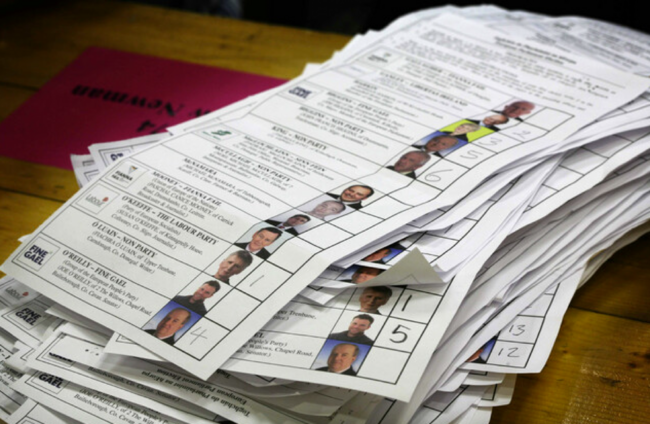
File photo of ballot papers from a previous European election. RollingNews.ie

Electoral Commission recommends removing addresses from the ballot to improve candidate safety

Women and minorities in politics have been subjected to increased harassments in recent years.

THE ELECTORAL COMMISSION has recommended a change in law to stop election candidates’ addresses appearing on the ballot paper in a bid to provide additional safety for women in politics.

Women and minorities in politics have been subjected to increased harassment in recent years. Last year an Oireachtas Taskforce Report on Safe Participation in Political Life found that abuse in politics is “disproportionately targeted at women or minority groups”.

Women for Election have been consistently calling for change in the area – something it believes will improve the gender imbalance in Irish politics.

Candidates’ addresses have appeared on the ballot paper since the foundation of the State as a symbol of openness and accountability, but the Commission said there are concerns that it can give rise to safety and privacy risks.

Under the Electoral Act 1992 candidates seeking to run for election to the Dáil must provide an address on the nomination paper, which is then published on the ballot paper.

The Commission has advised the government to change the law so there is a break in the automatic link between the address provided on the nomination paper for verification purposes and the address to appear on ballot papers.

It recommends candidates include their personal addresses on the nomination paper for the Electoral Commission, but also provide another address to appear on the ballot paper and on public notices.

The Commission said that when it comes to the address on the ballot paper, candidates should have a choice to include either a full address, a partial address or the area in which the address is located.

It also recommended that changes should be made to allow candidates experiencing homelessness to also apply.

‘Broader response’

Ms Justice Baker Chairperson of An Coimisiún Toghcháin welcomed the recommended changes but said more must be done to combat the issue.

“We believe the issue requires a broader response and would encourage all relevant stakeholders to reflect and take appropriate action, as these threats are an affront to the health of our democracy,” she said.

Art O’Leary, Chief Executive of An Coimisiún Toghcháin said: “Having listened to the voices of political actors, candidates and their families, and looked carefully at how candidates’ addresses are shared and used, An Coimisiún believes that these proposed reforms honour both our tradition and the real world in which we now live.”

“They safeguard the integrity of the nomination process, they ensure that voters continue to have the information they need, and they reflect a deep understanding of the challenges and pressures faced by today’s candidates.”

Brian Sheehan, CEO of Women for Election urged the Government to implement the necessary legislative changes in time for the upcoming by-elections.

He said: “In an increasingly challenging environment, ensuring the safety of women candidates and the integrity of the election systems is key to preserving our democracy.”

He said the change may improve the gender imbalance in Irish politics.

“Ireland lags well behind all our neighbours in the number of women in local and national politics. Addressing the barriers faced by women, especially safety, is key to ensuring more women run for and succeed in politics, and is key to building a gender-balanced, fairer and more sustainable democracy,” he said.

“From the last election cycle it is clear that women are coming forward in ever-greater numbers to stand in elections to represent their communities. However, harassment, intimidation and abuse of women candidates and elected politicians has escalated and was increasingly normalised during the elections”.

Readers like you are keeping these stories free for everyone...
A mix of advertising and supporting contributions helps keep paywalls away from valuable information like this article. Over 5,000 readers like you have already stepped up and support us with a monthly payment or a once-off donation.

View 35 comments
Close
35 Comments
This is YOUR comments community. Stay civil, stay constructive, stay on topic. Please familiarise yourself with our comments policy here before taking part.
Leave a Comment
    Submit a report
    Please help us understand how this comment violates our community guidelines.
    Thank you for the feedback
    Your feedback has been sent to our team for review.

    Leave a commentcancel

     
    JournalTv
    News in 60 seconds