We need your help now

Support from readers like you keeps The Journal open.

You are visiting us because we have something you value. Independent, unbiased news that tells the truth. Advertising revenue goes some way to support our mission, but this year it has not been enough.

If you've seen value in our reporting, please contribute what you can, so we can continue to produce accurate and meaningful journalism. For everyone who needs it.

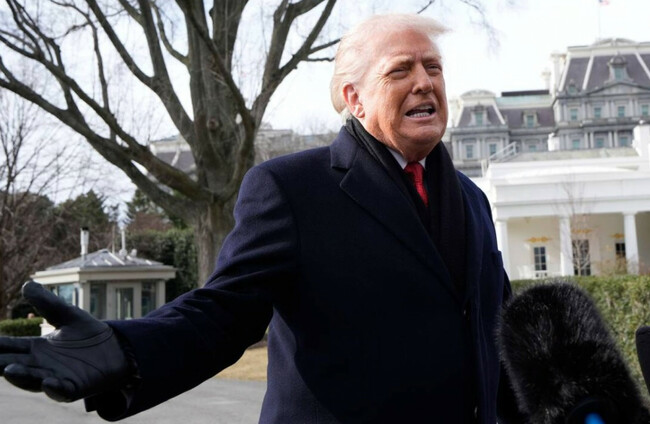
Donald Trump speaks to members of the media on the lawn of the White House in Washington, DC. Alamy Stock Photo

What is the EU's 'trade bazooka'? And three other ways Europe could respond to US tariffs

The EU has a few buttons it can press – but they all carry risks.

EU FINANCE MINISTERS are meeting in Brussels today as they look to form a response to Donald Trump’s threats to impose tariffs in the standoff over Greenland.

Trump stunned Europe on Saturday when he vowed to slap EU members Denmark, Finland, France, Germany, the Netherlands, and Sweden – and non-members the Uk and Norway – with levies of up to 25% unless the Danish territory is ceded to the United States.

If the EU is to hit back at the White House, what might that look like?

There are a small number of options facing EU leaders, each one more devastating to its relationship with the US than the last.

EU-US trade deal paused

A trade agreement initially between Trump and EU chief Ursula von der Leyen at the US president’s Turnberry golf course in Scotland last July looks to be one of the first items in the firing line of any European response.

That deal sets U.S. tariffs on imports from the EU at 15% – in exchange the EU would not apply levies on American exports.

Manfred Weber – the president of the EU’s largest grouping, the European People’s Party – posted on social media over the weekend that the deal would need to be put on ice in the name of “European unity”.

It means that the deal – which was due to be formally voted on in the European Parliament in coming weeks – may be a while away yet, if not destined for the bin.

“The EPP is in favour of the EU–U.S. trade deal, but given Donald Trump’s threats regarding Greenland, approval is not possible at this stage. The 0% tariffs on U.S. products must be put on hold,” Weber said.

Dan O’Brien, chief economist of the Institute of International and European Affairs (IIEA), said the likely scrapping of the trade deal means there could be danger down the road for Ireland as US-reliant industry here could get caught in the crossfire of a trade war with the White House.

“We’re back in the sort of territory we were before in the early part of this administration, where there’s potentially a recession causing impact from this,” O’Brien told The Journal.

While Ireland was “extremely fortunate” previously because those tariffs didn’t hit key sectors such as pharmaceuticals, there is a fear that the negotiations of last summer may have to be reopened.

The bazooka

Calls are growing louder for the EU to deploy its powerful ‘anti-coercion instrument’ in response to Trump’s fresh threat to impose tariffs.

Known as the ‘trade bazooka’, it was established in 2023 but has never been activated.

This allows the EU to take measures such as import and export restrictions on goods and services in its single market of 450 million people.

Such a move may alarm the Irish government given that a major target could be American tech giants.

The IIEA’s O’Brien said the nickname underplays the wide-ranging effects of the anti-coercion instrument, as it will also give Brussels the power to limit American companies’ access to public procurement contracts in Europe.

German minister backs bazooka

French president Emmanuel Macron has raised the prospect of hitting back with the EU’s trade weapon, and he has been joined this morning by German Vice-Chancellor and Finance Minister Lars Klingbeil.

“Europeans must make clear the limit has been reached,” Klingbeil told reporters according to Euronews.

On this, O’Brien said that the backing of senior German figures means it’s more likely that we see the bazooka implemented.

It also heightens the danger of both the EU and the US getting into a “retaliatory spiral” in a trade war, O’Brien added.

It’s indicative of just how different countries see this and the price they will pay. Because potentially we’re looking at a recession in Europe, which we get into a trade war with the US.

Any trade war will also mean difficulty for consumers caught in the middle of the international dispute.

To activate the bazooka, it would need the green light of at least 55 percent of EU member countries voting in favour, representing 65 percent of the bloc’s population.

Spook the bond market

Another option raised by economists on both sides of the Atlantic has been for the EU to target the US bond market.

Such a scenario – were it to happen – could mean serious risks to economies however.

This is because those European countries hit by the latest tariff threat each hold hundreds of billions of dollars in assets, meaning that a sell off could spark fears for the US economy.

Europe is also the biggest lender to the US, according to Deutsche Bank.

Professor Edgar Morgenroth in DCU’s business school argued that it’s a key lever that could force Trump to ease off, as it would heap pressure on the American economy and US voters amid their own cost-of-living struggles.

“What you really, really want is for the bond markets in the US to be spooked,” said Morgenroth, who pointed to how similar fears from bond markets saw the White House back down during its major tariff push last year.

Because these countries collectively own trillions in US bonds and equities, proponents of this measure believe that a push to “sell America” would see investors dump the dollar instead of investing in it.

However, O’Brien from the IIEA argued that it’s highly unlikely that central banks and sovereign wealth funds in Europe would coordinate to sell US Treasuries.

“They would be making losses for themselves,” O’Brien added.

Close US military bases

The US has almost 40 military bases across Europe, which it occasionally uses to help launch operations in the Middle East.

One suggestion has been to for Europe to shutter some or all of these as a counter measure against the White House.

The idea is the most extreme of the options here, and has not been suggested publicly by any head of government.

In the UK today, the leader of the opposition Green Party Zack Polanski proposed closing 14 US military bases located in the UK and the eviction of 10,000 soldiers, if Trump attacks Greenland.

One of a few reasons why this may not ever take place is that it’s more useful having those bases and their soldiers in the US as “bargaining chips” in case relations did get worse, according to Morgenroth.

“Bargaining chips are sometimes useful to have,” Morgenroth said.

“It’s not the way we normally play things and this is actually the biggest issue here, in that the EU has traditionally wanted to play by a rule book doesn’t exist anymore.”

With reporting by AFP

Readers like you are keeping these stories free for everyone...
A mix of advertising and supporting contributions helps keep paywalls away from valuable information like this article. Over 5,000 readers like you have already stepped up and support us with a monthly payment or a once-off donation.

Close
57 Comments
This is YOUR comments community. Stay civil, stay constructive, stay on topic. Please familiarise yourself with our comments policy here before taking part.
Leave a Comment
    Submit a report
    Please help us understand how this comment violates our community guidelines.
    Thank you for the feedback
    Your feedback has been sent to our team for review.

    Leave a commentcancel

     
    JournalTv
    News in 60 seconds