We need your help now

Support from readers like you keeps The Journal open.

You are visiting us because we have something you value. Independent, unbiased news that tells the truth. Advertising revenue goes some way to support our mission, but this year it has not been enough.

If you've seen value in our reporting, please contribute what you can, so we can continue to produce accurate and meaningful journalism. For everyone who needs it.

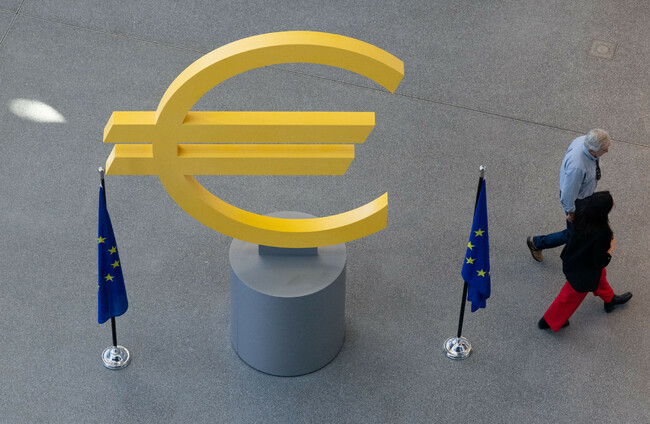
People walk past sculpture depicting euro symbol at ECB headquarters ahead of interest rate announcement

European Central Bank holds interest rates at 2% despite Iran war energy shock

‘The longer the war continues, and the longer energy prices remain high, the stronger is the likely impact on broader inflation and the economy,’ said the ECB.

THE EUROPEAN CENTRAL Bank has kept its key interest rate on hold as it warned that risks to growth and inflation had “intensified” as a result of the war in the Middle East.

The central bank for the 21 countries that use the euro left its benchmark deposit rate at 2%, where it has been since June last year.

“The upside risks to inflation and the downside risks to growth have intensified,” the ECB said.

“The longer the war continues, and the longer energy prices remain high, the stronger is the likely impact on broader inflation and the economy.”

Energy costs have spiked since the near-total closure of the Strait of Hormuz, through which about a fifth of the world’s oil and gas usually passes, following the outbreak of the US-Israeli war against Iran.

Eurozone inflation is already picking up – it jumped to 3% in April, above the ECB’s two-percent target – but the central bank is reluctant to quickly hike rates, fearing higher borrowing costs could weigh on the region’s already lacklustre growth.

Italian bank UniCredit wrote in a note that it did not “see the urgency” for the Frankfurt-based institution to act, particularly as inflation was around the ECB’s target before the conflict.

“The weakening of the outlook for demand, particularly for private consumption, reinforces the case for the ECB to be patient,” it said.

Eurozone economic growth slowed to 0.1% in the first three months of the year, official data showed today, while figures since the outbreak of the war have pointed to falling consumer and investor confidence and weakening business activity.

Other central banks are also taking a cautious approach.

The US Federal Reserve held interest rates steady yesterday, its third pause in a row, as it waits for the full impacts of the war to become clear.

The Bank of England froze borrowing costs too after its meeting today, but cut its forecasts for UK growth this year and next.

‘Not in a rush’

Much of the inflation and growth outlook depends on whether Iran and the United States can come to a lasting agreement that secures transit of energy supplies through the Strait of Hormuz, a factor over which the ECB has no control.

Speaking in Berlin earlier this month, ECB president Christine Lagarde said the institution was facing “double uncertainty” in that it was unclear both how long the shock would last and what its effect on the broader economy would be.

ECB officials have been keen to stress that the difference between the situation now and that after Russia’s invasion of Ukraine in 2022, when the central bank was criticised for moving too slowly to respond to surging inflation.

At that time, an energy shock coupled with post-pandemic supply chain woes and tight labour markets pushed eurozone inflation to record highs.

But for now, ECB officials are “not in a rush”, Bank of Latvia governor Martins Kazaks, a member of the ECB’s rate-setting governing council, told The Financial Times last week.

“We still have the large luxury of collecting data and forming our view.”

Brokers Ireland said maintaining the interest rate is likely to be a “short-lived reprieve”, with financial markets “pricing in at least two rate increases this year”.

Rachel McGovern, deputy chief executive at Brokers Ireland, said mortgage holders have been growing more cautious since the “last series of rapid ECB increases between July 2022 and September 2023”.

“Even though subsequently rates declined between June 2024 and June 2025, at a lesser level, cost of living concerns have heightened,” she said.

She added that this caution is evident in the growing number, over 90%, of new mortgage agreements being fixed-rate mortgages.

“With rapidly increasing house prices in recent years, mortgage holders are taking on higher levels of debt and wages have not kept pace for many, so people are wise to be prudent,” she said.

McGovern urged mortgage holders, particularly those who have not reviewed their situation in recent years, to do so.

© AFP 2026 and with additional reporting from Diarmuid Pepper

Author
View 6 comments
Close
6 Comments
This is YOUR comments community. Stay civil, stay constructive, stay on topic. Please familiarise yourself with our comments policy here before taking part.
Leave a Comment
    Submit a report
    Please help us understand how this comment violates our community guidelines.
    Thank you for the feedback
    Your feedback has been sent to our team for review.

    Leave a commentcancel

     
    JournalTv
    News in 60 seconds