Sign in. It’s quick, free and it’s up to you.
An account is an optional way to support the work we do. Find out more.
Sign in. It’s quick, free and it’s up to you.
An account is an optional way to support the work we do. Find out more.
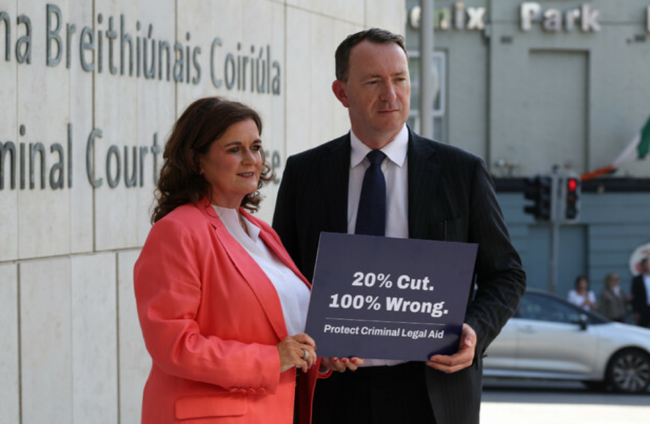
LAW SOCIETY PRESIDENT Rosemary Loftus has said that solicitors across the country are resigning from the criminal legal aid scheme due to changes to the payment model coming into effect Wednesday.
The introduction of a flat-fee payment model for District Court cases under the legal aid system means that from 1 July, solicitors will receive a single payment for District Court criminal cases regardless of the number of court appearances involved.
Justice minister Jim O’Callaghan has increased the proposed new flat fee from €455 to €520 following a week of disruption where thousands of District Court cases were adjourned after criminal defence solicitors withdrew their services in protest.
At present, solicitors are paid around €240 for the first appearance and about €60 for each subsequent sitting. Following talks with the legal profession over the last few days, the minister confirmed today that, regardless of the number of appearances, a fee of €520 will be payable to solicitors from 1 July.
On Friday, Loftus warned that the changes would lead to an “exodus” of solicitors from the area of practice by making it unsustainable financially.
Today she said that “it is our understanding that solicitors from across the country are resigning from criminal legal aid panels”.
“This will have a devastating impact on access to justice,” she added.
“The people who will pay the price are victims of crime, who will see trials delayed, as well as some of the most vulnerable in society. They are children in trouble for the first time. They are people struggling with addiction or serious mental health conditions. They are people who are homeless, victims of trafficking, and people in acute crisis.”
Last week the Department of Justice carried out a report which found that solicitors were “maximising” their earnings through criminal legal aid payments. After the report was released, O’Callaghan said “there are very clear abuses going on in the system”.
However, Loftus said the change is a “cost-cutting exercise dressed up as reform”.
“It is based on flawed assumptions from the Department of Justice,” she added.
“The Law Society’s position is unchanged and clear: any reform of criminal legal aid should be workable, fair and evidence based. This proposal is none of those things and the fundamental concerns the Law Society has outlined have not been addressed.”
The Department of Justice said the new flat fee model for Criminal Legal Aid follows “extensive engagement since October 2025 between the Department of Justice and the Law Society of Ireland and the Bar Council in relation to the proposed changes, and careful consideration of submissions received”.
“The one flat fee of €520 will be paid for representation from beginning to end of a case. This will remove the link between payments and the number of appearances, or defendants represented on a given day,” they said.
They said the reform will “simplify administration, incentivise timely case resolution without affecting quality of representation, protect access to justice, and ensure fair remuneration for legal practitioners”.
“The new district court fee model was introduced from today Wednesday 1 July 2026. In addition, a further 8% increase in criminal legal aid fees will apply for all cases heard in the circuit and higher courts from today.” they added.
They said the move fulfils the Programme for Government commitment to reform criminal legal aid and fully restore fees, and “comes into effect after a series of engagements with stakeholders” across the criminal justice system.
“The Department will keep the operation of the new system under review over the coming months to monitor progress and effectiveness,” they added.

To embed this post, copy the code below on your site












have your say