Sign in. It’s quick, free and it’s up to you.
An account is an optional way to support the work we do. Find out more.
Sign in. It’s quick, free and it’s up to you.
An account is an optional way to support the work we do. Find out more.
LAST UPDATE | 27 Jun
PLANS TO CHANGE the payment model for criminal legal aid work will lead to an “exodus” of solicitors from the area of practice, the president of the Law Society of Ireland said today.
Rosemarie Loftus made the comments this morning as thousands of cases have been impacted since criminal law solicitors withdrew their services over upcoming reform of payments.
The introduction of a flat-fee payment model for District Court cases under the legal aid system means that from 1 July, solicitors will receive a single payment of €455 for District Court criminal cases regardless of the number of court appearances involved.
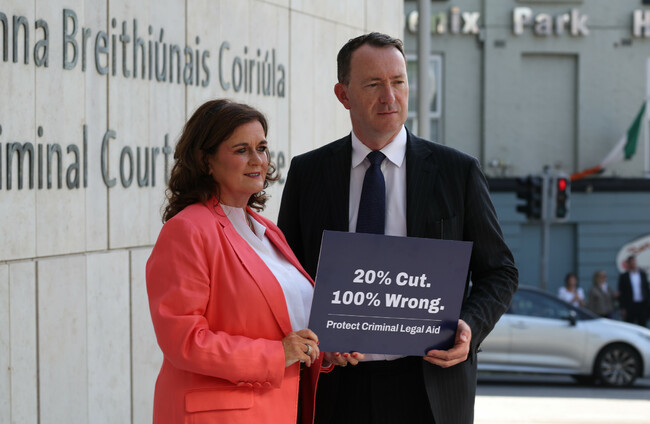
The Irish Human Rights and Equality Commission, Irish Penal Reform Trust, Free Legal Advice Centres and The Bar of Ireland joined the Law Society of Ireland at the Criminal Courts of Justice in Dublin today to protest the planned changes to the legal aid system.
Loftus described the proposed pay cuts as “an absolute insult to the legal profession and to the public it intends to serve”.
She said it is hard to overstate the level of anger amongst practitioners, and many are assessing on an individual level whether to exit the area of work.
“It will render criminal legal aid practices unsustainable financially, and therefore for many solicitors it will trigger an exodus from this area of practice and make the most vulnerable in our society in a situation of even more vulnerability because of lack of access to legal representation,” Loftus said.
“It’s not reform, it’s a cap on justice.”
Solicitors took industrial action last week when they withdrew their services in cases involving an accused person on bail, meaning they are temporarily released from custody and awaiting trial.
The solicitors will continue to act in custody cases they are already working on and in certain cases involving juveniles.
Speaking to The Journal, solicitor and Law Society spokesperson Mary Lavelle said “it’s just not sustainable to stay in this area if this measure comes in”.
“I think a lot of people will have to leave the sector, or they’ll only take on private work, which is few and far between in criminal law,” she said.
Lavelle said she doesn’t see how solicitors will be able to “sustain the level of care” currently given to clients, particularly vulnerable clients, if the new model is brought in.
“I do think it will impede their access to justice, because, as I said, I do think it will be an exodus of solicitors from the area,” she said.
The Law Society of Ireland, as well as hundreds of solicitors, are opposed to the new payment model – but Minister for Justice Jim O’Callaghan has indicated he won’t back down.
Last week the Department of Justice carried out a report which found that solicitors were “maximising” their earnings through criminal legal aid payments. After the report was released, O’Callaghan said “there are very clear abuses going on in the system”.
Loftus wrote to O’Callaghan to express the law society’s concerns with the report, which it said made assertions that are “flawed and are not a true reflection of practice in this area”.
Speaking to reporters Wednesday, O’Callaghan doubled down on the report’s findings, saying the current payment system “incentivises adjournments because you get paid an extra sum every time you adjourn the case”.
In a statement to The Journal today, O’Callaghan said it was “regrettable” that some criminal law solicitors had withdrawn their services over the payment reform.
He added that there has been ”extensive engagement” between officials in the Department of Justice and the Law Society and Bar Council regarding the proposed changes since October 2025.
“The Department continues to engage with relevant stakeholders, and in those circumstances, it would not be appropriate for the Department to comment further at this time,” a statement from O’Callaghan said.
Additional reporting by Emma Hickey

To embed this post, copy the code below on your site













have your say