We need your help now

Support from readers like you keeps The Journal open.

You are visiting us because we have something you value. Independent, unbiased news that tells the truth. Advertising revenue goes some way to support our mission, but this year it has not been enough.

If you've seen value in our reporting, please contribute what you can, so we can continue to produce accurate and meaningful journalism. For everyone who needs it.

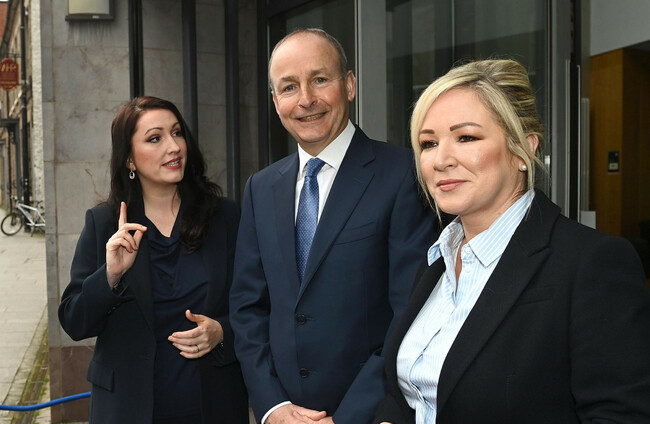
Micheál Martin and Michelle O'Neill (centre and right) back the boycott, but Emma Little-Pengelly said it won't 'make one jot of difference' Alamy Stock Photo

Taoiseach backs Eurovision boycott but DUP says it 'won’t make a jot of difference'

Michelle O’Neill welcomed the move but Emma Little-Pengelly said it ‘won’t make a jot of difference’.

TAOISEACH MICHEÁL MARTIN has described Ireland’s withdrawal from the Eurovision Song Contest as an “act of solidarity”.

Ireland is among a number of countries who pulled out of the contest after the European Broadcasting Union (EBU) agreed to allow Israel to participate amid the conflict in Gaza.

Martin said he “fully understands” the decision taken by RTÉ to withdraw.

However, during a joint press conference at the British-Irish Council, leaders in the North gave opposing views on the move.

Sinn Féin First Minister Michelle O’Neill said it sent a “strong message”, while DUP deputy First Minister Emma Little-Pengelly said it “won’t make a jot of difference” to the situation in the Middle East.

Martin said there are two groups of people, among many, who were extremely brave during the war in Gaza – the medical community and journalists.

“And this is, among other things, an act of solidarity with those journalists who were killed in breach of international humanitarian law during the war in Gaza,” he said.

“Without those journalists, the world would not have known to the degree that it knows the horrors of what transpired in Gaza.

“I think our focus has to be on peace and how now can we contribute to the bedding down of the ceasefire and how we, as a country, and Ireland is up to contributing to the peace process, and we work with other like-minded countries in that respect.”

He added that Ireland’s decision to recognise Palestine as a state was in the context of the Arab partner peace initiative.

“So we’re working with all involved to see how we can contribute in terms of the peace process the most and also then the absolute unimpeded flow of vital humanitarian aid into Gaza, which is not going in to the degree or sufficiency that the situation requires.”

Tánaiste Simon Harris said he understood the context for RTÉ’s decision.

“These are editorially independent decisions, I think that’s important,” he said.

“But I would say this by way of context, we’ve seen hundreds of journalists killed throughout this horrific, horrific conflict.

“We still today see a situation where there’s not free access by Israel for the media to get in to actually see the atrocities that have happened in Gaza and you can’t just forget or ignore the fact that a genocide has taken place in relation to Palestine.

“I’m sure this was a well-considered decision. Ireland has a long affinity with Eurovision, winning it more times than anyone, I think, at least jointly first.

“But I think RTÉ would have weighed up all of these issues and made their decisions editorially independent of the government, as it should be. But I certainly understand the context for that decision.”

O’Neill said she “absolutely agrees with the decision”.

“I think it’s a right and appropriate decision to take,” she said.

“This is the biggest humanitarian crisis of our time, when genocide prevails, and I think countries need to take action that actually sends a very strong message, and I think this is another one of those messages.”

Little-Pengelly meanwhile remarked: “I think the focus on everyone should be on what is actually going to make a meaningful difference in the Middle East. That must mean supporting all efforts to stabilise a ceasefire.

“I’m glad to see that the UK Government and others are working to help to stabilise that peace.

“It is a very fragile situation but, quite frankly, boycotting a singing competition is not going to make one jot of difference in terms of moving forward with a peaceful resolution and permanent resolution to that conflict.”

Meanwhile, the RTÉ Trade Union Group (TUG) has welcomed the decision. 

The TUG said: “As media workers we have been appalled at the loss of lives in Gaza and the targeted killing of journalists.”

“Given Israel’s continued denial of international media access and the ongoing genocide in Palestine, it is unconscionable that Ireland should participate in a musical contest with its representatives.”

TUG Co-chair, Emma O Kelly, said the TUG find it difficult to understand how the EBU can continue to support Israel despite violence against media personnel.

“Israel also continues to refuse to allow EBU members, such as RTÉ and the BBC, to send in their own staff to document what is happening in Gaza,” she said.

“By continuing to allow Israel to participate in its song contest, the EBU is turning a blind eye to this unprecedented assault on journalism and on media freedom. This is indefensible.” 

Readers like you are keeping these stories free for everyone...
A mix of advertising and supporting contributions helps keep paywalls away from valuable information like this article. Over 5,000 readers like you have already stepped up and support us with a monthly payment or a once-off donation.

Close