We need your help now

Support from readers like you keeps The Journal open.

You are visiting us because we have something you value. Independent, unbiased news that tells the truth. Advertising revenue goes some way to support our mission, but this year it has not been enough.

If you've seen value in our reporting, please contribute what you can, so we can continue to produce accurate and meaningful journalism. For everyone who needs it.

Debunked: A misleading graph of the warmest springs on record actually reveals Ireland is getting hotter

A graph of temperatures looks almost flat… if you exclude the data that would make it jagged.

A GRAPH USED to illustrate a message that concern over climate change is excessive actually indicates that Ireland is getting drastically warmer.

The misleading visualisation of Ireland’s weather, posted by MMA coach John Kavanagh, was shared to suggest that Ireland’s climate is steady. It instead shows that four of the five hottest spring seasons on record here have occurred since 2023.

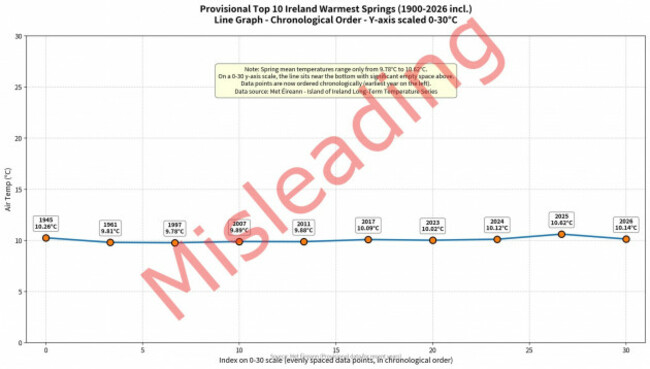
“Well the only logical next step after viewing this terrifying almost horizontal line spanning 80yrs is increase carbon tax, increase poverty and put nuclear on the long finger,” Kavanagh wrote in a 4 June post on X along with this image:

Shitty graph m

Kavanagh is the president of the Irish Mixed Martial Arts Association, and has coached Conor McGregor.

However, although the graph shows an almost horizontal line, as well as temperatures and year labels, those who see it would be wrong to assume that the chart shows anything as useful as the change in Irish temperatures over time.

Instead, the chart shows the “Provisional Top 10 warmest Springs” from 1900 to 2026, expressed as “evenly spaced data points, in chronological order”.

Is that just a complicated way of saying it shows how heat in Ireland has changed over time? No. This chart only looks at springtimes that are pre-selected for being hot, and then spaces them arbitrarily.

It does, however, correctly show that the second-hottest spring on record was recorded in 1945.

Let’s start with the vertical Y-axis. On this axis, the height of a point on the graph represents the average temperature of spring in certain years.

One might therefore assume that an upward trend from left to right would indicate that average temperatures are going up over time. 

Likewise, one would think a downward trend from left to right would indicate that average temperatures are going down over time.

These are reasonable assumptions, but would be wrong. All the data points used in the graph have been pre-selected to be the top 10 hottest springs recorded since 1900.

This means that the uncharacteristically hot springs of 1945 and 1961 are included, but none of the years in between, though there is no visual indication of a more-than-decade-long gap.

The graph makes it look like temperatures have been steady since 1900, but can only do so by excluding the available data from 116 of those years.

An honest graph of average spring temperatures that included all the data would show some peaks and valleys. It would not plot lines between years that are separated by decades.

The graph used by Kavanagh intentionally excludes the data that would form the valleys. 

When you remove all but the highest points, what is left is an “almost horizontal line” — but this is not a reflection of the world, just the method used to make the graph.

An analogy might be to make a graph of the oldest people recorded to have lived in Ireland. This would include three women who died at the age of 111, in 1932, 1984, and 2004 respectively.

Such a graph would be quite flat — the very oldest Irish people have died in and around the 110-year mark. But this tells us little about changes in the overall lifespan trend in Ireland. 

Life expectancy has gone up dramatically in the last century, but it would be hard to tell that from a graph that excludes anyone under the age of 109. 

Despite using pre-selected data, the Y-axis is not the most problematic part of the graph. The horizontal X-axis, which is described as chronological, is an even bigger issue.

At first glance, going left-to-right seems to bring the viewer forward in time, with 1945 at the very left and 2026 to the right.

But a closer look shows how distorted this timeline is: the first two years given are 1945 and 1961, a gap of 16 years. The next gap, to 1997, is even bigger: 36 years. But the last four years on the graph are 2023, 2024, 2025, and 2026. However, whether the gap is 36 years or only one, all these points are evenly spaced.

Or, to put it another way, the first half of the graph represents 66 years. The latter half only represents nine years.

So, using the same data, what would a graph where the “Provisional Top 10 warmest Springs” from 1900 to 2026, look like if the X-axis actually represented time? And there were some bars to indicate what years are actually counted, and which are excluded?

The line still remains relatively flat, but now that the years are properly spaced and represented by bars, we can see that the hottest years ever recorded in Ireland are much more likely to be recent than historical.

Kavanagh has not responded to requests for comment. 

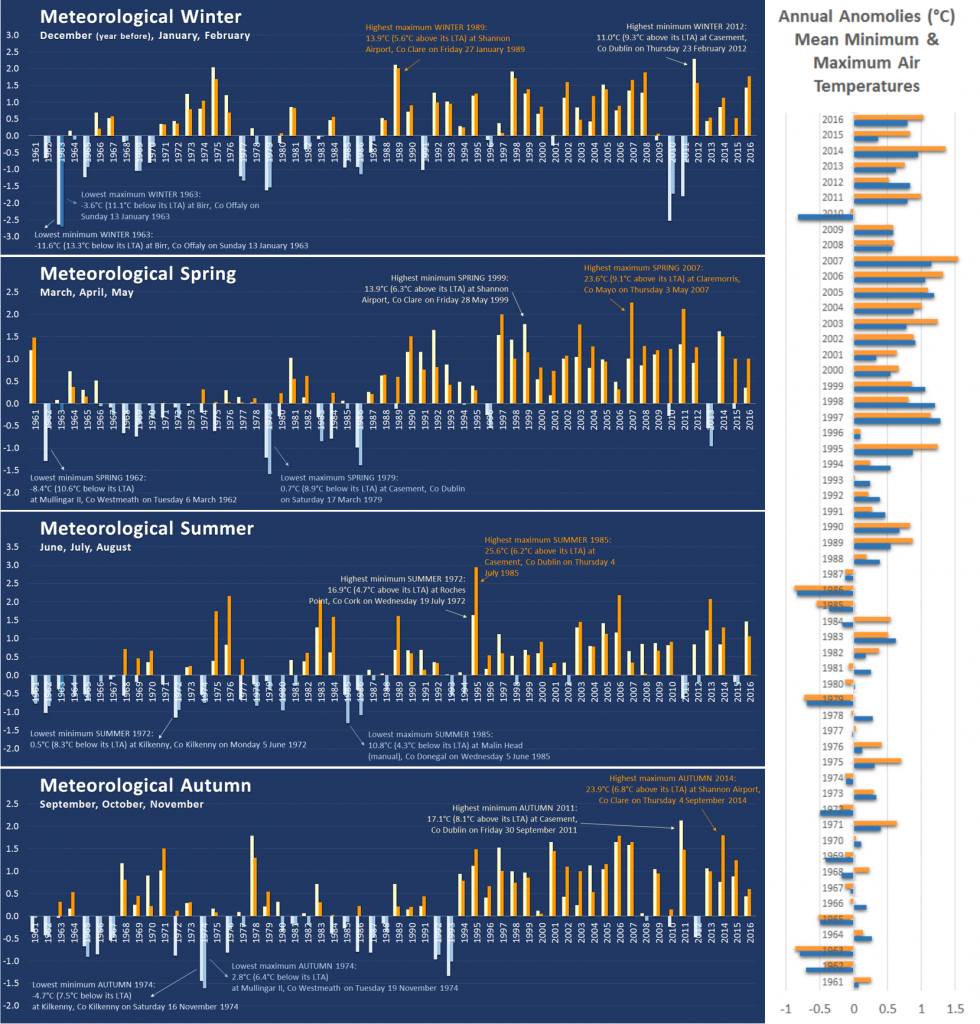
Met Éireann has also provided their own visualisations, showing the annual minimum and maximum air temperatures in springtime, as well as the full-year annual temperature anomalies.

All these graphs show weather extremes increasing in Ireland over the last few decades.

Kavanagh’s post about climate change was posted on the same day that Met Éireann released its climate statement for the month of May, which reported that the record temperature for the month had been broken by over 2°C, during what was the third-warmest spring ever recorded.

It comes as a group of researchers in Maynooth University, supported by climate scientists at Met Éireann, found that the record-breaking temperatures experienced last month would not have been possible without human-caused climate change.

The World Meteorological Organization on 2 June warned that there is a risk of extreme weather in the coming months due to “unusually warm ocean waters”. 

“The world must treat it as the urgent climate warning it is,” said UN Secretary-General António Guterres.

“The only effective response is climate action equal to the crisis – ending the addiction to fossil fuels, accelerating the shift to renewables, protecting the most vulnerable, and delivering early warning systems for all.”

Misleading statistics and graphs are a regular feature of climate change misinformation, sometimes citing real but skewed or cherry-picked data, isolated from the rest of the vast scientific literature.

The Journal’s FactCheck is a signatory to the International Fact-Checking Network’s Code of Principles. You can read it here. For information on how FactCheck works, what the verdicts mean, and how you can take part, check out our Reader’s Guide here. You can read about the team of editors and reporters who work on the factchecks here.

Readers like you are keeping these stories free for everyone...
It is vital that we surface facts from noise. Articles like this one brings you clarity, transparency and balance so you can make well-informed decisions. We set up FactCheck in 2016 to proactively expose false or misleading information, but to continue to deliver on this mission we need your support. Over 5,000 readers like you support us. If you can, please consider setting up a monthly payment or making a once-off donation to keep news free to everyone.

Close
JournalTv
News in 60 seconds