We need your help now

Support from readers like you keeps The Journal open.

You are visiting us because we have something you value. Independent, unbiased news that tells the truth. Advertising revenue goes some way to support our mission, but this year it has not been enough.

If you've seen value in our reporting, please contribute what you can, so we can continue to produce accurate and meaningful journalism. For everyone who needs it.

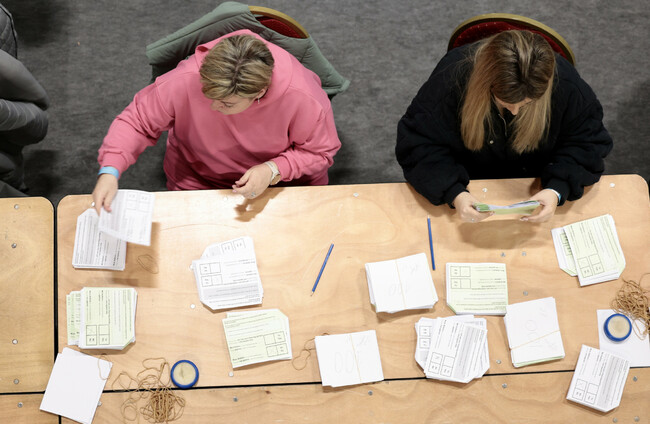
Counting the ballots in the Family and Care referendums of 2025. Leah Farrell

Debunked: Presidential candidates did not campaign to remove ‘women’ from the constitution

The care referendums sought to remove a reference to women’s ‘life within the home’.

FALSE CLAIMS THAT candidates for the Irish presidency voted to remove references to women in the Constitution have spread online, just days ahead of the election.

The posts appear to be referring to a referendum held in Ireland in March 2024, which proposed to delete an Article in the Constitution that refers to the role of women in the home.

If passed, the text would have replaced the word “woman” with non-gender specific language that would have instead recognised care within the home and within the wider community.

The proposal came after a recommendation by the Citizens’ Assembly on Gender Equality in 2020.

However, the proposal was rejected by the electorate, along with another proposed amendment seeking to change a section on marriage (though that mentioned neither women nor mothers).

In the run-up to this year’s election, claims about the referendum have circulated again that seek to target two of the candidates who are running.

“Imagine women voting for a woman that put forward a referendum to remove Women and Mother from the constitution,” a typical example on social media reads.

Comments underneath these posts seem divided on which candidate the claim is referring to: Catherine Connolly or Heather Humphreys.

(A third candidate, Jim Gavin, is also on the ballot, though he backed out from the race early this month. He is not the target of these claims, which are against “a woman”.)   

In either case, the posts are misleading. There are numerous uses of the word “women” in the constitution, so the referendum to change one of these paragraphs would not have removed women from the constitution.

In the run-up to the referendum, some commentators encouraged people to vote against the proposed 40th Amendment to the Irish Constitution, claiming that a Yes vote would remove references to women from Bunreacht na hÉireann.

The proposed change was to remove a section from the Irish constitution which reads:

The State recognises that by her life within the home, woman gives to the State a support without which the common good cannot be achieved. The State shall, therefore, endeavour to ensure that mothers shall not be obliged by economic necessity to engage in labour to the neglect of their duties in the home.”

Many felt that specifically referencing a woman’s “life within the home” and a mother’s “duties in the home”, was sexist.

Following a Citizens’ Assembly on Gender Equality that ended in 2021, the State planned to remove those references, and replace them with more gender-neutral language. The new text would read:

The State recognises that the provision of care, by members of a family to one another by reason of the bonds that exist among them, gives to Society a support without which the common good cannot be achieved, and shall strive to support such provision.”

However, removing the old wording would not have removed all references to women in the constitution.

Article 45, which sets down constitutional principles of social policy, features the word “women” twice.

In the first instance, Article 45.2(i) says that the State must direct its policy towards securing that “citizens (all of whom, men and women equally, have the right to an adequate means of livelihood) may through their occupations find the means of making reasonable provision for their domestic needs”.

And Article 45.4.2 says that the State should “endeavour to ensure that the strength and health of workers, men and women, and the tender age of children shall not be abused and that citizens shall not be forced by economic necessity to enter avocations unsuited to their sex, age or strength”.

As such, a candidate that promoted such an amendment would not have been advocating to “remove women from the constitution”.

However, it is also not the case that both candidates promoted such an amendment.

Heather Humphreys was Fine Gael’s director of Elections for those referendums, in charge of promoting a yes vote.

“Our Constitution must change,” she said. “In 2024, that it still says a woman’s role should be in the home is not appropriate.”

However, some posts featuring this narrative have also called out Catherine Connolly.

“This woman wanted a referendum to remove woman and mother from the constitution,” reads one post featuring a photo of Connolly’s face. This post has been shared more than 184 times since being posted on Facebook on 19 October.

Catherine Connolly, however, was less than enthusiastic about the proposed amendment.

Speaking ahead of the referendum, Connolly said that while she was “not happy” with the current ‘women in the home’ language in the Constitution, she would “take her chances” with it rather than accepting the government’s “wishy washy” replacement.

So it is not only false to say that the proposed 40th Amendment to the Irish Constitution would have removed all references to women from the constitution, it is also false to imply that Connolly was promoting such an amendment.

In the run-up to the election, The Journal has debunked false claims that candidates who wish to run for president need government backing, that Simon Harris blocked ‘the will of the people’ by not letting Fine Gael representatives nominate Conor McGregor for president, and that Irish presidents can unilaterally call referendums,

The Journal has also investigated Catherine Connolly’s visit to Syria in 2018, the Disability Green Paper that is haunting Heather Humphreys’ presidential run, as well as the “military industrial-complex”, often mentioned in presidential debates.

With reporting from Stephen McDermott and Christina Finn.

The Journal’s FactCheck is a signatory to the International Fact-Checking Network’s Code of Principles. You can read it here. For information on how FactCheck works, what the verdicts mean, and how you can take part, check out our Reader’s Guide here. You can read about the team of editors and reporters who work on the factchecks here.

Readers like you are keeping these stories free for everyone...
It is vital that we surface facts from noise. Articles like this one brings you clarity, transparency and balance so you can make well-informed decisions. We set up FactCheck in 2016 to proactively expose false or misleading information, but to continue to deliver on this mission we need your support. Over 5,000 readers like you support us. If you can, please consider setting up a monthly payment or making a once-off donation to keep news free to everyone.

Close
JournalTv
News in 60 seconds