Sign in. It’s quick, free and it’s up to you.
An account is an optional way to support the work we do. Find out more.
Sign in. It’s quick, free and it’s up to you.
An account is an optional way to support the work we do. Find out more.
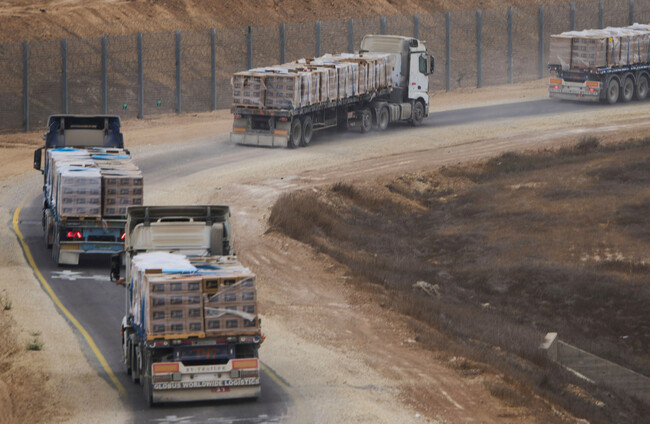
NEW ISRAELI LEGISLATION regulating foreign aid groups has been increasingly used to deny their requests to bring supplies into Gaza, according to a joint letter signed by more than 100 groups.
Ties between foreign-backed aid groups and the Israeli government have long been beset by tensions, with officials often complaining the organisations are biased.
The rocky relations have only gotten more strained in the wake of Hamas’s unprecedented attack on Israel in October 2023.
“Israeli authorities have rejected requests from dozens of NGOs to bring in lifesaving goods, citing that these organisations are ‘not authorised to deliver aid’,” the joint statement reads.
According to the letter, whose signatories include Oxfam and Doctors Without Borders (MSF), at least 60 requests to bring aid into Gaza were rejected in July alone.
In March, Israel’s government approved a new set of rules for foreign non-governmental organisations (NGOs) working with Palestinians.
The law updates the framework for how aid groups must register to maintain their status within Israel, along with provisions that outline how their applications can be denied or registration revoked.
Registration can be rejected if Israeli authorities deem that a group denies the democratic character of Israel or “promotes delegitimisation campaigns” against the country.
“Unfortunately, many aid organisations serve as a cover for hostile and sometimes violent activity,” Israel’s Diaspora Minister Amichai Chikli told AFP.
“Organisations that have no connection to hostile or violent activity and no ties to the boycott movement will be granted permission to operate,” added Chikli, whose ministry directed an effort to produce the new guideline.
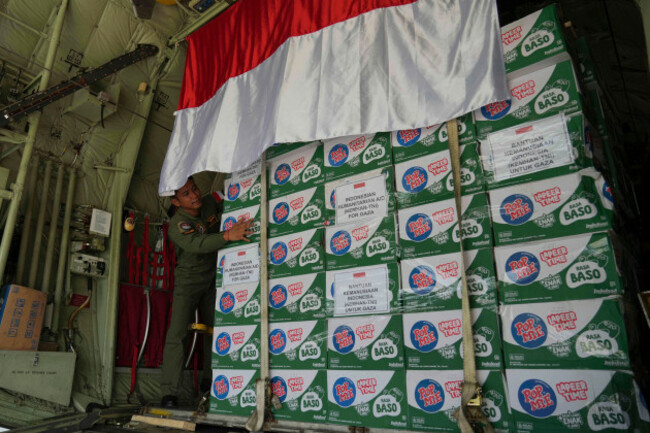
Aid groups say, however, that the new rules are leaving Gazans without help.
“Our mandate is to save lives, but due to the registration restrictions civilians are being left without the food, medicine and protection they urgently need,” said Jolien Veldwijk, director of the charity CARE in the Palestinian territories.
Veldwijk said that CARE has not been able to deliver any aid to Gaza since Israel imposed a full blockade on the Palestinian territory in March, despite partially easing it in May.
“Anera has over $7 million worth of lifesaving supplies ready to enter Gaza – including 744 tons of rice, enough for six million meals, blocked in Ashdod just kilometers away,” said Sean Carroll, President and CEO of Anera.
Israel has long accused Hamas of stealing aid entering the Strip, and since May, the government has relied on the US-backed Gaza Humanitarian Foundation to manage food distribution centres.
According to Gaza’s civil defence agency, its operations have been frequently marred by chaos as thousands of Gazans have scrambled each day to approach its hubs, where some have been shot, including by Israeli soldiers.
It comes as South Sudan denied reports of plans to relocate Palestinians from the Gaza Strip to the East African country.
South Sudan did however confirm that Israel’s deputy foreign minister had visited for talks.
Netanyahu has said that he would permit Gazans to emigrate voluntarily and that his government was talking to a number of potential host countries.
South Sudan, which is said to be one of the host countries, announced that Sharren Haskel had visited in what it called “the highest-level engagement from an Israeli official to South Sudan thus far”.
According to a statement, Foreign Minister Semaya Kumba held “a fruitful bilateral dialogue” with Haskel that touched on “the evolving circumstances within the State of Israel”, without elaborating.
The potential arrival of Gazans in South Sudan has sparked intense controversy both on social media and on the streets of the capital.
Impoverished South Sudan – the world’s youngest country – has been plagued by insecurity and instability since its independence in 2011.

To embed this post, copy the code below on your site












have your say