Sign in. It’s quick, free and it’s up to you.
An account is an optional way to support the work we do. Find out more.
Sign in. It’s quick, free and it’s up to you.
An account is an optional way to support the work we do. Find out more.
LAST UPDATE | 15 Jan
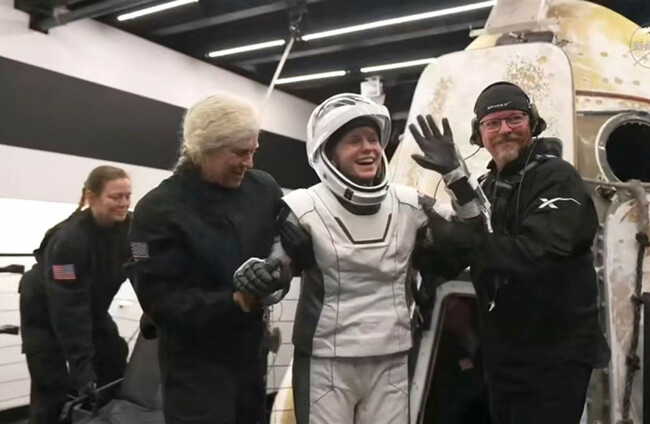
FOUR ASTRONAUTS HAVE splashed back down to Earth after leaving the International Space Station (ISS) in what was Nasa’s first ever medical evacuation.
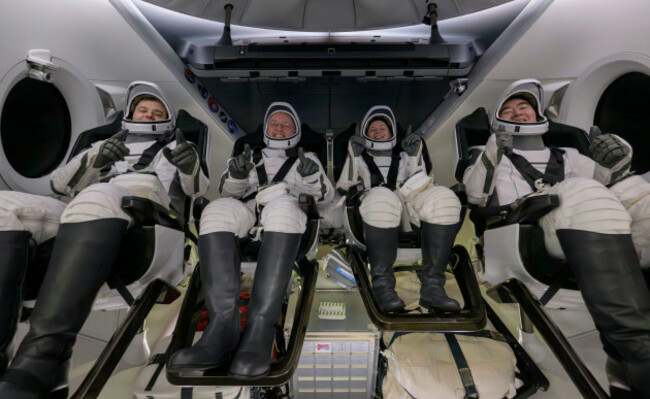
A medical issue prompted the mission of American astronauts Mike Fincke and Zena Cardman, Russian cosmonaut Oleg Platonov and Japanese astronaut Kimiya Yui to be cut short by a month.
A Nasa stream this morning showed their SpaceX Dragon capsule splashing down off the coast of California at 12.41am (8.41am Irish time). They undocked from the ISS at 10.20pm last night, after five months in space.
Welcome home, Crew-11! At 3:41am ET (0841 UTC), the @SpaceX Dragon spacecraft splashed down off the coast of San Diego, California. pic.twitter.com/8LFpdKwizc
— NASA (@NASA) January 15, 2026
“Our timing of this departure is unexpected,” Cardman said before the return trip, “but what was not surprising to me was how well this crew came together as a family to help each other and just take care of each other.”
The US space agency has declined to disclose which crewmember has the health problem or give details about the issue, but it has stressed the return was not an emergency situation.
The affected crewmember “was and continues to be in stable condition,” NASA official Rob Navias said yesterday.
“First and foremost, we are all OK. Everyone on board is stable, safe, and well cared for,” Fincke, the pilot of SpaceX Crew-11, said in a recent social media post.
“This was a deliberate decision to allow the right medical evaluations to happen on the ground, where the full range of diagnostic capability exists. It’s the right call, even if it’s a bit bittersweet.”
The Crew-11 quartet arrived at the ISS in early August and had been scheduled to stay onboard the space station until they were rotated out in mid-February with the arrival of the next crew.
James Polk, Nasa’s chief health and medical officer, said “lingering risk” and a “lingering question as to what that diagnosis is” led to the decision to bring back the crew earlier than originally scheduled.
American astronaut Chris Williams and Russian cosmonauts Sergey Kud-Sverchkov and Sergei Mikaev, who arrived at the station in November aboard a Russian Soyuz spacecraft, are remaining on the ISS.
The Russian Roscosmos space agency operates alongside Nasa on the outpost, and the two agencies take turns transporting a citizen of the other country to and from the orbiter – one of the few areas of bilateral cooperation that still endure between the United States and Russia.
Continuously inhabited since 2000, the International Space Station seeks to showcase multinational cooperation, bringing together Europe, Japan, the US and Russia.
Located some 400 kilometers above Earth, the ISS functions as a testbed for research that supports deeper space exploration – including eventual missions to return humans to the Moon and onward to Mars.
The four astronauts had been trained to handle unexpected medical situations, said Amit Kshatriya, a senior Nasa official, praising how they have dealt with the situation.
The ISS is set to be decommissioned after 2030, with its orbit gradually lowered until it breaks up in the atmosphere over a remote part of the Pacific Ocean called Point Nemo, a spacecraft graveyard.
With reporting from © AFP 2026

To embed this post, copy the code below on your site














have your say