We need your help now

Support from readers like you keeps The Journal open.

You are visiting us because we have something you value. Independent, unbiased news that tells the truth. Advertising revenue goes some way to support our mission, but this year it has not been enough.

If you've seen value in our reporting, please contribute what you can, so we can continue to produce accurate and meaningful journalism. For everyone who needs it.

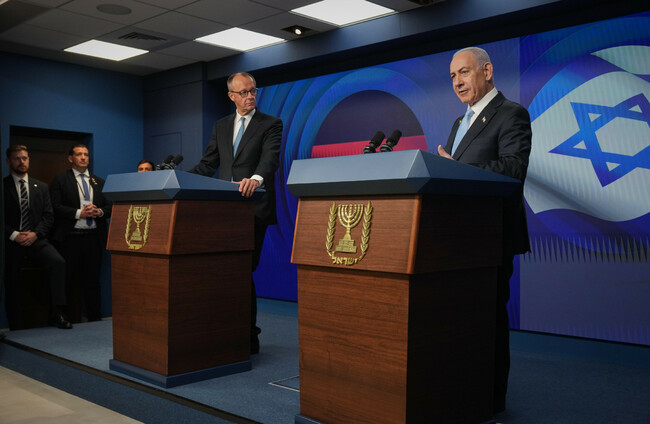
Israeli Prime Minister Benjamin Netanyahu, right, and German Chancellor Friedrich Merz speak to the media during a joint press conference in Jerusalem today. AP Photo/Ariel Schalit, Pool

Netanyahu expects to move to second phase of Gaza truce soon as he prepares to meet Trump

Benjamin Netanyahu also said he would meet Trump later in December to discuss’”opportunities for peace’ in the region.

ISRAELI PRIME MINISTER Benjamin Netanyahu announced today that he expected the second phase of the US-sponsored ceasefire plan for Gaza to begin soon, and said he would meet US President Donald Trump this month.

The truce, technically in effect since October 10, has halted the war. But it remains delicate as Israel and Hamas accuse each other of violations.

Under the terms of the ceasefire that entered into force on October 10, Palestinian militants committed to releasing the remaining 47 living and dead captives seized on their October 7, 2023 attack on Israel.

All of the hostages have so far been released except for the body of an Israeli police officer.

Speaking after meeting German Chancellor Friedrich Merz in Jerusalem, Netanyahu said: “We very shortly expect to move into the second phase, which is more difficult.”

The plan’s initial steps saw Israeli troops withdraw to positions behind a so-called “Yellow Line” in Gaza, though still in control of more than half the territory.

Israel’s army chief, Lieutenant General Eyal Zamir, said the demarcation line is a “new border line”, the military quoted him as saying later Sunday.

The second stage of the Gaza truce plan concerns disarming Hamas, the further withdrawal of Israeli forces as a transitional authority is established, and the deployment of an international stabilisation force.

A final goal of the agreement is the withdrawal of Israeli forces from Gaza in phases if certain conditions are met.

“We have a second phase, no less daunting, and that is to achieve the disarmament of Hamas and the demilitarisation of Gaza,” Netanyahu said.

Flurry of aid diplomacy

Qatar and Egypt, which helped secure the long-elusive truce, called yesterday for the next steps to be taken including the withdrawal of Israeli troops.

Hamas said on the same day it was ready to hand over its weapons in Gaza to a Palestinian authority on the condition that the Israeli army’s occupation ends.

Netanyahu also said he would meet Trump later in December to discuss “opportunities for peace” in the region.

The meeting is expected to take place in Washington after the premier’s office said Trump invited Netanyahu to the White House during a phone call Monday.

Before Israel, Germany’s Merz was in Jordan where he urged more humanitarian aid to flow into Gaza.

EU foreign policy chief Kaja Kallas and US ambassador to the UN Mike Waltz were also in Jordan today to discuss humanitarian aid for the territory.

Waltz is due to travel to Israel after Jordan.

Germany reaffirms support

The German leader, who took power in May this year, has repeatedly criticised Israel’s relentless military campaign in Gaza, which has killed tens of thousands of Palestinians.

Merz urged the implementation of the plan’s next steps while reaffirming Berlin’s support for Israel during a visit to the Yad Vashem Holocaust memorial in Jerusalem.

“Germany must stand up for the existence and security of Israel,” Merz said, after acknowledging his country’s “enduring historical responsibility” for the mass extermination of Jews during the Second World War.

During the press conference with Netanyahu, Merz said criticism of Israel was “possible and sometimes perhaps even necessary”.

“The relationship between Germany and Israel can withstand that. But criticism of the policies of the Israeli government must not be misused as a pretext for antisemitism,” he added.

Merz also underscored German support for a two-state solution.

ICC warrant

Germany had in August moved to restrict German sales of weapons for use in Gaza but has since lifted those export restrictions following the ceasefire.

Despite the truce, more than 360 Palestinians have been killed in Gaza, according to local health authorities, as well as three Israeli soldiers.

Although Merz’s public criticism of Israel was unusual for a German leader, it was measured by international standards.

Nevertheless, Merz said he did not discuss the possibility of Netanyahu’s visit to Germany with the prime minister.

The Israeli leader faces an arrest warrant for alleged war crimes in Gaza from the International Criminal Court (ICC).

“I am not going there because of an ICC decision,” Netanyahu said.

Merz this year vowed to invite the Israeli leader and told him he would not be arrested.

Close
JournalTv
News in 60 seconds