Sign in. It’s quick, free and it’s up to you.
An account is an optional way to support the work we do. Find out more.
Sign in. It’s quick, free and it’s up to you.
An account is an optional way to support the work we do. Find out more.
LAST UPDATE | 23 Jan

IF YOU’RE GETTING your payslip this month and notice a deduction from your wages that wasn’t there before, the answer may be you’re now part of the government’s auto-enrolment pension scheme.
The scheme officially began on 1 January when it began collecting contributions towards what the government hopes is a pension pot for each of the 760,000 workers in Ireland who don’t have their own pension.
Contributing to this pension pot will be you as the employee, your employer on top of that and then the State on top of that again.
The initiative has broad support across politicians, trade unions and employment experts but there is also an acceptance that there may be some teething problems in the early days.
The scheme is called MyFutureFund and the participant portal has been live for the past three weeks where people can go online to see their own fund.
But if you’re confused about it all, here are the basics.
As mentioned above, about one-third of workers have no pension outside of the social welfare pension, so this plan is designed to improve that situation.
The Contributory State Pension is currently €15,000 a year, or about €289.30 a week. While this is designed to cover the basics in old age, it is a big drop in income for many people.
As Laura Bambrick of the Irish Congress of Trade Unions explained on The Journal last week, there are potential consequences to this:
“Unless you have retirement savings to add to your social welfare pension, it will also mean a big drop in your living standards. While this drop is felt by individuals, a reduction in the spending power of over 66s will have wider economic consequences as the population ages.”
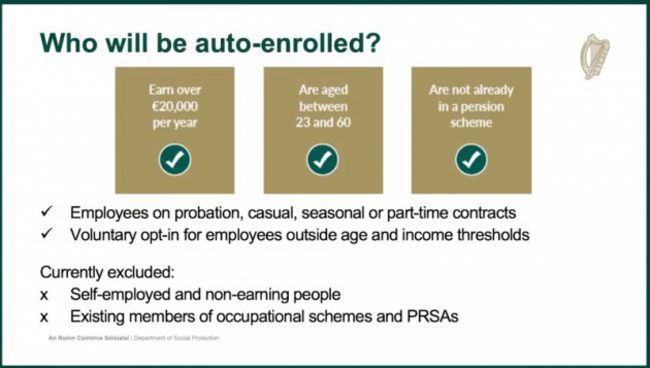
Basically, if you’re aged between 23 and 60, earning over €20,000 a year, and are an employee without pension contributions being paid through payroll, you’ll be ‘auto-enrolled’ into the pension fund.
The figure quoted above is gross salary and it includes employees on all types of employment contracts who meet the criteria, so those who are full or part-time workers, casual, seasonal or on probation will be included.
If ‘I’ means employee, then no you won’t have to do anything, eligible employees will be identified and enrolled by the authority running the scheme.
However, employers are required to actively register their company and face penalties for not meeting their obligations. Employers are required to register but are not required to determine whether employees meet the eligibility criteria.
Yes, if you earn below the amount above or if you’re outside of those age brackets you can still opt-in to MyFutureFund, it’s just that you won’t be automatically added to it.
However, if you have a current pension that you or your employer are paying into through the payroll you won’t be able to opt-in.
Additionally, people that are self-employed and those who aren’t currently working for an employer won’t be enrolled, and won’t be able to opt-in.
Let’s refer again to Bambrick:
PRSI you pay, and your employer pays on your behalf, funds your Contributory State Pension and the other contributory benefits for when you are out of work. MyFutureFund will not replace the social welfare pension or the need for PRSI to fund it.

The scheme will mean a deduction from your salary, with the contribution going to a pot that is still yours.
All contributions will be based on a percentage of gross salary and the amount increases in phases in over ten years.
For the next three years employee and employer contributions will start at 1.5% and this will increase by 1.5% every three years until 6% is reached in year 10.
The State is also contributing at an increasing rate that starts at 0.5% for the first three years and reaches 2% in year 10.
That means that at the current level, for every €3 you as an employee contributes, your employer will add another €3 while the State will top it up by €1.
If you are earning €35,000 a year, €10 a week will now be deducted from your wages and deposited in your MyFutureFund account, your employer will also put in €10, and the State will add €3.35.
By the end of this year, the total contributions towards your retirement savings will amount to €1,225.
What about longer term?
For this, let’s assume an employee is earning €20,000 a year.
Employee and employer contributions will be €300 per year for the first few years, rising incrementally over the ten years to €1,200.
The State contribution will be €100 per year for the first few years, rising to €400 in year 10.
That’s a total of €15,400 paid into the employee’s pot over 10 years before investment returns.
What’s this about investment?
The whole scheme is being managed by a new authority, the National Automatic Enrolment Retirement Savings Authority (NAERSA).
NAERSA will pool the contributions and allocate them to the investment management companies, who will invest the money and manage returns.
This will then be allocated to the employee’s personal pot by the Authority, and paid on their retirement.
People who are auto-enrolled will be able to withdraw their own funds but not for the first six months. The Department of Social Protection says that this is to give people time to adjust to the scheme before they decide if they want to opt-out.
The opt-out window is in months 7 and 8 and employees can get a refund of their contributions at this time.
However, the employer and State contributions will stay in the employee’s pot, so that they’ll still build up some savings.
The department has cautioned that there may be a lag of up to ten days in employees seeing contributions being deducted from their payslips and appearing in their participant portal, as the funds make their way through banks.
So that’s maybe something to be aware of if the contributions aren’t quite appearing online yet.

To embed this post, copy the code below on your site













have your say