We need your help now

Support from readers like you keeps The Journal open.

You are visiting us because we have something you value. Independent, unbiased news that tells the truth. Advertising revenue goes some way to support our mission, but this year it has not been enough.

If you've seen value in our reporting, please contribute what you can, so we can continue to produce accurate and meaningful journalism. For everyone who needs it.

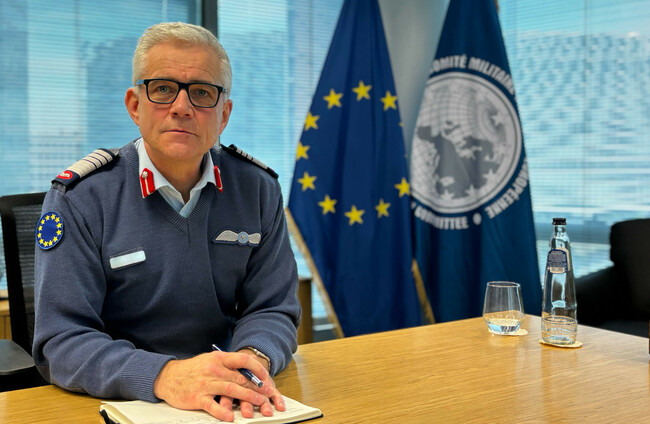
General Seán Clancy, chair of the EUMC, in his office in Brussels. Niall O'Connor/The Journal

Irish general in top EU role: Military build-up is not about war - it's about sustaining peace

The former head of the Irish Defence Forces insists “we have to be at a position whereby we show enough deterrence to ensure that we sustain the conditions for peace”.

THE EUROPEAN UNION’S most senior General has said that war is not a certainty and that the current military build up on the continent is about deterring armed conflict.

Seán Clancy is the chair of the European Union Military Committee (EUMC), which is made up of the heads of armed forces from each of the 27 member states, having previously served as Chief of Staff of the Irish Defence Forces.

Clancy, who took up his new role in June of last year, sat down in his office in Brussels with The Journal this week to talk about his perspective on his role and the work going on across the 27 member states around defence and security.

It comes as the EU steps up plans to deepen defence readiness in the coming years, in a bid to fill the gap left vacant by America’s role as Europe’s traditional security backstop. 

In the interview, he outlined how the build-up of military capability by European countries is not about a growing militarism but rather an effort to bring the continent back up to a level to deter war. 

“We have to be at a position whereby we show enough deterrence to ensure that we sustain the conditions for peace,” he said. 

The multi-billion project to boost Europe’s military capability was initially termed ‘ReArm Europe’ but later rebranded as ‘Readiness 2030′ after disquiet over the original name. 

Clancy said he agreed with the decision, calling it “probably an unfortunate term”

“It’s about our preparedness, our resilience, our capabilities and building them all up by 2030,” he added, noting that the focus was on getting back to a place “whereby Europe and its member states are in a position of strength to deter any possibility of those [countries] that would have nefarious intent towards any member state or the whole of the EU”.

“This is not about war. This is about sustaining peace,” he added. 

Consensus

Clancy’s role is to build consensus among the various countries and get to an accepted joint position which is then fed to civilian leadership of the EU. 

He said that the method of building that consensus never changes, but the geopolitical maelstrom is in constant flux. 

When he started in the role it was the Iranian issue, that has now shifted to Greenland – he said the one constant is the war in Ukraine and the threat posed by Vladimir Putin. 

He added: “What is very palpable, [in the EU in the last eight months] is the actual sense of urgency.”

Defence and security, he said, crosses all of the institutional areas within the union – “all of the economic portfolios, all of the trade portfolios, everything right across the board is now interlinked across defense and security”.

“And defence and security is the number one, and therefore it’s palpable, the urgency that’s there,” he said. 

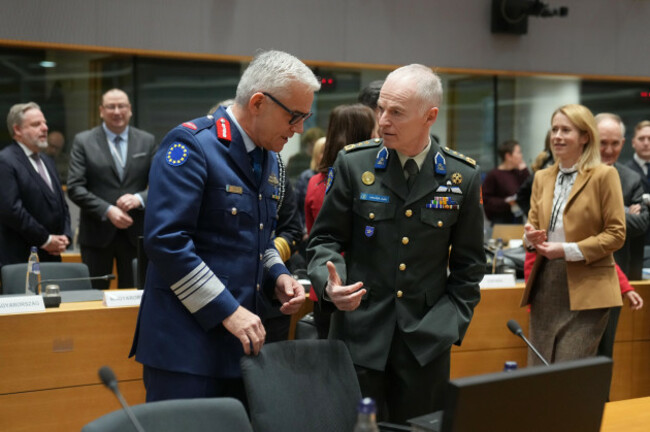
chairman-of-the-european-union-military-committee-general-sean-clancy-left-speaks-with-director-general-of-the-european-union-military-staff-lieutenant-general-michiel-van-der-laan-center-during Chairman of the European Union Military Committee, General Sean Clancy, left, speaks with Director General of the European Union Military Staff, Lieutenant General Michiel van der Laan, with EU Foreign Minister Kaja Kallas on the right. Alamy Stock Photo Alamy Stock Photo

‘This is why we’re talking’

Clancy said repeatedly throughout the interview that the focus was not just about building military capability but also the response from the whole of society.

The White Paper for European Defence fed into the EU’s Readiness 2030 which sets the deadline for increasing capability. The document comes after the bloc announced a raft of proposals it says could mobilise up to €800 billion.

For Clancy and his team there is a much bigger holistic viewpoint that defence is part of a broader effort to make the Union resilient to shocks. 

“This is why we’re talking. It is to try and communicate that this is not a binary choice,” he added. 

Clancy is keen to stress that the multilateralism of the EU is the key to get to a point where they can get a joint agreement on building deterrence.

He said one key issue is “communicating the challenges” to the public and developing a greater understanding.

“There is actually a need to try and bring this level of understanding to the whole of society, we cannot change the paradigm we now live in,” he added. 

Readers like you are keeping these stories free for everyone...
A mix of advertising and supporting contributions helps keep paywalls away from valuable information like this article. Over 5,000 readers like you have already stepped up and support us with a monthly payment or a once-off donation.

Close
JournalTv
News in 60 seconds