We need your help now

Support from readers like you keeps The Journal open.

You are visiting us because we have something you value. Independent, unbiased news that tells the truth. Advertising revenue goes some way to support our mission, but this year it has not been enough.

If you've seen value in our reporting, please contribute what you can, so we can continue to produce accurate and meaningful journalism. For everyone who needs it.

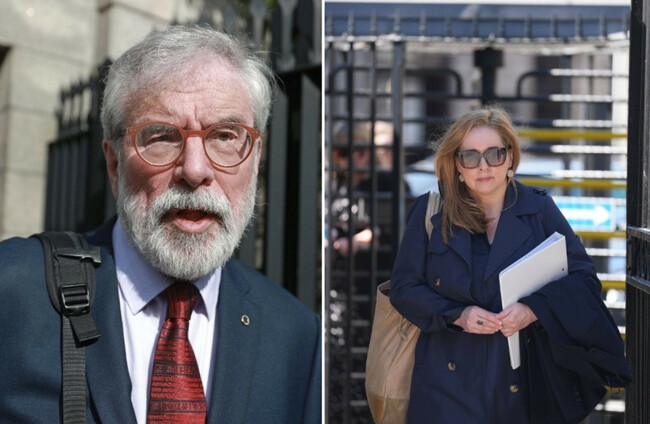
Gerry Adams and journalist Jennifer O’Leary at the High Court. PA

Gerry Adams defamation trial: Here's what he said in court, and how the BBC fought back

Adams gave emotional testimony denying IRA membership as the BBC defended its Spotlight allegations in a high-profile defamation trial.

FOR SEVEN DAYS at the High Court, former Sinn Fein leader Gerry Adams gave detailed testimony in his defamation case against the BBC.

The marathon evidence session began on the afternoon of the first day of the defamation case as the former MP and TD was invited by his own barrister to tell the jury about his upbringing during a time of turmoil on the streets of Belfast.

Describing political and civil developments in the 1970s and 1980s, Adams said: “I do think the IRA was a legitimate response to what was happening at the time.”

Soon attention turned to the Spotlight programme that led Adams to sue the BBC over allegation that he sanctioned the 2006 murder of Denis Donaldson, a Sinn Fein official who had been exposed as a spy.

Adams called the programme “an attempted hatchet job” and “bad, poor journalism”.

He described the BBC response when he attempted to raise a complaint as arrogant and insulting.

He said: “This is a public broadcaster. The public pay for all of this.

“They just dismissed it (the complaint), it was offensive, it was insulting and it is what has all of us here today.”

The tone of questioning changed dramatically at the end of the first week of the trial when Paul Gallagher SC, acting for the BBC, began his cross-examination of the former Sinn Fein president. The courtroom was packed as Ireland’s former attorney general rose to commence the questioning.

Under cross-examination, Adams was pressed on IRA-related violence but refused to speculate on details, saying such questioning trivialised victims’ deaths.

He rejected claims he was on the IRA Army Council and challenged the suggestion that the programme fairly represented his reputation. Reflecting on the IRA’s campaign, Adams said his greatest regret was the loss of civilian lives and the time it took to achieve peace.

The BBC argued Adams was widely believed to have IRA ties, contrasting with his barrister’s portrayal of him as a peacemaker.

‘To some, he’s a hero’

On the final day of testimony, Adams was questioned about attending funerals of prominent IRA members.

He retorted: “You’re trying to persuade this jury I had no reputation whatsoever because I attended funerals? And therefore Spotlight could say whatever they want about me and I would have no redress?”

Reflecting on the IRA’s violent campaign, Adams said, “My big regret is that so many people were killed and particularly civilians. My abiding regret is that it took so long to get a peace process together.”

The court heard closing arguments contrasting Adams’ reputation as a peacemaker with the BBC’s position that it was “universally held” he was involved in the IRA and its Army Council.

Adams’ barrister described the paradox simply: “To some he is a hero, to some he is not.”

‘Solid piece of journalism’

The BBC Spotlight team defended their reporting, insisting they took caution in airing allegations that Adams sanctioned Donaldson’s killing.

Reporter Jennifer O’Leary said the claim was corroborated by multiple reliable sources beyond the anonymous interviewee, and the programme’s tone was “measured” and “precise.”

“There was so much care taken over this programme. It was a solid piece of journalism and the result of many months work and a lot of diligence and a lot of rigour and a lot of scrutiny,” she said.

O’Leary added that she took the “utmost care” with the allegation and denied leaving out pieces of information from the programme that would contradict the claim against Mr Adams.

BBC barrister Paul Gallagher argued Adams could not claim damage to his reputation when it was “universally held” he was involved in the IRA, questioning if the court should ignore those facts.

The broadcaster maintained that the allegation was presented responsibly, including Adams’ denial and the Real IRA’s claim of responsibility.

Close
JournalTv
News in 60 seconds