Sign in. It’s quick, free and it’s up to you.
An account is an optional way to support the work we do. Find out more.
Sign in. It’s quick, free and it’s up to you.
An account is an optional way to support the work we do. Find out more.
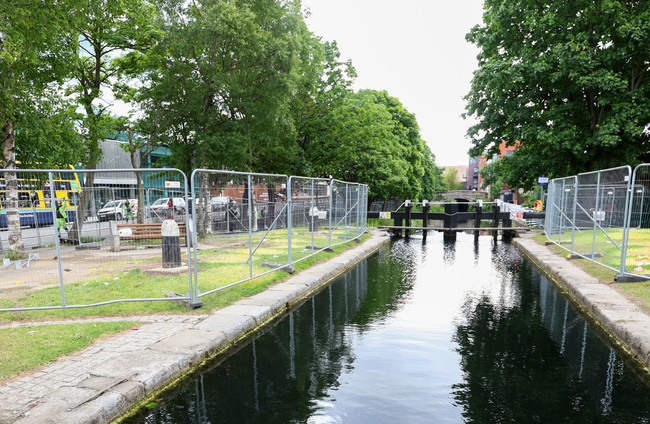
FENCING ALONG THE Grand Canal, erected to prevent refugees from camping in the area, is expected to be removed in the coming weeks, says Taoiseach Simon Harris.
Speaking to Newstalk, he said that while there are legitimate public safety issues that Waterways Ireland have to keep in mind, the idea of erecting barricades in Dublin city is not a long-term or sustainable practice.
The barriers were erected along the Grand Canal last month, as 100 asylum seekers were removed from the site. The barriers have met with criticism from opposition politicians and community groups.
Earlier this year, the government cleared a migrant camp housing 300 people from Dublin’s Mount Street, which forced many to find alternative areas to camp, including along the Grand Canal.
However, Harris stands by the decision to clear the Mount Street camp.
“The removal of tents at Mount Street was done for two simple reasons. One, there are laws in this country that have to be abided by and we cannot have a situation where migration policy is is so ad hoc that we can have random situations in relation to accommodation,” he said.
“The second was a humanitarian reason. On Mount Street we very nearly had a public health emergency, a horrific situation involving access to sanitation.”
He said that the situation at Mount Street was the result of an unacceptable “industrial game of pass the parcel” by government departments and state agencies, and that from now on the government will be taking decisive action.
“We can’t provide everybody who enters the country with turn-key accomodation and there’s no point pretending that we can. But we do have a responsibility to provide shelter, and that means safe accomodation on state lands.”
“The government have identified a site that is being advanced in that respect. We are going, in a matter of weeks, get to a situation where we will have tented facilities on state-owned land with access to sanitation,” he said.
The site in question is understood to be Thornton Hall, which is set to house upwards of 1,000 asylum seekers in emergency temporary accomodation.
However, in the meantime, he said the gap is being bridged by the state providing funding to NGOs to supply asylum seekers with tents, which he said will continue until the state is able to provide that service.
As of May 2024, when the latest figures were released, there were 9,199 people applying for international protection status.

To embed this post, copy the code below on your site













have your say