Sign in. It’s quick, free and it’s up to you.
An account is an optional way to support the work we do. Find out more.
Sign in. It’s quick, free and it’s up to you.
An account is an optional way to support the work we do. Find out more.
LAST UPDATE | 23 Feb 2025

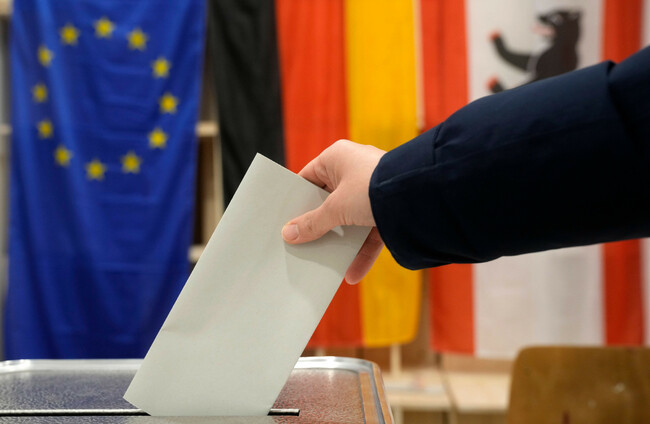
VOTING IS UNDERWAY across Germany in elections that will show where the country is at right now – and just how much one of the largest economies in the world has steered to the right.
Polling stations opened at 8am (7am Irish time) with more than 59 million Germans eligible to vote and first estimates based on exit polls expected after polls close at 6pm (5pm Irish time).
The parliamentary election is happening after the collapse of Chancellor Olaf Scholz’s three-party coalition late last year, with polls predicting that the likely outcome will be that his Social Democrats party (SDP) will only make it back into government as a junior partner, if at all.
Scholz looks likely to be replaced as chancellor by Friedrich Merz, whose conservative Christian Democrats (CDU) are set to win an election for the first time since Angela Merkel stepped down as leader seven years ago.
But recent overtures by Merz towards the far-right Alternative for Germany party (AFD) has shaken German politics, shattering the norms that have been in place for decades which attempted to prohibit cooperation with the far-right.
Today’s vote comes in a country that has reported recessions for the past two years amid inflation and cost-of-living issues, where migration has loomed large over debate.
Germany holds elections for its parliament, the Bundestag, every four years.
The next one was originally scheduled for September this year but Germans are going to the polls early after Scholz’s so-called traffic light coalition – of the SDP, the Greens and liberals – fell apart late last year.
Up to 630 parliamentary seats will be distributed proportionally according to how well each party does, but parties need to also secure at least 5% of the vote to enter the Bundestag.
This is a measure designed partly to exclude fringe elements, but a number of parties are in a race to secure the minimum required so they can have parliament representation for the coming four years.
Each voter gets two votes, one for their local representative and the other for a party.
The overall share of seats that parties gain in the Bundestag is determined by the percentage of second votes they win, so this is the number that will likely be singled out in reports tonight.
The first exit poll is expected at 5pm Ireland time and the first results are expected in the following hour. These will give an indication of who is set to have a good night and who is set to have a tough one, with final results to be determined overnight.
Polls have the AFD – Alternative für Deutschland – at around 20% of total support, twice that of the last election in 2021.
It places the party at about ten percentage points behind the conservative frontrunners Christian Democratic Union (CDU) but still leaves it in a very strong position, and ahead of all the current government parties.
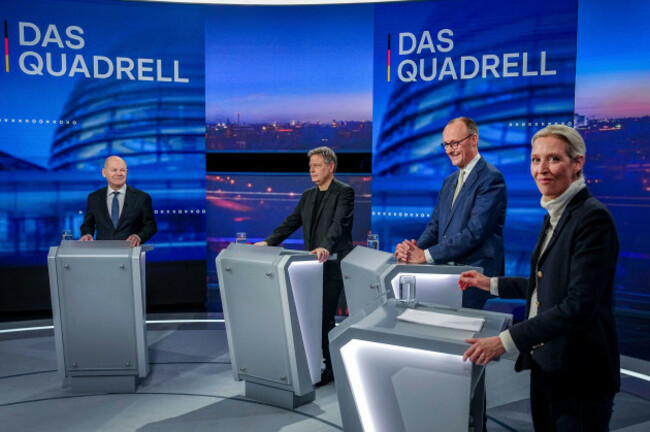
The CDU aren’t in government but its leader Friedrich Merz is tipped by many observers as the chancellor-in-waiting to replace Olaf Scholz of the Social Democrats.
The businessman originally retired from politics for the guts of 20 years after he lost out to Merkel as leader, but returned to the fold in recent years to take the reins.
While it is expected that the CDU will strike a deal to rule with the Social Democrats and another smaller party, it could leave AFD – led by Alice Weidel - to become the largest party in opposition and perhaps to solidify its gains, despite the party having only been founded in 2013.
Weidel is the first lesbian to serve as a lead candidate of her party, with its opposition to migration being at the core of its platform.
The party has increasingly spoken of ‘remigration’ – meaning to deport people from a migrant background to their native country.
Germany is a country where, as of 2022, a quarter of the 80 million-plus population had immigrated from elsewhere, even before an influx of Ukrainian refugees fleeing Russia’s invasion.
Concerns remain strong around significant elements of the party, which were bolstered last year after a German court’s ruling that sections were suspected of extremism.
Serious attacks in recent weeks have also been blamed on asylum seekers, hardening the mood – most recently a car-ramming in Munich that killed two and wounded dozens, and saw an Afghan man arrested.
A key moment in recent weeks has been the collapse of a long-standing agreement among German’s mainstream parties to not work with the far-right, a consensus among the parties since the end of World War II to prevent the rise of extremely right-wing parties again.
This ‘firewall’ was broken when Mertz’s centre-right conservatives agreed to vote with the AFD on a non-binding proposal to restrict migration.
While the move shocked other parties and their supporters, The Journal found some CDU voters who believe he did the right thing.
One man in the small town of Erkner in Brandenburg said that was not in favour of having the AFD “completely isolated” in parliament. “We live in a democracy and that is the bad side of it, but you have to work with people.”
From Metz’s point of view, he believes the gamble will help win the CDU the support it needs to return to government and enact measures that will weaken the AFD ahead of the next election in four years time.
The CDU has regularly recorded support in the high 20s to early 30s, with the AFD next at around 20%.
Of the likely junior coalition partners for the CDU, the SPD are around 16% and the Greens are around 13%.
The most recent polls show that support for the CDU has dropped slightly from the high it had entering the campaign. In one YouGov poll published earlier this week, it suggested that Merz’s party had lost 2% of its support.
No other party is making enough gains to even have a whiff of catching the CDU, although Die Linke – The Left – have made some gains in recent weeks. They were hovering around the 5% threshold but, according to this weeks’ YouGov poll, may be set to almost double that result.
The party has taken a strident position on Merz’s collaboration with the far-right, with its Bundestag leader Heidi Reichinnek delivering a blistering speech accusing the conservative leader of letting himself be “used as a stepping stone” for Alice Weidel’s party.
Since 1998, the SPD have featured in every government bar one four-year stint.
They were a junior coalition partner for much of Merkel’s time as chancellor as part of the arrangement dubbed the Grand Coalition for its combination of the main parties of the left and right of German politics.
But this has seen accusations from the left that the SPD has watered down its own policies and not been able to grasp the issues of the modern era.
There are likely to be negotiations taking place lasting several weeks as the parties seek to form a coalition once the full results are known.
The AFD are not expected to feature in these, with Merz instead tipped by observers to try and receive support from the SPD and Greens, and possibly the economic liberals in the FDU if they pass the 5% threshold.

To embed this post, copy the code below on your site















have your say