We need your help now

Support from readers like you keeps The Journal open.

You are visiting us because we have something you value. Independent, unbiased news that tells the truth. Advertising revenue goes some way to support our mission, but this year it has not been enough.

If you've seen value in our reporting, please contribute what you can, so we can continue to produce accurate and meaningful journalism. For everyone who needs it.

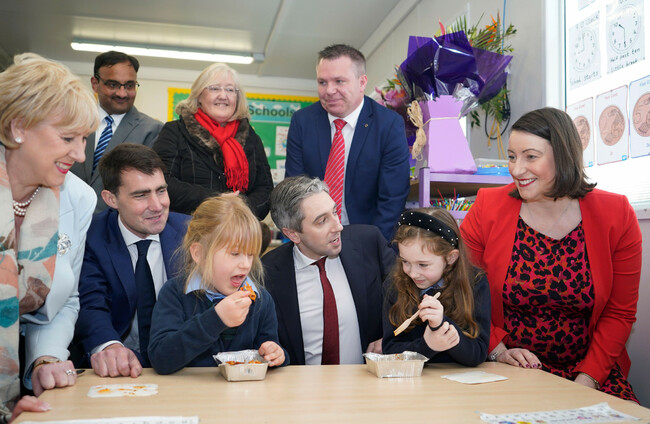
Tánaiste Simon Harris at a hot school meals announcement last year in St Thomas' Junior National School, Esker, Lucan. Alamy Stock Photo

Hundreds of schools have not opted into hot school meals over fears meals are poor quality

An Oireachtas Committee was told by officials that there needs to be an effort to get the message out there that nutritional standards have improved within the scheme.

HUNDREDS OF SCHOOLS across the country have opted not to participate in the Government’s Hot School Meals programme, an Oireachtas committee has heard.

Simon Shevlin, Chairperson of the group steering the programme, told politicians that negative coverage of the previous standards of the food on offer may have played a role in putting schools off from participating.

Initially he said that schools didn’t sign up in most cases “due to a lack of demand amongst parents”.

Sinn Féin Senator Pauline Tully raised questions about how the department could know that there are not children with a need for hot school meals in those schools that didn’t sign up.

“I taught in a secondary school, we were a DEIS school. I remember talking to a first year on a Monday, and asking her why she wasn’t having lunch, and she said she hadn’t eaten since 5 pm the previous day, I went straight to the home school liaison and made sure she was on the list to get a meal.

“That arose from a conversation, so I’m just wondering how we are ensuring that children in those schools who really need this are getting it?” she asked.

“We’ve contacted most of those schools and most of them are applying. I think under 120 have changed their minds.

“I think it’s about giving a positive message as to the nutritional value, because we have heard a lot of negative social media pieces regarding the standard of school meals, we need to get the message out that we have a dietitian involved now in ensuring the nutritional standards are good.

“It’s about tackling negative news about the standards so we get all those schools on board,” Shevlin said.

TD Shónagh Ní Raghallaigh raised the point that some children have dietary needs that mean that they prefer plain foods, and that now due to the change in standards some of those foods may not be on offer.

“So out of my two children, one child would have dietary issues, let’s say, and one would eat anything. So one of them is getting the meals. One of them has opted out… they removed high salt, high sugar and saturated fats and I’m delighted for my daughter who is getting these healthy meals, but there are children who we would just like to ensure that they can eat a meal,” she said.

Ní Raghallaigh added that a lot of children in her child’s class just ordered plain pasta, and that previously her son’s class had pizza and goujons on a Friday, which he enjoyed, but since its been done away with he’s “excluded completely”.

Fiona Ward, a dietitian who is a member of the interdepartmental working group on hot school meals, said: “The whole purpose of the school meal programme is not to leave anybody behind and that everybody gets an even playing field. That will take some time but we need the evidence there as part of that.”

Ward added that the scheme will be reviewed at the end of the year with a specific look at portion sizes and food wastage.

Shevlin said that around 3200 schools and 550,000 children will be eligible for hot school meals in 2025, as the Government has committed €300 m to the project.

He said that its the responsibility of each school to administer the programme locally, and that the main relationship is between the supplier and the school, with the Department of Social Protection providing the funding.

Shevlin said that applications for the 2025/26 academic year “continue to be processed”.

This is the first year that all schools are eligible for the programme, and a dietitian has been brought in to oversee the removal of foods that are high in salt, sugar, and saturated fat from the menus schools are offering.

The committee also heard that 112 schools have been impacted by the withdrawal of two suppliers from the programme that have the same CEO.

Meals on Wheels services have been providing hot school meals to 11 of those schools in rural areas.

Readers like you are keeping these stories free for everyone...
A mix of advertising and supporting contributions helps keep paywalls away from valuable information like this article. Over 5,000 readers like you have already stepped up and support us with a monthly payment or a once-off donation.

Close
46 Comments
This is YOUR comments community. Stay civil, stay constructive, stay on topic. Please familiarise yourself with our comments policy here before taking part.
Leave a Comment
    Submit a report
    Please help us understand how this comment violates our community guidelines.
    Thank you for the feedback
    Your feedback has been sent to our team for review.

    Leave a commentcancel

     
    JournalTv
    News in 60 seconds