We need your help now

Support from readers like you keeps The Journal open.

You are visiting us because we have something you value. Independent, unbiased news that tells the truth. Advertising revenue goes some way to support our mission, but this year it has not been enough.

If you've seen value in our reporting, please contribute what you can, so we can continue to produce accurate and meaningful journalism. For everyone who needs it.

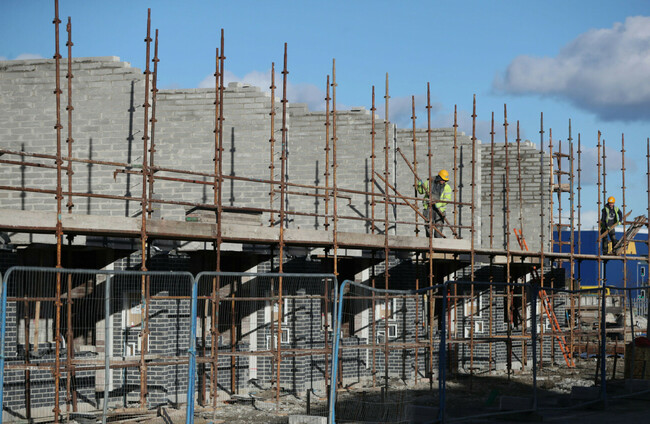
Construction firms recently reported a 79% of firms reported year-on-year increases in raw material costs. File photo. Alamy

Housing summit hears US-Iran war adding up to €20,000 for homes

A housebuilding summit is underway today at Croke Park in Dublin.

COSTS INVOLVED IN the building of new homes have spiked by “€15,000-20,000″ due to the US war with Iran, according to one state-backed housing provider.

A housebuilding summit is underway today at Croke Park in Dublin where the Irish Home Builders Association (IBHA) has gathered dozens of companies and state bodies involved in the delivery of housing to weigh up the major challenges facing the industry.

Construction industry figureheads told the conference that prices are jumping in “every direction” as a result of the Middle East conflict and closure of the Strait of Hormuz, with a knock-on impact on the price of a house.

Eibhlin O’Connor, chief commercial officer at Approved Housing Body (AHB) Cluid, said that the war would make it hard to meet targets “over the next five years” unless it soon ends.

She said the war is adding “€15,000 to €20,000″ to building materials for each home the not-for-profit provides. Its developments are funded through a mix of government support and private finance.

“If this goes on, the war in the Middle East is going to impact on viability along with inflation,” O’Connor said.

IMG_4462 (1) Cluid 's chief commercial cfficer Eibhlin O'Connor warned that costs were rising significantly for each new home and apartment. Eoghan Dalton / The Journal Eoghan Dalton / The Journal / The Journal

IHBA chairperson Michael Prenty told the conference that the war – now in its eight week – risks “undermining the real progress” that he said had been made in improving housing viability.

“The only thing rising faster than demand for housing is the cost of delivering housing,” Prenty said.

Slowdown feared

Several industry figureheads at different ends of the industry voiced fears over the impact the war was having on the cost of doing business and how that will impact housing output overall.

The government’s housing targets aim for 300,000 new homes built by 2030. These would be across the private sector, affordable housing and social housing.

Conor Manning, managing director of piping company Pipelife, told The Journal there is a fear that a slowdown could be seen in the industry unless the war ends soon.

The Cork-headquartered company, which employs 240 people, sources materials from an oil-based derivative to create the piping used in housing, roads and other infrastructure across the country.

IMG_4435 Pipelife's managing director Conor Manning Eoghan Dalton / The Journal Eoghan Dalton / The Journal / The Journal

Manning said his company has witnessed “very significant and rapid increases” in raw material costs across the pipe industry.

“These increases are impacting all manufacturers and placing pressure on margins across the supply chain,” he added.

The “key concern”, Manning added, is what is the “potential knock-on effect on overall demand” for housing if prices for materials keep rising.

If cost inflation continues at this pace, there is a real risk it could impact project viability and slow activity levels across the construction sector, which ultimately feeds through into housing delivery.

Survey on inflation

A recent survey by the Construction Industry Federation (CIF) found that insulation and cement had also spiked over the past two months.

Overall, 79% of firms reported year-on-year increases in raw material costs.

Addressing the summit this afternoon, Housing Minister James Browne said that he was “acutely aware” of the challenges posed by the war, as he added that his department “continues to monitor” the situation.

Conor O’Connell, director of housing and planning at the IHBA, told the summit that there had been a trend of welcoming moves by the government in the right direction over the past “12-18 months” that made building more viable.

“But unfortunately in the last number of weeks building materials have increased significantly,” O’Connell said.

These include, O’Connell said, fuel costs for heavy plant equipment used on sites, for which CIF has been looking for the government to provide state relief.

The Housing Minister appeared cautious about extending this month’s €500 million support package for fuel to builders, telling media today that it would mean the government is “chasing inflation” and that it could lead to even worse increases.

However, despite the doom and gloom, he believes the sector has learned how to cope with the turmoil of the pandemic and the war in Ukraine.

Industry figures were coy about how much that might mean added on to the final sale price of a new house, partly as the war is still evolving.

“We don’t know where for sure where that figure is going to land,” O’Connell said.

“There is definitely concern and prices are rising but we can’t say for certain yet.”

Readers like you are keeping these stories free for everyone...
A mix of advertising and supporting contributions helps keep paywalls away from valuable information like this article. Over 5,000 readers like you have already stepped up and support us with a monthly payment or a once-off donation.

Close
34 Comments
This is YOUR comments community. Stay civil, stay constructive, stay on topic. Please familiarise yourself with our comments policy here before taking part.
Leave a Comment
    Submit a report
    Please help us understand how this comment violates our community guidelines.
    Thank you for the feedback
    Your feedback has been sent to our team for review.

    Leave a commentcancel