Sign in. It’s quick, free and it’s up to you.
An account is an optional way to support the work we do. Find out more.
Sign in. It’s quick, free and it’s up to you.
An account is an optional way to support the work we do. Find out more.
LAST UPDATE | 5 Oct 2025

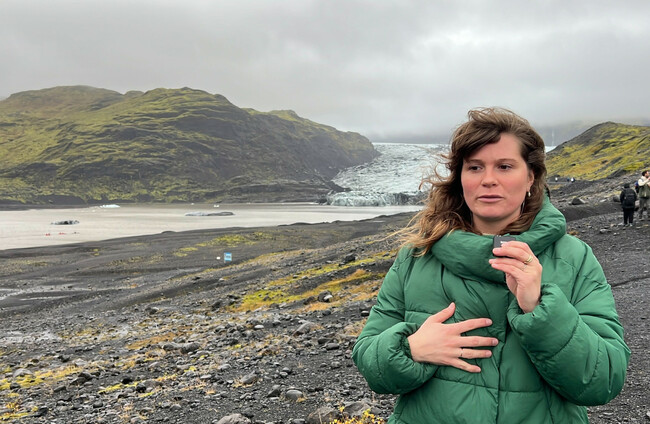
“I’VE HAD SOME of the best times of my life up here exploring the glacier, its landscape, how it changes, but now it’s going away and it feels like I have limited time with it.”
Esther Jónsdóttir is a writer and PhD student from Reykjavík, the capital of Iceland, a country known for its geographical beauties like hot springs, volcanoes and glaciers.
Esther spent time as a glacier tour guide, taking groups to see and learn about the large swatches of ice that cover significant sections of the country’s landmass, and says that some of her most treasured memories from throughout her life have been from spending time on glaciers.
But Iceland’s glaciers are disappearing.
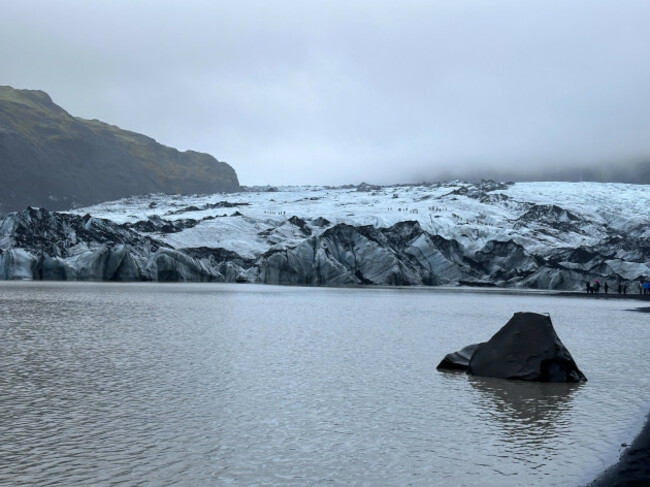
As part of a conference of researchers and journalists in Iceland this week, The Journal visited Sólheimajökull, a prominent glacier in southern Iceland.
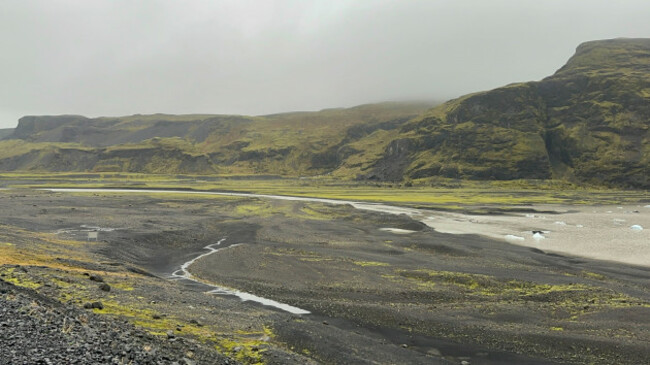
Over the last century, Sólheimajökull has retreated by about 2,000 metres, leaving behind a lake where the glacier once covered the valley.
As the glacier melts, it’s not only retreating to cover less area, but also shrinking in size and becoming thinner and more fragile.
“This glacier, along with the other glaciers in Iceland, is melting. This glacier has become one of those glaciers that we have really seen [melting] with our eyes in the past years,” said Esther.
“I first came here in 2015 and coming now ten years later, it’s a very different place,” she said.
Describing the glacier losses over the years due to climate change, Esther said: “I can really feel it in my heart.
“You want to do something, but there’s a little bit of a sense of dread or hopelessness, even though I think we still have the opportunity to change our ways and make sure that this glacier can stay for as long as possible.”
There are around 400 named glaciers in Iceland, ranging in area size from just a few square kilometres to several thousand.
The total area of glaciers in Iceland has declined from around 12,600 square kilometres in 1880 to 10,300 square kilometres in 2020, a loss of about 18% since pre-industrial times.
The largest ice cap in the country, and the second-largest in all of Europe, is called Vatnajökull. Close by is Hoffellsjökull, an outlet glacier from the Vatnajökull icecap.
Dr Thorvardur Arnason, a professor at the University of Iceland, lives near to these. Around 20 years ago, when he moved to his current home, he started to photograph the changes in the landscape.
“I realised fairly early on that I was becoming an eye witness to the impacts of global climate change on this local environment where I live,” he said.
On Hoffellsjökull, which is around half an hour from his home, he took a photograph from the same spot every month for eight years.
“It was the process of going there again and again and again that was very formative for me. I got to know the glacier really well. I experienced the changes, but it was also an inner process that started,” he said.
“What is worrying is that what we’re seeing in Iceland is happening also in Greenland and in glaciated regions all over the world.”
Climate change is causing glaciers like Sólheimajökull, Vatnajökull and Hoffellsjökull to melt. As the world’s atmosphere heats up due to excessive greenhouse gas emissions, glaciers are melting and losing mass more and more each year.
Glaciers and ice sheets store about 70% of global freshwater. Loss of glaciers threatens water supplies to populations who live downstream, as well as increasing the risks of extreme weather events like flooding.
For the people who live nearby or feel a connection to the land, like Esther and Thorvardur, there’s a also profound sense of loss.
“For me personally, I can’t deny that there is a considerable sadness involved with seeing these glaciers that I’ve now been interacting with for almost two decades,” Thorvardur said.
He said that glaciers melting in Iceland may not have as significant effect on the rest of the world compared to losses in places like Greenland or Antarctica, but that the ones in Iceland are “much more accessible for humans”.
“The glaciers that I’m closest to that I visited most often, it feels like there’s a friendship that has emerged over this period with repeat visits, and especially all the gifts that these landscapes have given to me for my photography but also experiences that are very valuable.”
Christopher Long is a conservationist from Scotland. He lived in Dublin for several years as child before moving to Norway and most recently settled in Iceland about five years ago.
“For me, meeting a glacier, coming up to it, you get a sense of it as an entity. It’s a being, in a way, and it lives within the landscape. That’s really what I feel when I see one,” he said.
“It has the energy of a living thing – it’s moving and it’s changing, and it’s affecting the landscape around it.
“People mourn the loss of glaciers as beings. It connects them to the effects of climate change.”
Professor David Robbins of Dublin City University, one of the researchers on the visit to Sólheimajökull, said he was struck by the sense of grief felt by locals at the loss of the glaciers.
He recounted one of the Icelanders describing to him the experience of coming to the glacier and witnessing its decline as being like paying a visit to an old friend who is suffering from an illness.
It’s not too late to halt or slow the decline of the world’s glaciers.
Large volumes of greenhouse gas emissions are being pumped into the atmosphere by human activities, trapping heat close to the earth’s surface and causing average global temperatures to rise.
Fast and collective action by countries to reduce emissions would steer the world away from worst-case scenarios and help to prevent not only glacier loss but also limit other damaging impacts of climate change like heatwaves, droughts and extreme storms.
In 2014, a glacier called Okjökull in western Iceland was declared ‘dead’ because it had lost so much mass that it had become too thin to be considered a glacier.
In Icelandic, the suffix jökull means glacier, and so Okjökull is now simply known as Ok.
A commemorative event was held in 2019 that that has been compared to a ‘funeral’ for the lost glacier. Former President of Ireland Mary Robinson was among the attendees at the ceremony, where a commemorative plaque was installed titled ‘A letter to the future’.
It carried the inscription:
“Ok is the first Icelandic glacier to lose its status as a glacier. In the next 200 years, all our glaciers are expected to follow the same path. This monument is to acknowledge that we know what is happening and what needs to be done. Only you know if we did it.”

To embed this post, copy the code below on your site












have your say