We need your help now

Support from readers like you keeps The Journal open.

You are visiting us because we have something you value. Independent, unbiased news that tells the truth. Advertising revenue goes some way to support our mission, but this year it has not been enough.

If you've seen value in our reporting, please contribute what you can, so we can continue to produce accurate and meaningful journalism. For everyone who needs it.

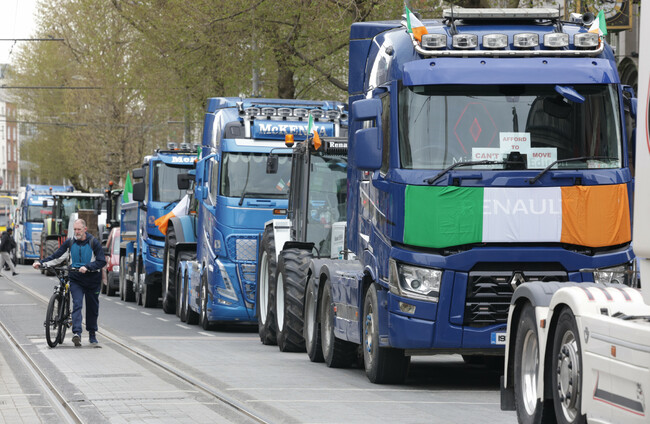
A convoy of trucks on O'Connell Street this week

The internet's bad actors quickly distorted the fuel protests into a narrative divorced from reality

Our FactCheck editor details the internet trends seen by a thirty-something-year-old man.

IT STARTED WITH an image posted to a far-right Facebook page.

I spotted it while I was scrolling early on Saturday afternoon: a map of Ireland with six red dots in a ring outside Dublin, and a caption in block capitals that read “National fuel protest assembly points Tuesday 7am”. 

Soon I saw others share the same map, or AI slop pictures of trucks with the same details about assembly points for Tuesday morning, almost exclusively on pages that usually share far-right and anti-immigrant content.

Plans for a protest had, of course, been building in the days beforehand, but the images were my first glimpse into this online callout for people to go to Dublin.

They appeared in my feed because of the types of pages I monitor for work, but their reach extended far beyond those spaces over the course of the weekend.

It’s never easy to tell how big these things will be from early on, though it quickly became clear from my social media feeds that the protest was underway virtually – even though roads and motorways were clear.

The fact that the same image appeared so many times across multiple pages created the impression that the protests would be on a huge scale way before any real-world blockading had begun.

And yet, by the time tractors and buses rolled in and blockaded Dublin and motorways around the country on Tuesday morning, the reality on the ground was that those involved were less unified in their views.

The version of the protests on social media, and the pages behind them, smoothed over the reality that a loose coalition of agricultural workers, hauliers and rural groups was involved in events this week.

Social media bifurcated the protest into one version that is happening on the streets and another version that is happening online.

Having witnessed the online version of similar protests in Canada and Brussels in recent years, it felt weird to see the same process play out in Ireland from the alternative point of view this week.

On the ground here, there does not appear to be a single organiser or identifiable leadership structure among the protesters or, initially, a centralised set of demands.

The fact that Ireland’s media have been engaging with three separate spokespeople for protesters in Dublin – let alone those who are involved in other parts of the country – is indicative of how fragmented things are.

Extreme groups on Facebook called for people to assemble, and there have been extreme views aired (like people calling for international protection centres to be closed), but it would be an oversimplification to say these were wholly representative of protesters.

A lot of those involved are just aggrieved at the rising cost of doing their jobs, particularly the price of fuel since the war in Iran began six weeks ago, and are not protesting against immigrants or Ukrainians or the apparent ‘wokeness’ of the government.

But online, the momentum from the Easter bank holiday weekend allowed fringe Facebook groups and accounts on X to claim the online messaging from early on.

Well-known far-right and anti-immigrant influencers appeared at the protests from the first day, using their appearances for online content and re-sharing videos taken by others to further their incendiary political messaging.

It helped that Dublin-based spokespersons James Geoghegan, John Dallon and Christopher Duffy appeared on the social media channels of prominent far-right figures over the course of the week. 

The messaging from the far-right movement is that the events of recent days are a broader stand against the government, the European Union and, in some cases, immigration and the war in Ukraine.

It was a narrative quickly picked up outside Ireland: as early as Tuesday, a Canadian conspiracy theorist posted a video of O’Connell Street claiming that Ireland had “erupted into full civil war” and was standing against “EU tyrannical liars”.

British far-right activist Tommy Robinson soon joined in and began posting incessantly about the protest on X in a show of support – including re-sharing a video of army vehicles on the streets with a claim that the government was “at war” with citizens.

The Defence Forces made it clear that this was a routine movement of vehicles and nothing to do with the protests.

Screenshot 2026-04-10 155151 A parody post with an AI-generated image about Tommy Robinson's commentary of the protests X.com X.com

At one point on Friday, he sought to further link himself to the protests by suggesting that his mother – who is Irish – may have lived on O’Connell Street in Dublin where a large blockade is in place.

But Robinson, who was name-checked by Justice Minister Jim O’Callaghan on Thursday, was far from the only one to share misinformation about army vehicles, nor was he the only one to ramp up misinformation about the protests from abroad.

Others shared videos of old anti-immigration protests or footage of sulkies racing down O’Connell Street, AI images of gardaí using water cannons, and in one case, a video of an army vehicle trapped under a railway bridge that wasn’t even captured in Ireland.

By Saturday morning, a fake document circulated claiming gardaí wanted to “identify and record” the registration numbers of protesters’ vehicles.

This online version of events was stoking tensions in a way that felt eerily similar to what happened on the day of the Dublin riots, albeit over a much more drawn-out time frame.  

It’s been a while since the internet’s eyes were focused on events in Ireland as they are now, but the playbook for bad actors on social media is always the same because they’re constantly aware of the possibilities events like this present.

Disruption at the level of the fuel price protests makes for salient content: just look at the images of people walking up the M50 with suitcases or days of traffic queues on motorways around the country. 

Such images can travel easily when they’re attached to a broader narrative, particularly one that is polarising, or makes big claims about political unrest or societal breakdown.

It’s also why the presentation of the protests on social media was so divorced from the reality on the streets and motorways of Ireland. 

Once an event begins to trend, its presentation online no longer belongs to the people responsible for it or who are taking part in it.

Algorithms don’t tend to reward content about protesters who are mostly just standing around beside buses and tractors, and can’t distinguish between factual reports and those that exaggerate or entirely misinform people.

Instead, a diffuse set of grievances among protesters is lost on social media, where they are condensed into something that looked like a unified movement from the outside, or are re-figured into something that looks like a unified political message.

It wasn’t protesters who were open to being “manipulated” by “outside actors” from abroad, as Jim O’Callaghan suggested on Thursday.

Instead, it was the social media platforms themselves – and the whole narrative around the protests.

Readers like you are keeping these stories free for everyone...
A mix of advertising and supporting contributions helps keep paywalls away from valuable information like this article. Over 5,000 readers like you have already stepped up and support us with a monthly payment or a once-off donation.

Close
JournalTv
News in 60 seconds