Sign in. It’s quick, free and it’s up to you.
An account is an optional way to support the work we do. Find out more.
Sign in. It’s quick, free and it’s up to you.
An account is an optional way to support the work we do. Find out more.

JUST A DECADE ago, speaking Irish certainly wasn’t seen to be as cool as it is now. But a new wave of young digital natives are bringing the teanga/language to social media, and boosting Irish speaking among people at home and abroad.
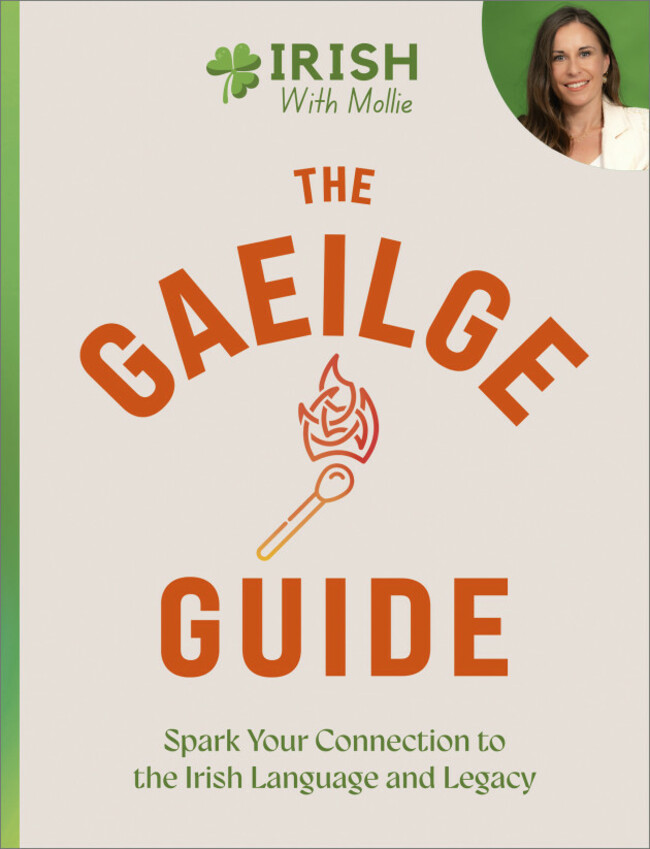
One of the key figures spreading grá/love for Irish is Mollie Guidera, known as Irish With Mollie to her almost 230k followers on Instagram. Now Guidera has written a new book, The Gaeilge Guide, to help spread her love for the language even further. But The Gaeilge Guide is more than a textbook or learner’s guide – it’s a passionate call for people to reconnect with the language in a deep way.
Difficulties/Deacrachtaí
As Guidera outlines in her book, she didn’t have the typical journey to becoming an Irish teacher. For starters, she was once kicked out of Irish college. “I said eight words in English,” she laughs. This led to her being sent home on the train, “bawling my eyes out”. But Guidera returned to the college, eventually becoming a príomhcinneire.
“I think it’s interesting how all of this shame, or punishment, or the highs and lows of learning Irish, it all comes back to teach us something,” says the bubbly and enthusiastic Guidera now.
“I’m not from the Gaeltacht, I don’t speak Irish with my family – they have a good level of Irish, but I wasn’t brought up through the language – and my name isn’t typically Irish… so I felt that detaches me from the ‘real’ Gaeilgóirí… But I think coming through that, practicing what I’m teaching, is … actually it can be refreshing to not be from that community, and love [the language] anyway.”
The Gaeilge Guide explores Guidera’s thoughts about her relationship with the language, colonisation’s impact on Irish, and how we can all recover our relationship with our native tongue.
“It’s more a holistic approach to psychologically supporting the reader into a sphere of unshackling themselves and revealing what the language really is,” she says.
“There’s a common misconception that it is a means of communication and you don’t need it if it’s not 100% utilised by you to transmit information. And I like breaking down that myth and saying it’s a carrier of culture and it’s something to be protected and celebrated, even if it’s not the language that you receive your paycheck in.”
Guidera initially taught English as a foreign language, but while working in the Basque country and witnessing the connection to language there, she saw parallels to Gaeilge. This reawakened her interest in Irish, and soon she was asked to teach Irish classes.
Community/pobail
Guidera is “fascinated” with how we learn, and has moved from individual classes to a business built on webinars, group courses, Telegram groups for students, a podcast, and social media content. She also offers free content on her website, and a weekly free newsletter which she records for YouTube
“It’s an amazing community. People are so supportive, friendly, helpful, warm and funny,” she says. About 40% of her students are Irish – up from 5% when she first started teaching.
Even if you don’t have great memories of initially learning Irish, she says you can carve out a new relationship with it. “I think it takes time for people to maybe let the trauma go and let the bad memories of school go, and realise the syllabus there and the curriculum is still not built for learning types,” she says. Some people even contact her to say that they “hate” Irish but she’s convinced them that actually they can give it a proper go.
Guidera describes Irish as a “very psychological, very onomatopoeic language”.
“It’s powerful to know that we can change the way we look at things, and see it in a completely different way. Growing up in the 90s, there was this ingrained view that Ireland was somehow inferior, and Irish things were uncool, like wearing an Aran sweater. I remember someone buying me a book called Irish Myths and Legends, and I was like, ‘Who would want to read this?’, I didn’t find it interesting at all. And now, I’d be like ‘oh my God, what an amazing gift’.”
She says there is a “deeply colonised mindset” that is very pervasive in Ireland. “It’s very hard to let go of, and I think there’s a fear and a resentment there, so people feel – let’s leave it in the past,” she says. “I think that association with poverty or backwardness just compounds this belief, because people think it’s too difficult to learn or it’s not useful. So it’s like they’re collecting all these reasons why not to learn it, instead of reasons to learn it.”
How does speaking Irish affect how she sees the world?
“I think it invites a lot more intimacy and vulnerability in speech,” she says. “So I notice, even if I’m writing an email, I will add a lot more ‘and what about yourself’… This focusing in on the other person, which is very intertwined with Hiberno English, but in more of a sense, like we’re thinking about how the world around us is on us, at us, within us, around us. So just the use of those prepositions reminds us – ‘I’ll give a visit on you’, or ‘I’ll put a call on you’.”
She adds that learning animal and place names in Irish “opens your eyes to everything around us, and in that way it informs us and helps us protect the landscape and the environment around us.”
Her classes and webinars attract people of “ all different ages, people from all over the world, maybe 50-50 male, female”, she says. In her early days she tended to mostly get older American men learning Irish while also learning about their Irish genealogy. But now she teaches people from Moscow to Morocco, including many who have never been to Ireland but love the culture, music and literature.
“Or a lot of Ukrainians recently say ‘this is important for me, because I want to show gratitude and respect to Ireland’, and they see the parallels with their own language,” she says.
Vulnerability/Leochaileacht
Guidera first started posting content online in July 2022. Initially, she decided to share one post and a reel a day. “When I look back now, I’m like, 12 likes or two follows – how did I keep it up? That’s so demotivating,” she laughs. But she was determined and soon learned more about what resonates with people.
“Even if I wasn’t Irish and wasn’t learning the language, what do I want to see? I’d want to see that Irish has no word for ‘yes’ or ‘no’, but what does mean to our psychology? Or we say ‘God to you’, Dia Dhuit, and yet Irish predates Christianity. So what did people say before Dia Dhuit, and why do we have so much Christianity in the Irish language? So stuff like that – and that really made it kick off. People around the world were saying ‘I wake up every day and I watch your videos’… it was so life-affirming.”
The requests for more videos and information led to the creation of her first beginner course.
Guidera manages to maintain a sense of privacy beyond her Irish With Mollie persona. That said, she does get recognised in “the weirdest of places… like the Alps in Austria”, she laughs.
“Of course, you get random messages and criticism and all this and that, but thankfully, the overwhelming majority is very positive,” she says of social media. She’s learned “that people are really craving something that’s authentic and powerful and positive, and really illuminates something for them”.
Often, she’s told that Irish is more difficult than other languages. What’s her response to that?
“No language is that difficult. It just takes patience, practice and perseverance. So it’s a really fun, enlightening journey, and a very revealing journey, not just about language and culture and heritage and identity, but about our own barriers, and the ways we hold ourselves and each other back, and the way we judge ourselves and each other.”
Who is the book aimed at? “Anyone who is curious about the culture and the psyche, and of course the language of Ireland, the ways that our society is built…
“There’s so much craic to be had, and people love the Irish. Everywhere you go around the world, we have this other element, this other way of seeing things, this playfulness, and it all comes back to language. So anyone who is curious about that… but also people who want to root themselves in the language, who never feel like they’ve connected with it. I think that’s extremely common.”
Looking ahead, Guidera has many ideas for children’s books in Irish and bilingual books for adults, with an aim of spreading her love for gaeilge to people of all ages and backgrounds. But she urges people not to feel silly when making mistakes as they learn.
“Learning Irish is an act of vulnerability,” she says, adding: “You have to look silly in order to succeed in anything.”
The Gaeilge Guide by Mollie Guidera is out now, published by Hachette.
To embed this post, copy the code below on your site





have your say