We need your help now

Support from readers like you keeps The Journal open.

You are visiting us because we have something you value. Independent, unbiased news that tells the truth. Advertising revenue goes some way to support our mission, but this year it has not been enough.

If you've seen value in our reporting, please contribute what you can, so we can continue to produce accurate and meaningful journalism. For everyone who needs it.

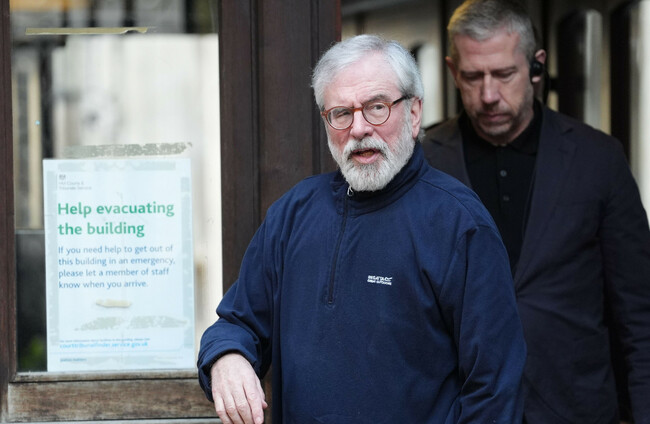
Gerry Adams arriving at the Royal Courts of Justice in London yesterday Alamy Stock Photo

Damages claim against Gerry Adams in UK High Court discontinued

Adams told the court earlier this week that he had ‘no involvement whatsoever’ in the three IRA bombings.

THREE VICTIMS OF Provisional IRA bombings in England will discontinue their damages claim against former Sinn Féin president Gerry Adams, their lawyers have told the UK High Court.

John Clark, a victim of the 1973 Old Bailey bombing in London; Jonathan Ganesh, a 1996 London Docklands bombing victim; and Barry Laycock, a victim of the 1996 Arndale shopping centre bombing in Manchester, had all alleged that Adams was a leading member of the Provisional IRA on those dates, including of its Army Council, and are seeking £1 in damages.

Today, the last day of the two-week trial, Anne Studd KC, for the victims, told the UK High Court that the claim would be discontinued with “no order as to costs” after “proceedings developed overnight”.

She continued that the development was “related” to an argument around “abuse of process”, but was then stopped by the judge, Justice Swift, who said: “Whatever statement your clients may wish to make outside court is entirely a matter for them.”

“I am happy to make an order in the terms the parties have agreed,” he continued.

Studd then said: “The claimants’ view is that these proceedings have been affected by unfairness.”

Adams, who was not in court today, has welcomed the decision.

He said in a statement that he had attended the case “out of respect” for the claimants.  

“This decision brings to an emphatic end a case that should never have been brought,” he said.

“I contested this case and defended myself against the smears and false accusations being levelled against me.

“I asserted the legitimacy of the Republican cause and the right of the people of Ireland to freedom and self-determination. I do so again.”

He noted that he had rejected the claims throughout the court proceedings. 

“I am glad to have been one of those who helped bring an end to the conflict,” Adams said.

“We now have, through the Good Friday Agreement, a peaceful and democratic route to a new Ireland. That needs a renewed focus, especially by the Irish government.

“An Ireland that is respectful of all of its people and that is based on equality, tolerance and respect.

He thanked the people who had “expressed their solidarity with me and the Sinn Féin team”. 

Evidence ‘bordering on non-existent’

In written submissions for the trial, Studd said that the three men claimed that none of the bombings “took place without the knowledge and agreement” of Adams in his role in the Provisional IRA and of its seven-man Army Council.

She continued that the men believed that Adams was “as involved as the people who planted and detonated those bombs”.

In his evidence, Adams said that opponents of Sinn Féin, of which he was president from 1983 to 2018, “have repeatedly sought to conflate” the party with the Provisional IRA, and stressed that they are “separate organisations”.

He continued that he had “no involvement in or advance knowledge of” any of the bombings, and was “never a member of the IRA or its Army Council”, telling the court on Tuesday that he was “glad that the IRA has left the stage”.

He also said that while he believed in the “broad principle that people have the right to resist occupation”, he was “very, very clear that there were dastardly things that were done that should never have been done”.

Edward Craven KC, for Adams, told the court in London that evidence that Adams was involved in the bombings was “extremely limited and we say bordering on non-existent”.

The barrister also said that the claim should be dismissed for being brought too late, suggesting that the three men were using the claim to try to have a “public inquiry-style” hearing into finding historical truths.

He added: “The desire to establish for the historical record that Mr Adams was a member of the IRA is the purpose that has driven this claim,” adding that this could be an abuse of the court system.

In their evidence, the three men said the reasons they did not bring claims earlier were that they did not realise they could do so, could not afford it, were suffering from mental or physical injuries and feared violent reprisals.

With reporting from David Mac Redmond

Close
JournalTv
News in 60 seconds