We need your help now

Support from readers like you keeps The Journal open.

You are visiting us because we have something you value. Independent, unbiased news that tells the truth. Advertising revenue goes some way to support our mission, but this year it has not been enough.

If you've seen value in our reporting, please contribute what you can, so we can continue to produce accurate and meaningful journalism. For everyone who needs it.

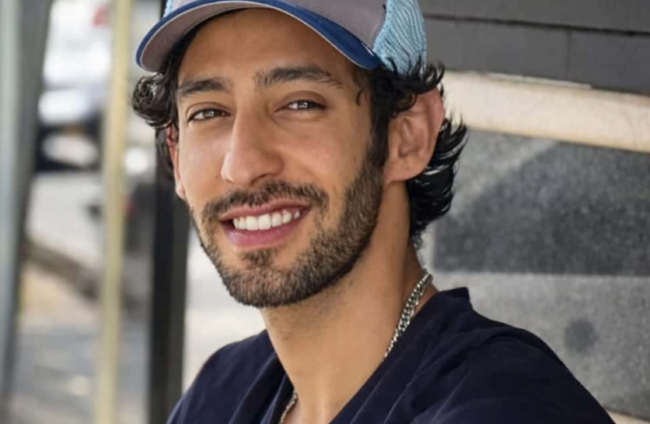
Peyvand Naimi who was detained on 8 January. BIC

Dublin relatives worry for jailed man facing execution in Iran after alleged torture

Peyvand Naimi, a member of a Bahá’í faith, is set to be executed by Iranian officials for what his family assert are false charges.

A DUBLIN-BASED relative of a young man imprisoned in Iran has said his family is living in fear as he faces possible execution after what they describe as weeks of torture, mock executions and forced confessions.

Peyvand Naimi, a member of the Bahá’í faith, has been held in custody since January following his arrest during protests in the country.

Various Bahá’í organisations say that he has been subjected to severe physical and psychological abuse, including two mock hangings.

Now in solitary confinement in Kerman Prison in southeastern Iran, a site known for harsh conditions including overcrowding, poor sanitation, and severe restrictions, his condition is said to be deteriorating.

Speaking to The Journal, his distant cousin Sama Sabet, who lives in Dublin, said the situation has left family members both in Ireland and abroad “mentally distressed” and fearing the worst.

“My mother has sleepless nights,” Sabet said.

“You go to sleep not knowing what’s going to happen to this innocent young man.”

IMG-20260330-WA0001 Peyvand Naimi. Supplied by family Supplied by family

Communication with prisoners in Iran has become increasingly limited amid an ongoing internet blackout in the country, as the conflict with US and Israel continues.

Sabet said families are sometimes allowed only extremely brief phone calls, which can be expensive.

“You’re allowed a 30-second phone call, which is very expensive, about $35 or $40,” she said.

“Basically you can just say that you’re okay, just so your loved ones can have some peace.”

Sabat said those calls are tightly controlled, leaving families with little real insight into the wellbeing of relatives in custody.

According to the Bahá’í International Community, Naimi was arrested on 8 January and later forced to make a televised confession under duress.

Authorities have accused him of involvement in violent unrest, including the deaths of security personnel. His family strongly denies these claims, pointing out he was already in detention at the time of the alleged incidents.

“They don’t show any evidence. There is no lawyer. You can’t defend yourself,” Sabet said.

She added that Naimi had not been able to appear in court since he was arrested in January.

“He’s just declared an ‘enemy of God’, so that he can be executed,” Sabat said.

She described the reported use of mock executions as a form of psychological torture designed to break prisoners.

According to his family, a noose was put around Peyvand Naimi’s neck by security officers at the prison, before it was later removed, as a form of psychological torture.

“The rope is tied. They give you hope, then they take it away,” Sabat said.

“It’s all to break you down to the point where you confess, even if you’re not guilty.”

Despite this, she said Naimi has continued to insist on his innocence.

Capital punishment is still regularly sentenced in Iran. Officials hanged three men in the city of Qom on 19 March, according to the Mizan News Agency, and an estimated 1,500 were executed in 2025, according to Norwegian-based Iran Human Rights (IHR) group.

Crackdown and protests

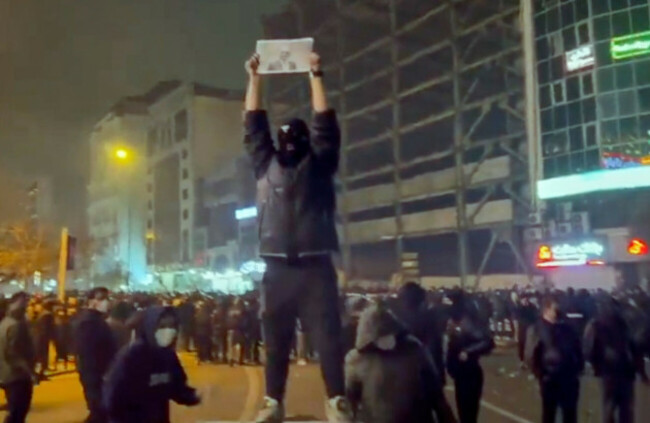
Naimi’s case comes amid a broader crackdown following protests that began earlier this year, initially driven by economic hardship before evolving into wider demonstrations against the Iranian government.

The scale of the violence remains unclear, partly due to the communications blackout, but estimates suggest thousands have been killed.

The Iranian government has acknowledged more than 3,000 dead. US-based organisation HRANA (Human Rights Activists News Agency) says it has verified more than 6,000 dead and has more than 11,000 more recorded deaths under investigation, giving a possible total of about 22,000.

Other estimates from doctors based outside Iran range up to 33,000 or more.

protest iran A masked protester in Iran pictured in January holding a picture of Iran’s exiled Crown Prince Reza Pahlavi. PA PA

Human rights organisations have also reported widespread arrests, with many detainees held without charge or access to legal representation.

Sabet said Naimi’s case reflects a longer pattern of discrimination against Bahá’ís in Iran, who have faced restrictions since the 1979 Islamic Revolution.

“It’s a systematic persecution. They are denied education, denied jobs, denied basic rights,” Sabat said.

The Bahá’í faith is a monotheistic religion that originated in 19th‑century Iran that teaches the unity of all people and religions.

Followers in Iran have faced systematic persecution for decades, including restrictions on education, employment, and property.

In Ireland, the Bahá’í community numbers around 450 people, including more than 280 in Northern Ireland.

Sabat added that Bahá’ís in Iran are often portrayed by authorities as enemies of the state, a narrative she described as baseless.

“They are branded as spies or part of conspiracies, but there is never any proof.”

The community has instead sought to respond in what she described as a “constructive” way, including setting up underground education systems after being barred from universities.

“They’ve never taken on the characteristics of the oppressor,” Sabat said.

“They try to respond with resilience.”

International rights organisation Human Rights Watch has said that Iranian authorities’ decades-long systematic repression of Baha’is simply because they belong to a faith group “amounts to the crime against humanity of persecution”.

International pressure

Sabet said Naimi’s family has given permission for his case to be publicised in the hope that international attention could help save his life.

“At this point, they feel they have nothing to lose,” Sabat said.

She believes pressure from governments and international bodies could be crucial, pointing to previous interventions by Ireland at the United Nations highlighting the treatment of Bahá’ís.

In a statement addressed to Iranian officials at the UN Human Rights Council working group in January last year, a statement from the Irish delegation said that they were “concerned by reports of continued discrimination against ethnic and religious minorities, including members of the Baha’i faith.”

In March last year, at the 58th Session of the UN Human Rights Council, Ireland’s Permanent Representative to the UN, Noel White, condemned the “continued discrimination and oppression of minority groups in Iran”.

“We believe if there is enough international pressure, they might not do it,” She explained.

High-profile figures, including actors Mark Ruffalo and Penn Badgley, have also raised awareness of the case, while the US Commission on International Religious Freedom has warned he could face execution following what it described as a “sham judicial proceedings”.

Readers like you are keeping these stories free for everyone...
A mix of advertising and supporting contributions helps keep paywalls away from valuable information like this article. Over 5,000 readers like you have already stepped up and support us with a monthly payment or a once-off donation.

Close
17 Comments
This is YOUR comments community. Stay civil, stay constructive, stay on topic. Please familiarise yourself with our comments policy here before taking part.
Leave a Comment
    Submit a report
    Please help us understand how this comment violates our community guidelines.
    Thank you for the feedback
    Your feedback has been sent to our team for review.

    Leave a commentcancel

     
    JournalTv
    News in 60 seconds