We need your help now

Support from readers like you keeps The Journal open.

You are visiting us because we have something you value. Independent, unbiased news that tells the truth. Advertising revenue goes some way to support our mission, but this year it has not been enough.

If you've seen value in our reporting, please contribute what you can, so we can continue to produce accurate and meaningful journalism. For everyone who needs it.

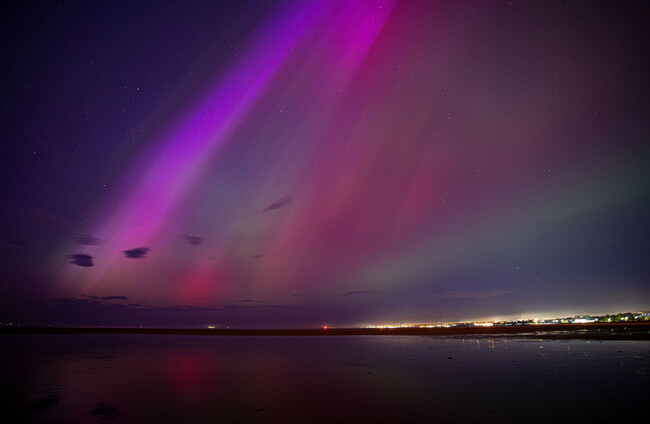
Northern lights shimmering in the sky above Dublin Bay in October 2024. Alamy Stock Photo

Northern lights could be visible across Ireland from tonight after strong solar flares

It’s not clear yet whether this week’s display will be as strong but astronomer Gavin Ramsey suggests taking a look just in case.

THE NORTHERN LIGHTS could be visible from Ireland tonight and tomorrow, although it remains to be seen if the display will match what was witnessed last year.

The NOAA Space Weather Prediction Centre has said that successive solar flares and eruptions from the Sun are setting the scene for a major aurora display over the next couple of nights - potentially reaching a rare ‘G4′ level, the second-highest severity rating.

Visibility could be an issue in Ireland: Met Éireann currently isn’t predicting the cloudless night skies which are necessary to see the display, but clear spells could offer glimpses.

The northern lights have been visible frequently over the past year, but rarely do they reach the level of being visible in mid-latitude regions with ease; this week offers our best chance, if conditions are right.

People across Ireland saw the northern lights light up the skies in both May and October last year after massive solar flares and associated eruptions of plasma from the Sun.

It’s not clear yet whether this week’s display will be as strong but astronomer Gavin Ramsey from the Armagh Observatory and Planetarium suggests taking a look just in case.

Aurora borealis, or the northern lights, occurs as a result of eruptions of plasma from the Sun – often, but not always, associated with solar flares – interacting with Earth’s magnetic field and particles in the upper atmosphere.

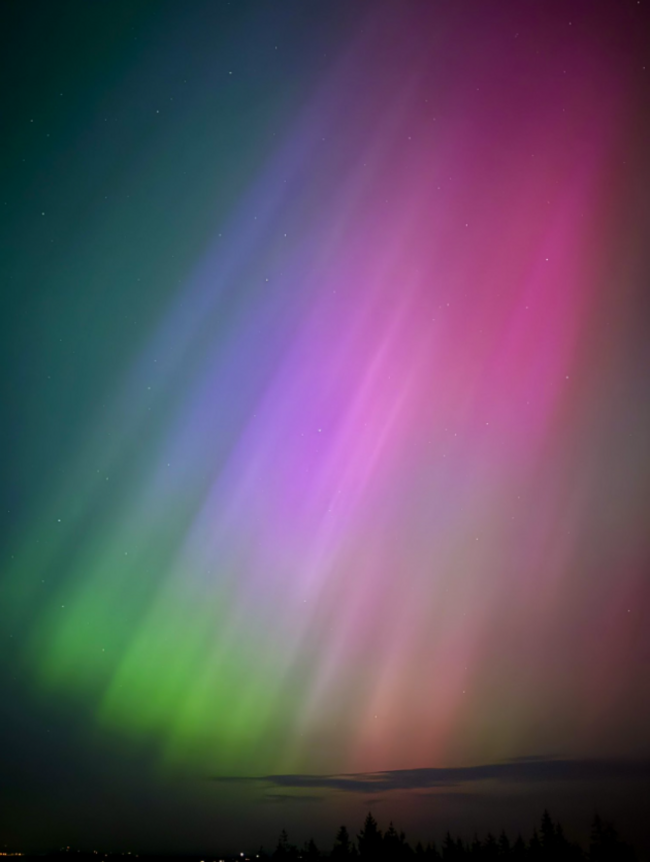
Screenshot 2025-11-11 160310 People across Ireland saw the northern lights last year Nicky Ryan / The Journal Nicky Ryan / The Journal / The Journal

Ramsey told The Journal that the northern lights could be visible for the next three nights in a row.

But he said how much of the display depends on several factors, the main one being whether the weather is clear.

“If it’s not clear if it’s raining you’re guaranteed not to see a thing. If it’s clear its definitely worth having a look,” he said.

To get the best chance to see the aurora he recommends looking northward in an area with as little light as possible, and ideally away from bright city lights. According to the Professor the Northern coast of Ireland will offer the best view of the lights.

“It’s unlikely to be as impressive as last year but you never know,” he said.

Wil Cheung, an astronomer and fellow of the UK’s Royal Astronomical Society, said that three eruptions which cause northern lights are currently heading toward Earth.

Cheung, who shares aurora photos and advice on his Facebook page, predicts that due to their trajectory the aurora could be visible within 12 hours, potentially followed by a second display a few hours later.

The third eruption – caused by a massive solar flare on Tuesday moving – is due to arrive at Earth on Wednesday, potentially causing another spell of strong aurora. This display is the most likely to be widely visible.

However, all space forecasts are subject to a high degree of uncertainty. It is difficult to predict when exactly the plasma eruptions could hit Earth. Sometimes they miss our planet completely, or their internal structure doesn’t lend itself to causing aurora. The aurora themselves also ebb and flow; ‘substorms’ can cause intense spikes in activity, but require careful (and often expert) monitoring to predict.

So for now if you’re hoping to get a look at the aurora, find an area with as little cloud cover and light pollution as possible and a clear view north. You can also monitor aurora chaser pages like Cheung’s to learn more and get information about substorms.

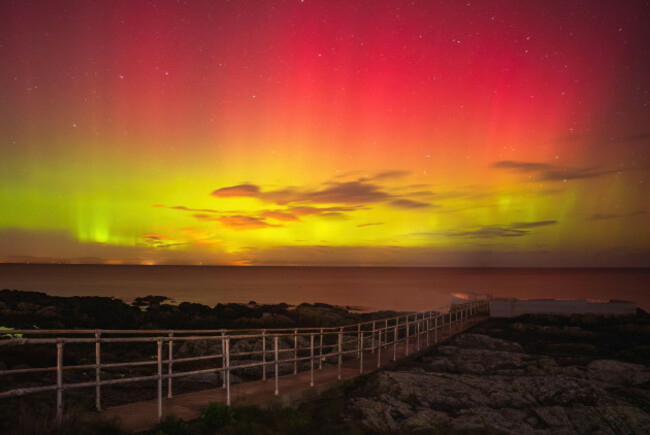
an-intense-display-of-the-aurora-borealis-at-the-captains-skerries-during-the-biggest-geomagnetic-storm-since-2014 An intense display of the aurora borealis at the Captains, Skerries during the biggest geomagnetic storm since 2014. Alamy Stock Photo Alamy Stock Photo

The display is often more visible through a camera lens than to the naked eye.

Advanced image sensors in phones mean you can now take a reasonably clear long exposure photo, which lets in more light than a normal photo and makes dark scenes brighter. You might not even need a tripod.

For us in Ireland, this is crucial. In the likes of northern Scandinavia, aurora can be visible in colour with the naked eye. Here, that level of visibility is not unheard of (especially in very dark and/or northern parts of the island) but it is rare, with aurora more commonly appearing like grey wisps to the naked eye.

Faint aurora can still only be captured using professional equipment, but now people who previously might have thought they missed the lights are at least able to see it on camera.

Readers like you are keeping these stories free for everyone...
A mix of advertising and supporting contributions helps keep paywalls away from valuable information like this article. Over 5,000 readers like you have already stepped up and support us with a monthly payment or a once-off donation.

View 11 comments
Close
11 Comments
This is YOUR comments community. Stay civil, stay constructive, stay on topic. Please familiarise yourself with our comments policy here before taking part.
Leave a Comment
    Submit a report
    Please help us understand how this comment violates our community guidelines.
    Thank you for the feedback
    Your feedback has been sent to our team for review.

    Leave a commentcancel

     
    JournalTv
    News in 60 seconds