We need your help now

Support from readers like you keeps The Journal open.

You are visiting us because we have something you value. Independent, unbiased news that tells the truth. Advertising revenue goes some way to support our mission, but this year it has not been enough.

If you've seen value in our reporting, please contribute what you can, so we can continue to produce accurate and meaningful journalism. For everyone who needs it.

Uncertainty behind the scenes in Ireland as von der Leyen touts 'precise plans' for Ukraine deployment

European Commission President Ursula von der Leyen said last week that plans for an EU peacekeeping force were advancing.

IN A POLITICAL show of force this week European Commission president Ursula von der Leyen indicated that she wanted member state troops deployed in a Ukrainian peacekeeping role. 

Ukraine’s European allies, she said, are working on “pretty precise plans” and a “clear road map” for a potential deployment of troops to Ukraine should a peace deal be struck between Kyiv and Moscow.

Von der Leyen, in comments published in The Financial Times on 31 August, added that any such venture would have to have the full backing of the United States.

Back in February, government sources confirmed to The Journal that Ireland would consider sending troops as part of a multinational peacekeeping mission, most likely dependent on a UN resolution similar to that used in Lebanon.

At the time, sources stressed that this was not just “kite-flying” but that real preparations and contingency planning were quietly under way across Europe.

Von der Leyen has uncharacteristically gone further than ever before with her most recent comments – the otherwise cautious German has caused an uneasy ripple through the defence sector and administrative offices in Europe. 

Taoiseach Micheál Martin and Tánaiste Simon Harris sounded made positive soundings on the subject in recent days and said Ireland would consider participation in such a peacekeeping force.

Behind closed doors in the Irish Department of Defence (DOD) and other associated State agencies, sources have said, civil servants are not so sure about the likelihood of such a mission.

We asked the DOD for a statement but it has not responded.  

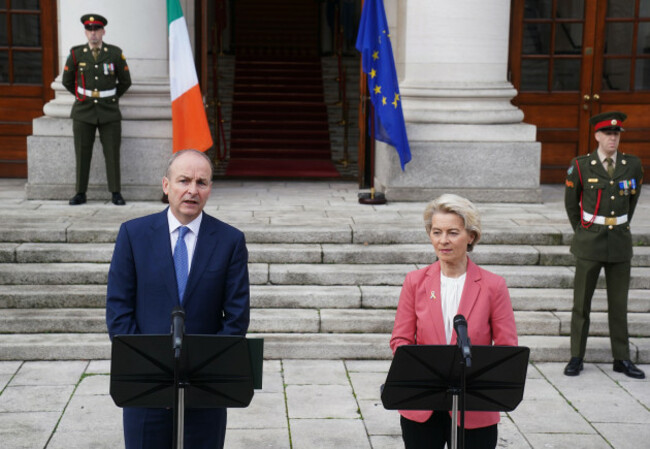
taoiseach-micheal-martin-and-european-commission-president-ursula-von-der-leyen-speak-to-the-media-on-her-arrival-at-government-buildings-in-dublin-picture-date-thursday-december-1-2022 Taoiseach Micheál Martin with Ursula von der Leyen in Dublin with two Irish army soldiers. Alamy Stock Photo Alamy Stock Photo

Coalition

The Taoiseach will join leaders from a number of nations allied with Ukraine in Europe, labelled the ‘Coalition of the Willing’, for a meeting this Thursday to discuss the ongoing Russia-Ukraine war.

It is understood that specifics on security guarantees will be discussed at the meeting. 

Despite this a number of sources we spoke to said that any discussions are in their infancy and that there is a nervousness across Europe and in Ireland about committing to a mission before the real power brokers – namely, the US and Russia – set the peace agreement.

It is understood that both the Tánaiste and Taoiseach have been in meetings where the topic has been discussed with other EU leaders. 

A source said that one of the key issues to consider is if it is to be a European Union mission which would require consensus from members of the bloc. The Coalition of the Willing is a group of 31 countries and is not an EU body. The UK is one of the more prominent members of the grouping. 

Von der Leyen has been on a tour of military installations on the European frontier with Russia for the last week.

There is a theory, among a number of sources both here and abroad, that she may have overstepped the mark and wandered into an area of policy for which she does not have responsibility. 

Critically, multiple well-informed sources said that it was far from agreed that European boots would be on the ground inside Ukraine. 

This was further backed by a definitive slap down to von der Leyen by her fellow German, Defence Minister Boris Pistorius. He said on Monday that it was “fundamentally wrong” to discuss troop deployments before there was agreement in peace talks. 

Regardless, any such deployment would need to be a very big force. Sources have said there are multiple options including air policing and observers backed by Quick Reaction Forces in centres along the huge front in Eastern Ukraine. The most current source information is that Ukrainian troops would act as the troops manning the frontline. 

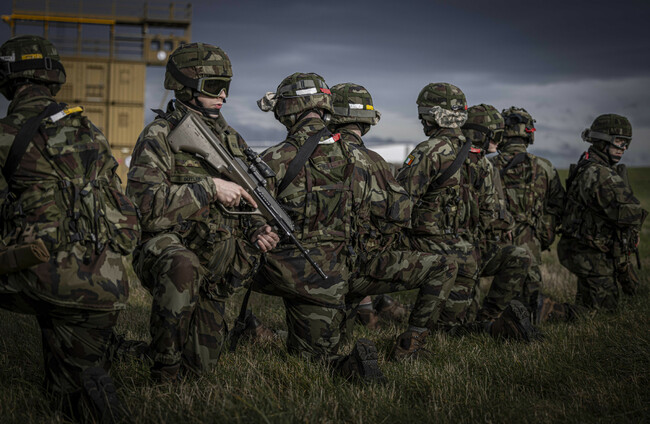
For its part the Irish Defence Forces, if it were cleared to get involved, would have a small footprint in any deployment.

Sources have said that if the Taoiseach and Tánaiste are stating they want Ireland to be involved then that is a well lit signal to suggest that the Irish military could find itself sending a team to Ukraine. 

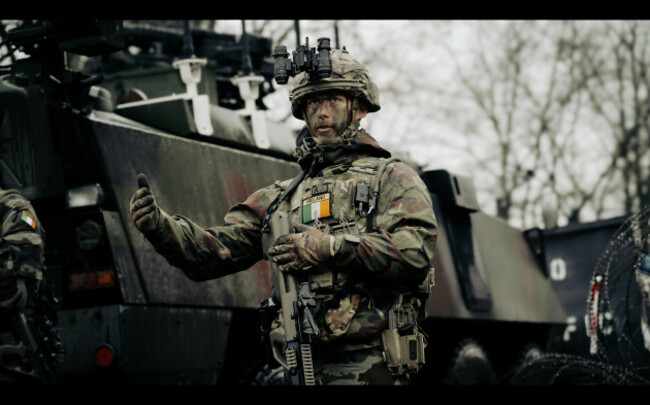
1000036367 An Irish soldier taking part in an EU Battlegroup exercise.

Irish involvement

At the moment Irish soldiers are tied up in the UNIFIL mission in Lebanon and a smaller group are part of the European Union Battlegroup (EUBG) which is an EU military emergency response initiative. The EUBG standby ends in December.

Sources have said that the Defence Forces would not be able to fulfil a largescale deployment of Irish troops until 2028. The other complicator for Ireland is the Triple Lock mechanism that would limit the amount of troops deployable without a United Nations Security Council agreed mandate. 

Behind the scenes the Defence Forces are said to be focusing on the impending wind-down of UNIFIL and filling the next three to four rotations of troops until the ultimate withdrawal from Lebanon in 2027.

As reported previously past missions are the best indicator – the most likely option is a small detachment of specialists. 

Ireland could provide smaller numbers of specialists as in the former NATO mission in Afghanistan or like the current involvement in the administration of the peacekeeping mission in Kosovo. Irish expertise in Explosive Ordnance Disposal is also well respected.

An other source said that the preferred option for Ukraine has been pushing for multiple operational training centres in Western Europe. This concept has been pushed by Britain and NATO and supported by the Zelenskyy administration.

Want to know more about what’s happening in Ukraine and why? Check out our FactCheck Knowledge Bank for essential reads and guides to finding good information online.

Readers like you are keeping these stories free for everyone...
A mix of advertising and supporting contributions helps keep paywalls away from valuable information like this article. Over 5,000 readers like you have already stepped up and support us with a monthly payment or a once-off donation.

Close
JournalTv
News in 60 seconds